
Gartner’s Top Strategic Technology Trends for 2027


Blog
The Last Mile & the Importance of Cyber Resilience In Financial Institutions

Compliance
Endpoint Hardening
Risk Management

Financial institutions have invested heavily in detecting cyber threats, yet many of the conditions that expose their systems remain unresolved. Correctly defined security policies coexist with misconfigured endpoints, excessive privileges, insecure services, and vulnerabilities that cannot be patched without operational risk.
The problem is particularly acute in banking, where correcting an unsafe configuration can disrupt authentication, payment processing, or legacy applications.
Consider, for example, the case of the Royal Bank of Scotland. In September 2018, an incorrectly implemented firewall rule update disrupted online and mobile banking across RBS, NatWest, and Ulster Bank for approximately 4.5 hours. Although the change had passed two levels of peer review, neither identified the potential disruption. Services were restored only after the bank reversed the update.
It's why cyber resilience for financial services increasingly depends on the ability to execute safe, controlled remediation across heterogeneous infrastructure and verify that the corrected security state persists.
Between Security Policy and Device State
The importance of cyber resilience in financial institutions has never been higher. Why? Becauase a bank can have correctly defined security policies, successful deployment records, and thousands of endpoints that remain improperly configured. The existence of a policy does not establish that its intended controls are actually enforced.
The problem is that there's almost always a difference between how things are meant to be on paper and how they actually play out in the field. Keeping those differences to a minimum and making sure they can't harm the business is what we call closing the last mile of security. Increasingly it's that last mile that determines whether a financial services institution's digital defenses stand tall or tawdry.
Consider a payment-processing server whose Group Policy restricts remote administrative access. A conflicting policy, local override, or failed application may leave that access available to unauthorized accounts. The bank's management console shows the correct policy, but the server retains an exploitable pathway into an environment responsible for critical financial transactions.
Similar discrepancies can emerge across core banking systems, employee workstations, customer-facing applications, and infrastructure supporting payment authorization and settlement. Software updates may re-enable unnecessary services, temporary access exceptions can become permanent, and legacy applications may require insecure configurations that persist long after their original justification expires.
These weaknesses deserve the same operational attention as software vulnerabilities. A fully patched server can still expose administrative interfaces or retain excessive privileges. Such conditions can provide attackers with opportunities to move laterally, access sensitive financial data, or interfere with transaction-processing systems.
Banks must not only be able to identify failed policy enforcement and governance gaps, but they must also determine which corrections can be applied without disrupting critical operations.

The appropriate intervention may involve patching, configuration hardening, service restriction, privilege correction, or application control. Each requires visibility into the affected systems, their operational dependencies, and the resulting security state.
You Can't Measure Success Without Properly Defining It
Financial institutions frequently report vulnerability counts, SLA adherence, patch completion rates, and numbers of closed security tickets.
These measurements describe activity, but they can conceal important differences in residual risk.
A bank that closes 95% of its vulnerability tickets may still retain substantial exposure if the remaining 5% affect its most critical systems.
Similarly, a successful patch rollout is of limited value if the vulnerability takes a new form, a configuration is subsequently weakened, or operational disruption forces the change to be reversed.
A better measurement approach examines several connected outcomes:
Together, these measures reveal whether remediation capacity is actually reducing the institution's attack surface.
They also expose the difference between increasing automation and achieving operational resilience. An organization that automates changes but frequently reverses them may be generating activity without delivering durable risk reduction.
These measurements should also be segmented by business criticality. A prolonged configuration weakness on a payment-processing server deserves different attention from the same weakness on an isolated development workstation.
Remediation performance should therefore be evaluated in relation to both the affected population and the business functions that depend on it.
How Remedio Closes the Last Mile of Financial Cyber Resilience
Remedio connects exposure identification, impact assessment, corrective action, and verification in a continuous remediation process.
For financial institutions, that means eliminating preventable exposure across diverse and distributed infrastructure without compromising the availability of critical banking services.
Find: Establish the Actual Security State
Remedio continuously identifies insecure configurations, software vulnerabilities, policy deviations, and other exposure conditions across supported systems.
Remedio Baseline validates actual device configurations against approved security requirements, including controls managed through Active Directory, Group Policy, and Microsoft Intune.
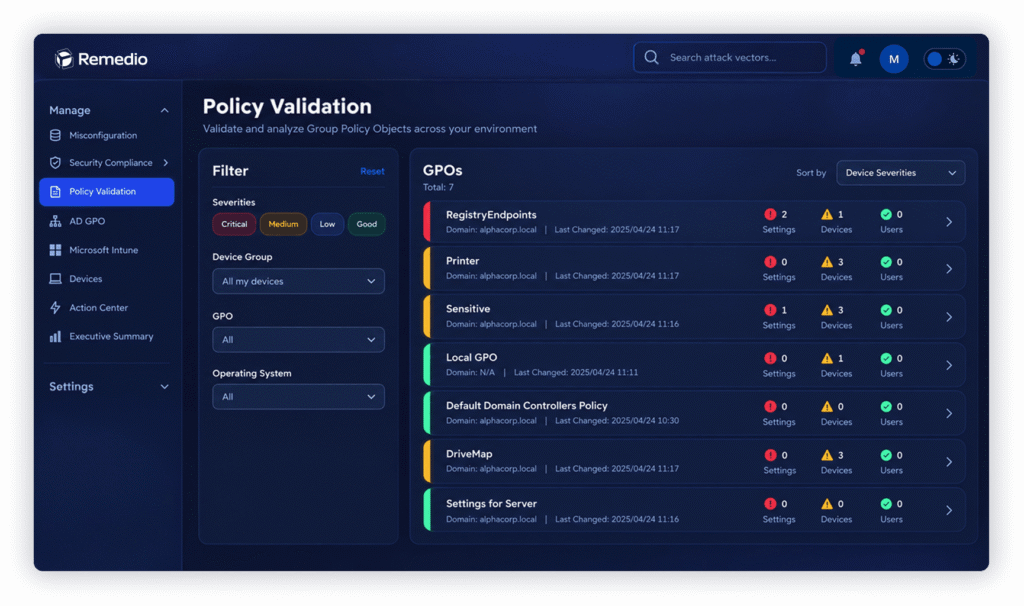
It identifies where effective settings diverge from intended policies because of inheritance conflicts, local overrides, incomplete deployment, or subsequent drift.
For banks, this reveals exposure that conventional policy reporting can miss, such as excessive administrative privileges, weakened authentication settings, or unnecessary remote-access services on systems supporting sensitive financial operations.
Rather than assuming successful policy deployment establishes compliance, security teams can identify precisely which devices remain exposed and what requires correction.
Anticipate: Understand Impact Before Applying Changes
In highly connected digital environments built out over decades, the greatest security challenge is determining whether a correction will interfere with critical operations.
Remedio uses dependency intelligence and pre-execution validation to clearly contextualize and communicate the operational implications of supported remediation actions before changes are applied.
This is particularly important when hardening legacy systems, modifying authentication controls, restricting services, or updating software with application dependencies.
Instead of treating every affected device identically, institutions can establish repeatable criteria for determining which changes are eligible for automation and which require additional validation or approval.
This allows banks to expand remediation coverage while retaining operational control over sensitive infrastructure.
Fix: Execute Corrections Under Controlled Conditions
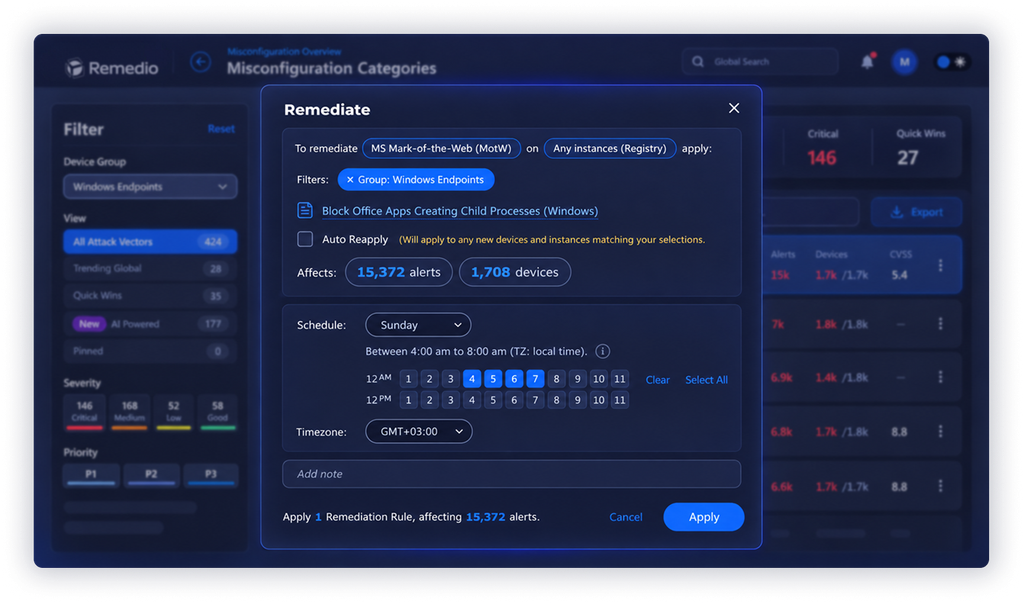
Once a corrective action has been evaluated and authorized, Remedio supports push-button execution across the affected device population.
Remedio Baseline addresses insecure configurations and security-baseline drift. Remedio Fortify connects vulnerability identification and prioritization with automated patch execution, including intelligent scheduling, staged rollout, and rollback capabilities. Remedio Gate provides application control to restrict unauthorized or unnecessary software.
These capabilities allow institutions to apply approved corrections according to the operational requirements of different systems.
The result is a more scalable correction process in which repeatable changes proceed under predefined safeguards while exceptional or high-impact cases remain subject to additional control.
Verify: Prove the Exposure Was Removed
A patch may fail to resolve the targeted condition, a configuration change may not reach every affected device, or an approved setting may subsequently revert.
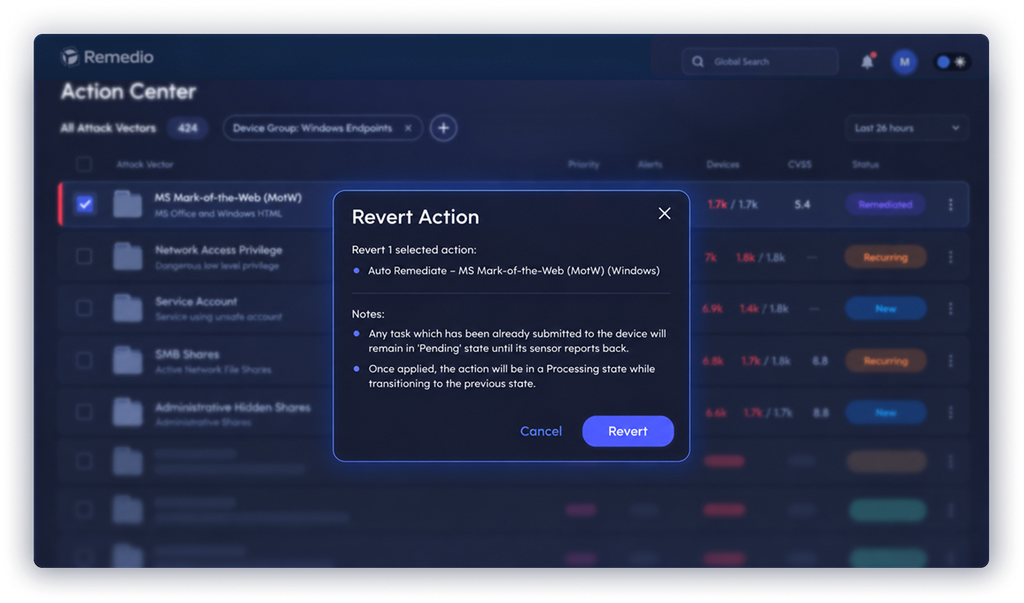
To ensure deployed changes live up to their designs, Remedio provides post-execution verification and continuous reassessment of the resulting security state.
Security teams can distinguish between corrections that were initiated, those that completed, and those that demonstrably eliminated the targeted exposure. Recurring configuration drift can be identified and addressed rather than remaining undetected until the next assessment.
Remedio Assure extends this visibility into compliance governance by mapping technical control evidence to relevant security requirements and supporting ongoing audit readiness.
For financial institutions, this connects remediation outcomes with demonstrable control effectiveness rather than relying exclusively on deployment records or closed tickets.
This also improves the quality of security reporting. Remediation progress can be tied to the actual security state of the affected population, rather than administrative completion of the associated work orders.
A Financial Institution That Closed the Gap
A large U.S. credit union with approximately 4,000 employees faced inconsistent security policies and configurations across its heterogeneous infrastructure. Despite investments in endpoint detection, vulnerability assessment, and penetration testing, it struggled to identify and safely correct configuration deviations while demonstrating control effectiveness to auditors.
Regulatory burdens adds another dimension to the challenge. The EU's Digital Operational Resilience Act (DORA), establishes requirements covering ICT risk management, incident management, resilience testing, third-party risk, and related obligations for in-scope financial entities.
The SWIFT Customer Security Controls Framework similarly establishes mandatory and advisory controls for the operating environments of SWIFT users, including measures related to system hardening, attack-surface reduction, credential protection, and vulnerability management.
Using Remedio, the institution gained visibility into actual configurations across workstations, servers, Active Directory, macOS, Linux, and virtualized environments. It identified discrepancies between Group Policy definitions and effective device settings, applied supported corrections, and maintained continuously updated audit evidence.
- Baseline identifies the endpoints and servers where remote-access settings diverge from the approved standard.
- Assure shows the related control posture and preserves a traceable record of the deviation and its correction.
- Fortify addresses associated patch exposure where vulnerable software is part of the same attack path.
- Gate restricts unapproved tools or software that increase exposure or enable unauthorized execution.
With a clear view of their exposure, their remediation options, and their dependencies, the credit union was able to systematically pursue hardening without hassle and without disruption. Using existing change controls, rollback when needed, and auto-reapplied remediation, the organization quickly worked through their security backlog and halved their MTTR benchmark.
Just as importantly, the credit union introduced more granular and more accurate standards for risk monitoring and management. Instead of blanketly calling the project complete when tickets close, they were able to clearly tag, introduce compensatory controls for, and track any remaining exception populations.
Ultimately, the credit union saved 16 weeks of remediation time in their first year. Effectively, that gave the team 30% more time in the day; allowing them to do more and dive deeper into their work.
From Periodic Assessment to Continuous Compliance Assurance
Financial resilience depends on more than discovering exposures. It depends on knowing the effective state of the systems that support critical services, applying the appropriate correction under controlled conditions, and retaining evidence that the change worked and continues to hold.
Remedio brings configuration security through Baseline, vulnerability remediation through Fortify, compliance assurance through Assure, and application control through Gate into one operational model.
For financial institutions, the outcome is not simply faster remediation, but a more defensible way to reduce configuration, vulnerability, compliance, and application exposure. Critically, this functionality is delivered while respecting legacy dependencies, change-management requirements, and operational continuity.

FAQ
How should banks decide which security remediation actions can be automated?
Automation eligibility should depend on the risk of the specific change, its operational dependencies, and the ability to verify and reverse it. Repeatable corrections with predictable outcomes can run within preapproved boundaries. Changes affecting authentication infrastructure, payment processing, or tightly coupled legacy systems may require additional testing, staged deployment, or human authorization. Business criticality alone should not determine whether automation is permitted.
What should banks test before changing security configurations on payment-processing systems?
Testing should cover the business services that depend on the affected configuration. That includes service-account authentication, network connectivity, encryption compatibility, transaction authorization, settlement processes, and failover behavior. Banks should use representative transaction tests and service-health checks before and after deployment. A configuration can meet its security baseline while still breaking an application dependency.
Does rollback eliminate the operational risk of automated security remediation?
No. Rollback can restore a previous configuration, but it cannot necessarily recover interrupted transactions, reverse authentication failures, or undo downstream effects. Banks need predefined recovery procedures, dependency-aware validation, and criteria for stopping a rollout. Successful recovery should be measured by restored business functionality as well as restored system configuration.
What should a financial institution do when a legacy application cannot support a required security configuration?
When immediate remediation would cause unacceptable disruption, the institution should document the exception and implement compensating controls. These might include network segmentation, restricted administrative access, additional monitoring, or tighter application permissions. Each exception needs an accountable owner, an expiration or review date, and a remediation or replacement plan. An accepted exception remains an exposure and should be reported accordingly.
Why do insecure configurations sometimes return after successful remediation?
The original correction may be overwritten by Group Policy refreshes, Intune assignments, configuration-management scripts, software updates, or inherited settings. Repeatedly correcting the endpoint without addressing the authoritative configuration source can create a recurring remediation cycle. Security teams should identify which system is reintroducing the weakness, correct the conflicting policy or process, and continuously verify the resulting device state.
How should banks prioritize configuration weaknesses across systems with different operational risks?
Prioritization should consider exploitability, potential attack paths, business criticality, and the operational consequences of remediation. An exposed administrative interface on a payment-processing server may warrant greater urgency than hundreds of lower-impact workstation findings. However, urgency does not automatically justify immediate deployment. Where remediation introduces material service risk, temporary exposure-reduction measures may be necessary until a controlled correction can be executed.
What evidence should banks retain to demonstrate that a security remediation was effective?
Useful evidence includes the original configuration deviation, affected systems, applicable security requirement, approved corrective action, execution record, and verified post-remediation state. For critical services, operational validation and documented exceptions are also important. Remedio Assure can help connect technical control evidence to compliance requirements, while formal approvals and other governance records may need to be retained in separate systems.
Does continuous security remediation automatically establish DORA or SWIFT CSCF compliance?
No. Continuous remediation can support the technical controls, risk reduction, and evidence requirements relevant to these frameworks, but neither compliance program is satisfied by remediation technology alone. DORA also addresses ICT governance, incident management, resilience testing, and third-party risk. SWIFT CSCF includes additional organizational and technical requirements. Institutions must demonstrate that applicable controls operate effectively across the full assessed scope.
How should a financial institution begin implementing continuous security remediation?
Start with a bounded group of endpoints and a small set of well-understood, reversible configuration changes. Establish the approved security state, test application dependencies, define rollback conditions, and measure verified remediation success, recurrence, and operational failures. Expand into more sensitive infrastructure only after the initial deployment demonstrates predictable results. The objective is to establish a repeatable, evidence-backed change process before increasing automation coverage.
About Author