Gartner’s How to Achieve the Minimum Viable AI Governance


Blog
AI Governance for the Agentic AI Era

Config hardening
Misconfigs
Operational Excellence
Risk Management
Today, AI is everywhere. It is embedded in coding environments, operating systems, browsers, collaboration platforms, and desktop assistants. But it's not only baked into tools and technologies, it's all interacting with every platform and service through agents. It writes production code, modifies files, accesses credentials, and interacts with enterprise data in real time.
As organizations race to adopt agentic AI, the opportunity is enormous. So is the risk.
Ban AI or Embrace Chaos?
A common reaction to emerging AI risk is simple: ban agentic AI.
Disable desktop assistants. Block coding agents. Prohibit Copilot. Lock down browsers.
This approach sounds prudent. In reality, it's silly. Blocking AI outright is both unrealistic and counter-productive. Nearly half of employees admit to using AI without approval, often exposing data. A majority of workers conceal their AI usage. Even worse, many would continue using AI even after it's expressly banned.
Most importantly though, even if that draconian approach worked, you would be entirely the worse for it. Using AI in all its time-saving agentic glory, your competitors will accelerate ahead while you stall.
AI is part of operating systems, browser environments, developer tooling, and productivity platforms. Attempting to prohibit its use entirely ignores economic reality. It penalizes productivity, slows innovation, and pushes risk underground rather than eliminating it.
The right response is not prohibition. It is control.
AI Is Rewriting the Economics of Cyber Risk
Device and network level attack surfaces are expanding. Threats are accelerating. And difficult-to-exploit attack vectors are now being democratized.
But if you're looking only at the threats poised by external actors, you're missing the bigger picture. The real AI risk multiplier is overwhelmingly And most organizations are ill-prepared and ill-equipped to deal with it.
AI tools are being deployed faster than governance frameworks are evolving. And excess permissions and convenient defaults are normalized.
Traditional reactive models are reaching their limits.
- AI agents operate with filesystem and network access.
- Browser-based GenAI features process live page content.
- Copilot indexes internal data and interacts with Microsoft Graph.
- Coding agents execute commands and modify repositories automatically.
Consider the potential ripple effect of an employee enabling a bypass mode in a coding agent. Or if a default Copilot setting exposes authentication tokens.
If the excessive permissions and weak sandboxing of AI tools weren't enough, the agents themselves and the models they rely on remain something of a black box. Their decision pathways are opaque. their outputs are non-deterministic, their memory lacks clear persistence boundaries, and their "honesty" is questionable.
All of which makes governance a nightmare.
As AI Adoption Accelerates, Risk Multiplies
What makes this shift different from previous technology waves is the truly unleashed nature of agentic AI. With agents in the wild, risk anywhere = risk everywhere is no longer a philosophy. It's a fact.
These systems are not isolated SaaS dashboards. They run on employee endpoints. They access local files, tokens, browser sessions, system memory, and developer environments. And they connect outward.
As organizations scale adoption, the number of configuration permutations explodes. Default settings, convenience features, auto-approval modes, unrestricted plugins, and persistent memory capabilities quietly expand privilege and exposure. Each deployment decision compounds the surface area of risk.
As the saying goes, you can't manage what you don't measure and unfortunately for security teams, most enterprise organizations couldn't even tell you how many AI tools they have installed; let alone what permissions they hold, or how they are configured at device level.
Governance frameworks alone cannot solve this problem. Visibility and remediation must extend to where these agents actually operate. For that, there's Remedio.
As of today, we can detect and fix over 100 misconfigurations across major AI tools and product families on both macOS and Windows. And that number will only grow.
Coverage includes tools such as:
- ChatGPT Desktop
- Claude Desktop
- OpenAI Codex
- OpenClaw
- Comet & Perplexity Browser
- Chrome & Edge GenAI
- Microsoft Copilot
- Windows Recall
- M365 Copilot
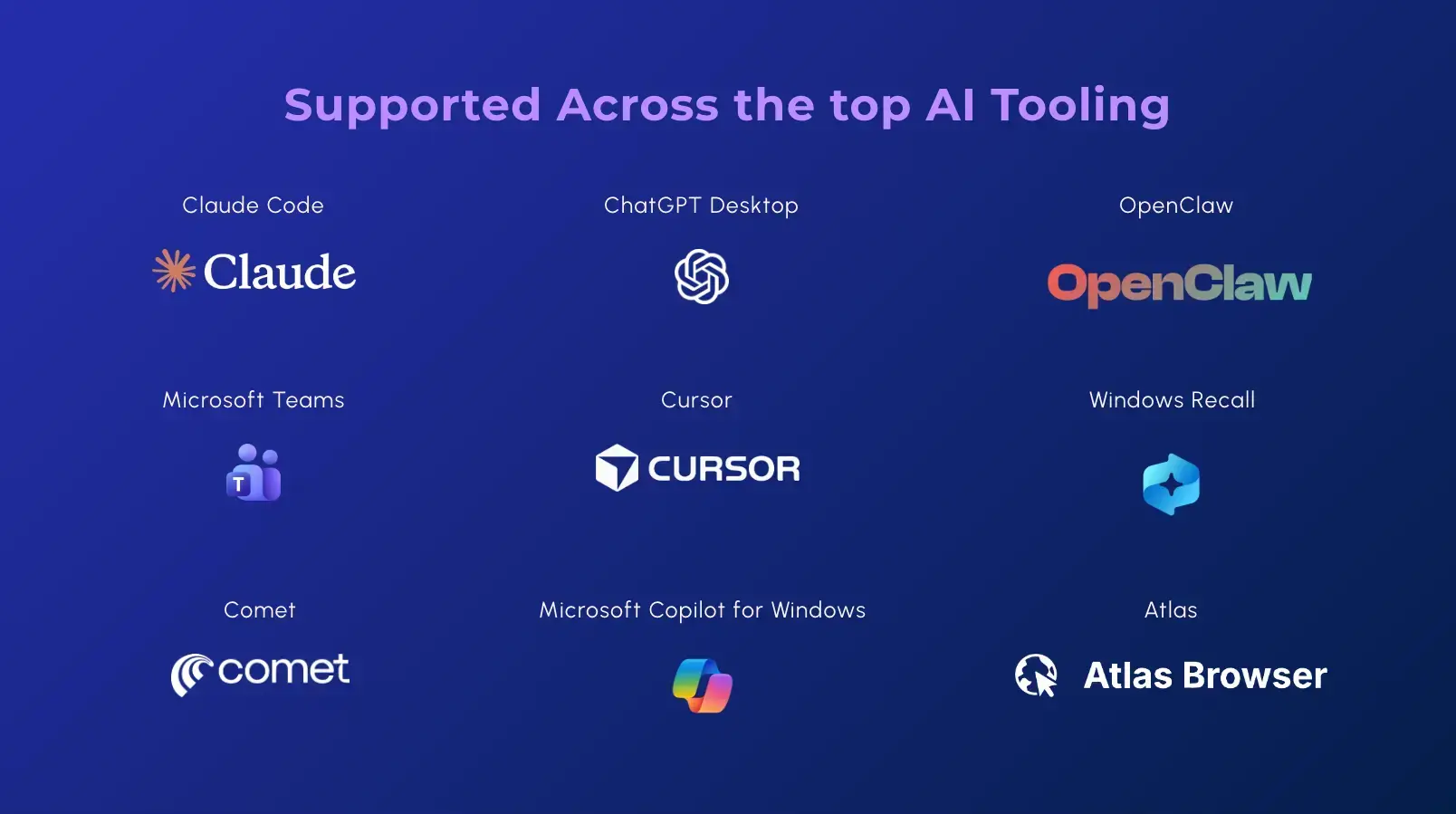
This breadth reflects a simple truth – AI governance cannot be abstract or API-only. It must operate where AI actually executes: on endpoints.
Common Areas of Exposure for Agentic AI
Most of AI exposure emerging today is not from zero-day exploits or exotic adversary breakthroughs. They are default settings, convenience features, and permissive execution modes that quietly expand privilege and persistence on enterprise endpoints.
Remedio continuously monitors for these AI-specific misconfigurations and helps enterprises correct them before they are weaponized.
Some of the most common examples include:
Prompt Injection
Many coding agents and AI platforms include full execution or “dangerous” sandbox modes for developer convenience. When improperly configured, they allow arbitrary code execution with filesystem and network access.
This is not a vulnerability in the operating system. It is a behavioral and configuration issue within the agent itself. Traditional EDR and network tools are not designed to detect when an AI model’s instruction hierarchy has been subverted.
Remote Code Execution
Misconfigured sandbox or exec modes allow agents to run arbitrary code with full system access.
These are often default or easily enabled settings. Traditional security tools see legitimate processes executing commands, not the unsafe execution context that enabled them.
Silent Data Exfiltration
AI agents frequently operate with outbound network access. Combined with permissive sandbox configurations, this allows proprietary data or source code to be transmitted externally without triggering conventional data loss alerts.
From a network perspective, the traffic may appear legitimate. The risk lies in the agent’s configuration and scope of access, not in anomalous packet behavior.
SpAIware – Persistent AI Memory Backdoors
Many AI desktop tools include memory features designed to retain context across sessions. If an attacker injects malicious instructions into that memory, those instructions can persist and influence future outputs.
This persistence is often a product feature, not a bug. Traditional endpoint tools are not built to inspect or validate AI memory states, making these backdoors effectively invisible without dedicated configuration oversight.
Traditional endpoint or SaaS security tools often miss these AI-specific configuration weaknesses. They were not built to inspect AI memory features, MCP server configurations, plugin privileges, or agent bypass modes.
Remedio was.
But it's not just about keeping an eye on favored attack paths. It's also about the quirks and peculiarities of each model and agent that can be weaponized to give bad actors the foothold from which to launch attacks.
Consider the following cases.
Microsoft Copilot and Windows Recall
Enterprise Copilots are often deployed with default settings that:
- Expose authentication tokens to other users on the same device
- Enable transcription and recording by default
- Save and export system snapshots without DLP controls
- Allow external LLM providers and AI image generation without governance
Without device-level oversight, these risks remain invisible.
ChatGPT Desktop and Claude Desktop
AI desktop assistants may:
- Store conversation history and OAuth tokens locally with weak permissions
- Enable unrestricted agent modes
- Allow user-added MCP servers running with full OS privileges
- Persist memory across sessions, enabling SpAIware-style attacks
Governance must include inspection of local data directories, file permissions, sandbox settings, and account types.
AI Coding Agents
Platforms such as OpenClaw and Claude Code can:
- Execute arbitrary code via full exec modes
- Install unvetted MCP servers
- Disable sandbox isolation
- Auto-approve file modifications
- Transmit code snippets via telemetry
A misconfigured coding agent can exfiltrate source code or inject persistent backdoors directly into development pipelines.ject persistent backdoors directly into development pipelines.

Blocking these tools is not viable. Governing them is essential. Remedio provides continuous and proactive posture management – noting areas of exposure and teeing them up push-button hardening.
Standalone Tooling Adds Clutter and Complexity
There is a rapidly growing category of “AI governance” platforms. These tools deliver policy documentation, LLM usage monitoring, API-level observability, and risk modeling frameworks.
These capabilities are useful. But they often operate above the layer where AI risk actually materializes: on the device.
What's more, security teams are already managing crowded stacks. Each new category introduces another console, another alert stream, another integration layer, and another ownership boundary.
A dedicated AI governance product that primarily monitors user and model behavior, but lacks native enforcement at device level, risks expanding the stack without materially reducing exposure.
In many cases, these platforms do not have their own configuration controls. To remediate issues, they must integrate with EDRs, MDMs, Identity providers, endpoint configuration tools, or CASB or SSE products.
This creates a multi-step chain from detection to action. And that chain is fragile. Detection in one system. Ticketing in another. Enforcement in a third. Validation somewhere else. Every transition increases latency and the probability of dropoff.
Distributed security architecture, limited interoperability, and growing complexity is already one of cybersecurity’s most significant challenges – and it increasingly leads to mismanaged and underutilized tooling.
Ultimately what matters is not theoretical governance, but execution. And that's where dedicated AI governance tools are most likely to fall short.
AI governance is a configuration security problem at its core. Remedio’s expertise in configuration security means it understands:
- How operating system policies interact with application behavior
- How identity permissions cascade into local device exposure
- How developer tools impact production risk
- How to map misconfigurations to compliance and executive risk metrics
Not every misconfiguration carries equal business impact. An unrestricted MCP server on a developer laptop handling proprietary code is different from a consumer AI feature enabled on a low-privilege device. Persistent AI memory features in a coding agent introduce different risk dynamics than a read-only Copilot setting.
The defining security challenge of the AI era is not detection. It is correction velocity.Effective AI governance requires context-aware prioritization to balance security, operational efficiency, and business continuity.
Remedio evaluates AI misconfigurations within the broader device and organizational context, assigning priority based on:
- Privilege level
- Data sensitivity
- Exposure surface
- Lateral movement potential
- Business criticality
- Fixability
This prevents overreaction and under-reaction alike and allows for:
- Targeted remediation
- Controlled policy enforcement
- Gradual rollout strategies
- Validation before broad deployment
And because governance is integrated into an existing posture management framework, changes are executed in a way that is operationally aware and minimally disruptive.
AI misconfigurations are treated as configuration control failures and governed within the same operational framework already used to manage OS baselines and enterprise application settings.
Moving Forward with Focus and Control
AI is reshaping productivity. It is also reshaping risk. The real question is not whether to adopt agentic AI. It is how to adopt it safely.
As enterprises deploy agentic AI at speed, Remedio ensures they do not inadvertently create massive new attack surfaces.
In the era of agentic AI, governance cannot be another silo.
Remedio avoids unnecessary stack expansion by embedding AI governance directly into established security posture management to provide:
- Automatic AI agent discovery across endpoints
- Protection against novel threats like SpAIware before they persist
- Cross-platform support for macOS and Windows
- Console-level visibility into misconfiguration categories across Microsoft Copilot, ChatGPT, coding agents, AI browsers, and embedded GenAI features
- Context-aware prioritization
- Native, push-button remediation
AI governance is not a new category to bolt on. It is a new dimension of configuration security. Remedio ensures enterprises can accelerate into the agentic era with focus, discipline, and enforceable control.



FAQ
What makes AI agents different from traditional SaaS applications?
Traditional SaaS applications primarily store and process data within the service itself. AI agents actively interact with enterprise environments. They can access local files, execute commands, use credentials, connect to APIs, modify code, and make decisions with limited human intervention. That combination of autonomy, endpoint access, and dynamic behavior means governance must extend beyond user accounts and API activity to include device-level configuration, permissions, and runtime controls.
Why does AI governance require continuous monitoring?
AI environments change constantly. New copilots, browser features, coding assistants, plugins, MCP servers, and model capabilities appear far faster than traditional governance processes can adapt. At the same time, permissions, configurations, and user behavior continuously evolve. A one-time assessment quickly becomes outdated. Continuous monitoring allows organizations to detect newly introduced AI tools, identify configuration drift, validate policy compliance, and ensure controls remain effective as the environment changes.
What is Shadow AI?
Shadow AI refers to AI tools, agents, or services that employees use without organizational visibility or approval. This can include public chatbots, coding assistants, browser-based AI features, desktop applications, locally hosted models, or unauthorized AI integrations. Shadow AI increases risk because security teams often have no visibility into what data these tools can access, what permissions they have been granted, or whether they comply with corporate security and governance policies.
What should an enterprise AI inventory include?
An effective AI inventory should extend well beyond application names. It should identify every AI tool, agent, copilot, browser feature, coding assistant, MCP server, local model, and embedded AI capability across the enterprise. It should also capture where each tool is installed, who owns it, what data it can access, what permissions it holds, how it is configured, whether it complies with policy, and whether any high-risk features such as unrestricted execution, persistent memory, or external integrations are enabled.
How do organizations govern AI agents without blocking innovation?
Successful AI governance focuses on enabling safe adoption rather than restricting AI altogether. Instead of banning tools, organizations should establish approved AI services, maintain continuous visibility, enforce least-privilege permissions, monitor configuration drift, and remediate unsafe settings before they become exploitable. This approach allows employees to benefit from AI while reducing operational and security risk.
Why is permission management becoming central to AI governance?
AI agents are only as powerful as the permissions they receive. Access to source code, cloud storage, collaboration platforms, identity systems, local files, browsers, or developer environments determines what an agent can read, modify, or transmit. Excessive permissions dramatically increase the potential impact of prompt injection, compromised accounts, or malicious plugins. Effective AI governance therefore requires continuous validation that permissions remain appropriate as users, devices, and AI capabilities evolve.
How is AI governance different from AI security?
AI security focuses on protecting AI systems from attack, including threats such as prompt injection, model manipulation, data poisoning, and adversarial inputs. AI governance is broader. It establishes how AI is deployed, configured, monitored, and controlled across the organization. It addresses ownership, acceptable use, permissions, compliance, accountability, and operational oversight to ensure AI adoption remains secure, compliant, and aligned with business objectives.
What controls should organizations prioritize before deploying AI agents?
Before deploying AI agents at scale, organizations should establish complete AI asset discovery, approved usage policies, least-privilege permissions, secure default configurations, identity integration, audit logging, continuous configuration monitoring, and the ability to rapidly remediate unsafe settings. They should also validate AI deployments against internal governance requirements and industry regulations, ensuring new agents strengthen productivity without creating unmanaged attack surfaces.
About Author