
Gartner’s How to Achieve the Minimum Viable AI Governance


Blog
Security Misconfiguration Impact: The Real Business Cost

Ransomware
Risk Management
Security Misconfigurations

From compromised endpoints to disrupted workflows, misconfigurations are one of the leading causes of disruptions in complex IT environments.
Their impact extends far beyond the technical realm: data breaches, downtime, regulatory fines, and lost customer trust can quickly turn a single oversight into a costly disaster.
In this article, we’ll explore the true cost of misconfigured security through real-world examples, clarifying the case for proactive management and how the right tools are integral to minimizing risks and safeguarding your organization.
Understanding Misconfigurations and Their Causes
Misconfigurations occur when systems, devices, or applications are set up or operated in ways that leave them susceptible to security threats. Unlike software bugs, these issues are not about design, but deployment – and they’re not defects as much as instances of dereliction. From default credentials to excessive permissions, un-patchable vulnerabilities to unnecessary ports and risky services, misconfigurations come in many forms.
The diverse nature of misconfigurations adds to the complexity of detecting and correcting these issues. What is acceptable for one organization under one set of circumstances can be extremely problematic for another organization under different circumstances.

And the fix will depend on the context, the business needs, and the operational dependencies. It’s for these reasons that configuration security is considered something of a moving target.
Why Do Misconfigurations Happen?
Misconfigurations arise for several reasons, reflecting the challenges of modern IT landscapes:
- Human Error: Missteps during setup or maintenance (due to oversight or lack of expertise) are among the most common contributing factors.
- The Complexity of IT Systems: Expanding cloud environments, hybrid infrastructures, and interconnected devices bring added intricacy, increasing the likelihood of errors.
- Evolving Environments: The popularity of remote work, cloud infrastructure, and distributed teams has complicated monitoring and security practices, further amplifying misconfiguration risks.
The Growing Problem
Misconfigurations are as costly as they are common, affecting organizations of all sizes and across various industries. Their frequency makes them a persistent challenge, leading to significant financial losses, security vulnerabilities, and operational disruptions.
Each overlooked setting or improperly configured system can open the door to cyber threats, compliance violations, and downtime, ultimately impacting business continuity and reputation.
The sheer prevalence of these issues amplifies their cost, making proactive prevention and remediation essential for minimizing risks and maintaining secure, efficient systems. As operations scale and IT systems grow more complex, the frequency and severity of misconfigurations increase almost by definition.
Putting Security Misconfiguration Impact in Financial Terms
Effective posture management is essential for closing these security gaps, as misconfigurations and weaknesses in system settings are prime targets for attackers. Cybercriminals actively seek out these oversights due to their widespread nature and the minimal effort required to exploit them.
Without a strong security posture, organizations leave themselves exposed to breaches, data theft, and system compromise.
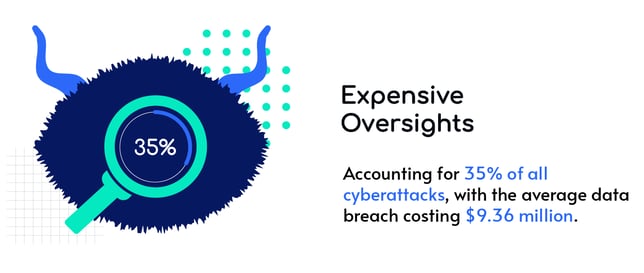
Ransomware attacks are not only among the most financially devastating cyber threats but also heavily reliant on configuration weaknesses to gain access and spread within an organization’s network.
The increasing sophistication of ransomware groups, combined with the growing attack surface of modern IT environments, makes secure configuration management absolutely vital.
Attackers frequently exploit misconfigured remote desktop protocols (RDP), open ports, weak access controls, and unpatched software to infiltrate systems and deploy ransomware. Once inside, they can escalate privileges, move laterally, and encrypt critical data, bringing business operations to a halt.
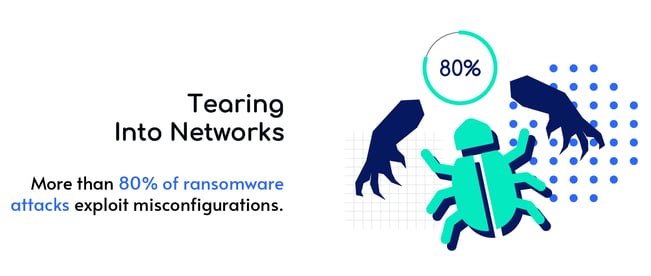
When it comes to ransomware, security misconfiguration impact extends beyond the ransom payment itself: organizations must also contend with downtime, data loss, recovery costs, reputational damage, and regulatory fines.
With penalties coming in especially steep for certain more heavily regulated industries, e.g. financial services, healthcare, energy, and manufacturing.
The problem is that there are a million ways to misconfigure your devices and services. And even minor configuration missteps can lead to substantial financial consequences.
In 2021, Meta (then Facebook) experienced a significant global outage lasting approximately six hours, affecting all platforms, including Instagram, WhatsApp, and Messenger.
The cause? Configuration changes on the backbone routers coordinating network traffic between data centers caused issues that interrupted their communication.
Compounding the problem, Facebook's Domain Name System (DNS) servers were designed to withdraw their Border Gateway Protocol (BGP) routes if they couldn't connect to the data centers, rendering Facebook's domains unreachable from the internet.
The six-hour outage resulted in a direct loss of over $60 million of revenue - a rate of $163,565 for every minute.
Indirect Costs
While somewhat harder to calculate, the indirect costs associated with a data breach are normally even more damning. In one way or another, most indirect losses revolve around damage to the organization’s reputation. Attacked businesses experience a significant erosion of customer trust and loyalty.
Rebuilding trust is a slow and resource-intensive process: high-pressure sectors like healthcare have been observed to spend 64% more on advertising over two years post-breach. And those efforts aren’t always successful:
- Companies lose up to 20% of their customer base following security incidents.
- Over 57% of organizations are forced to increase prices post-breach, representing a potential deathblow for industries already struggling with severe inflation.
- 60% of small businesses close within six months of a major attack.
Dealing With Disruption
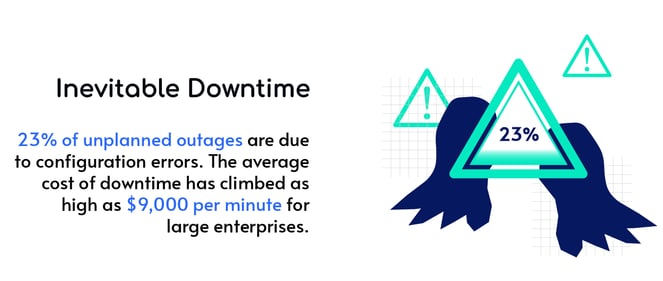
Misconfigurations are among the leading causes of unplanned downtime, according to a Databarracks report. These mistakes often go unnoticed until they trigger an outage.
In February 2017, Amazon Web Services (AWS) experienced a significant service disruption caused by human error in executing a maintenance command. An AWS engineer intended to remove a small number of servers supporting the S3 billing process but inadvertently executed a command that removed a larger set of servers than planned, leading to the shutdown of two critical subsystems.
Prominent companies like Slack, Trello, and Docker were caught up in the unexpected disruption. From delayed announcements to mobile banking, this complete halt was felt by enterprises and individual users alike. According to one estimate, S&P 500 companies lost approximately $150 million due to the four-hour AWS outage.
At the end of the day, the toll taken by misconfigurations is simply enormous, both in on the financial and operational sides of security misconfiguration impact.
Proactive Misconfiguration Management
Regular audits are critical for identifying and addressing configuration issues stemming from system drift and improper settings. These audits should be scheduled routinely and conducted after significant events such as software updates or system expansions to ensure all devices remain aligned with security standards.
Continuous monitoring is another essential preventive tool; identifying issues as they arise makes it possible to take quick action. Of course, you’ll also need the right tools in place to empower quick, effective, and disruption-free remediation.
.png?width=689&height=172&name=security-misconfiguration-impact%20(1).png)
By prioritizing proactive strategies, organizations instill confidence across all levels. From Security personnel to IT teams and beyond, a proactive mindset supports business continuity, enhances compliance efforts, and fosters a tip-top culture that positions organizations to handle future challenges confidently.
Configuration security requires more than patchwork fixes carried out as issues happen to be encountered. It demands a systematic and proactive approach that integrates regular audits, continuous monitoring, and automation.
The best way to minimize exposure, ensure compliance, and maintain operational integrity is to invest in systems, processes, and technologies committed to prevention and hardening.
By continuously monitoring, assessing, and improving security configurations, and enforcing least privilege access, operators can achieve and maintain the posture needed to help organizations identify and remediate risks before they can be leveraged by malicious actors.
This proactive approach strengthens defenses, reduces the attack surface, and ensures compliance with industry standards, ultimately safeguarding critical assets from exploitation.


FAQ
How do security misconfigurations create business costs beyond cybersecurity?
Security misconfigurations create both direct and indirect costs. Direct costs include incident response, ransomware recovery, regulatory fines, and downtime. Indirect costs often have a longer impact, including lost productivity, customer attrition, reputational damage, delayed projects, and increased operational overhead.
Why are security misconfigurations considered a business risk instead of just an IT problem?
Misconfigurations can disrupt critical business services, expose sensitive data, interrupt operations, and increase compliance risk. Because they affect revenue, customer trust, and business continuity, they should be managed as an enterprise risk rather than solely a technical issue.
Which industries are most affected by security misconfiguration costs?
Every industry is vulnerable, but highly regulated sectors such as healthcare, financial services, manufacturing, energy, and government often face greater financial and operational consequences due to stricter compliance requirements and the potential for business disruption.
What are the hidden costs of recovering from a security misconfiguration?
Recovery extends well beyond fixing the affected system. Organizations may need to investigate incidents, validate configurations, restore services, notify customers, satisfy regulatory requirements, retrain staff, and implement additional security controls to prevent similar issues.
Can a small configuration error really lead to a major security incident?
Yes. Many high-profile outages and cyberattacks have been traced to seemingly minor configuration changes or overlooked settings. Attackers frequently exploit these weaknesses because they often provide easier access than developing new exploits.
How can organizations measure the financial impact of security misconfigurations?
Organizations should evaluate downtime costs, incident response expenses, compliance penalties, remediation effort, lost employee productivity, and business disruption. Combining these operational and financial metrics provides a more accurate picture of configuration-related risk than technical findings alone.
How does proactive configuration management reduce business risk?
Continuous monitoring, regular configuration reviews, standardized baselines, and rapid remediation help identify issues before they become security incidents. This reduces the likelihood of outages, compliance failures, and costly emergency response activities.
Is fixing security misconfigurations a one-time project?
No. Enterprise environments change constantly as systems are updated, applications are deployed, and infrastructure evolves. Configuration security is an ongoing process that requires continuous validation to prevent configuration drift and maintain a secure posture.
About Author