Gartner’s How to Achieve the Minimum Viable AI Governance


Blog
AI Attack Surface: Five Ways AI Is Expanding Enterprise Risk

Automation
Operational Excellence
Risk Management
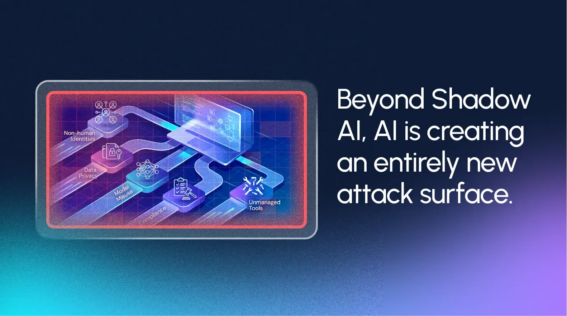
Enterprise AI adoption is spreading through approved and unapproved paths: copilots, coding assistants, autonomous agents, browser extensions, MCP connectors, plug-ins, local AI models, and AI-enabled SaaS features.
Most organizations know they have AI risk. Few know where that risk actually lives. And fewer still know how to govern it.
That's not the product of incompetence. It's the natural consequence of navigating uncharted ground.
AI did not simply add another category of software to the enterprise. It changed what software can do. A traditional application waits for a user to click, type, upload, approve, or execute.
AI systems increasingly read data across sources, summarize sensitive information, invoke tools, call APIs, modify workflows, write code, retain context, and act inside a user’s identity.
That means the attack surface is no longer just the devices you manage, the apps you approve, and the vulnerabilities you patch. It now includes AI systems that can access data, apply reason, take action, and change too quickly for traditional governance models
Where AI Introduces New Security Exposure
Many security teams cannot fully answer the basic questions:
- What AI is running?
- What data can it reach?
- What actions can it take?
Clearly answering those questions is essential to establishing any sort of adequate governance. Those questions all take aim at the same target: identifying where risk lives.
This article endeavors to provide some perspective and guidance around that shared aim - highlighting 5 new wrinkles AI added to your attack surface.
1. AI Agents as Non-Human Identities
The most important change is not that AI tools can generate text. It is that AI agents can act.
When an AI agent connects to email, file storage, source code, CRM, cloud infrastructure, ticketing systems, or internal workflows, it becomes more than an application. It becomes a non-human identity with delegated authority.
That matters because identity security was built around humans, service accounts, and applications. AI exacerbates identity problems by creating machine-speed actors that inherit human authority. They may inherit a user’s permissions, hold broad OAuth scopes, operate through API tokens, and take actions at machine speed.
A misconfigured AI agent is not just a misconfigured app. It is an actor with access, context, and authority.
Consider an AI agent granted organization-wide GitHub access to assist developers. A single misconfigured scope could expose repositories unrelated to its intended function, increasing the blast radius far beyond the original use case.
The risk is obvious once you map the blast radius. An agent given mailbox-wide read access for one workflow can expose far more than that workflow requires.
A coding assistant with access to an entire Git organization can touch repositories it was never meant to modify.
A Copilot Studio agent without proper authentication can become a public-facing path into internal processes.
The security question changes from “Is this tool approved?” to “What identity does this AI operate as? What can it access? What can it do? And who reviews that authority over time?”
To rein in the chaos, operators should look to the old identity governance playbook with renewed gusto: least privilege, scoping by function, credential rotation, action logging, de-provisioning, and approval gates for sensitive actions.

2. Shadow AI & Unmanaged AI Tooling
Shadow IT was inconvenient. Shadow AI is operationally dangerous.
Employees do not adopt AI because they are trying to bypass security. They adopt it because it makes work faster. A developer installs Cursor or Windsurf. A sales team uses a meeting notetaker. A marketer uploads campaign data into a consumer AI account. A finance analyst tests a browser extension. An ops team spins up an MCP server to automate a repetitive workflow.
Each decision may look harmless in isolation. Together, they create an unmanaged AI layer across the enterprise.
This is especially hard to govern because AI enters through side doors. It may not go through procurement. It may not be visible to CASB. It may be accessed through personal accounts. It may be embedded inside a SaaS product the company already approved. It may run locally on a developer workstation.
Indeed, recent research suggests that shadow AI is already the norm, finding that roughly 80% of employees use AI tools that have not been formally approved by their organizations.
The result is a category of exposure that security teams are expected to manage but may not be able to inventory.
As the old saying goes, "you can't manage, what you can't see," so the first step needs to be continuous discovery. With that, you then create and enforce a practical path for approved, conditional, and restricted AI usage.
Shadow AI is not primarily a policy failure. It is a visibility failure, followed by an enforcement failure.
3. AI Connectors, Plug-ins, and MCP Servers
AI becomes much more useful when it connects to tools. That is also when it becomes much more dangerous.
MCP connectors, plug-ins, Skills, API integrations, and agent tools are the bridges between AI systems and enterprise data. They let AI retrieve documents, query databases, search repositories, send messages, update records, invoke workflows, and automate actions. Those bridges are now part of the attack surface.
The problem is that many of these connectors were built for speed and developer convenience, rather than enterprise security. They may rely on long-lived tokens. They may use broad scopes. They may be exposed without proper authentication. They may trust the AI agent’s input without validating it at the backend. They may be installed from community marketplaces without the same scrutiny applied to traditional software dependencies.
A compromised connector can become a shortcut into sensitive systems. A poisoned tool can manipulate agent behavior. A misconfigured MCP server can expose internal data to any agent that can reach it.
MCP server exposure and misconfigurations are rapidly growing risks. Security researchers have already identified thousands of internet-exposed MCP servers, many of which disclosed their capabilities without authentication, demonstrating how quickly convenience-driven integrations can become attack paths.
Security teams need to treat AI connectors like privileged integration points. Every connector should be registered, authenticated, scoped, monitored, and governed. Third-party MCP servers and plug-ins should be evaluated like software supply chain dependencies. Unauthorized AI tools and connectors should be blocked from execution, not merely logged after the fact.
4. Natural-Language Access to Overshared Data
Copilots and enterprise GenAI tools did not create your permission hygiene problem. They made it searchable.
Before AI, overshared files were often difficult to find. A payroll spreadsheet in the wrong SharePoint folder might technically be accessible to too many people, but discovering it required knowing where to look. With AI, that same data can become reachable through a natural-language question.
That changes the practical risk of stale permissions, broad groups, “anyone with the link” sharing, abandoned Teams channels, inherited Drive access, and unlabeled sensitive documents.
The best evidence comes from Microsoft itself, which has been warning customers that generative AI amplifies existing oversharing problems because AI can rapidly surface content that is over-permissioned, obsolete, or poorly governed.
The permissions may not be new, but the accessibility is.
AI traverses enterprise data at a scale and speed humans do not. It can summarize, correlate, and surface information from locations users would never manually inspect. In environments with poor cyber hygiene, the copilot becomes an accelerator for exposure.
This is why over-permissioned copilots and GenAI data access are so significant. The AI is often doing what it was designed to do: respect the user’s existing permissions. The problem is that those permissions were never designed for AI-scale retrieval.
The fix begins before broad deployment. Organizations need to audit overshared repositories, tighten group memberships, remove stale external shares, apply sensitivity labels, and verify how labels propagate into AI outputs.
Most importantly, access reviews need to include AI-traversable data, not just human access patterns.
5. Persistent AI State, Drift, and Autonomous Change
AI environments do not stay still. Memory settings change. Plug-ins are added. Permissions expand. Connectors are enabled. Local tools appear. Browser extensions update. SaaS vendors switch on AI features. Agents are granted new scopes. Models gain new capabilities. A configuration that was acceptable last month may no longer match policy today.
This makes AI security a drift problem.
Traditional governance often assumes point-in-time review: approve the tool, document the control, revisit later. AI breaks that rhythm.
The environment changes constantly, and the exposure window can open between reviews. Even approved AI tools can drift away from secure baselines over time through memory features, integrations, plug-ins, permissions, and vendor-side changes.
Persistent AI memory adds another layer. If an AI system retains context across sessions, that memory becomes part of the attack surface. It may store sensitive information. It may preserve manipulated instructions. It may influence future outputs long after the original interaction is forgotten.
Autonomous agents also introduce the risk of machine-speed change. If an agent can update code, alter policy settings, or invoke operational workflows, human-speed remediation is not going to be enough.
This is why AI governance has to move from periodic review to continuous enforcement. Secure baselines need to be monitored continuously. Drift needs to be detected quickly. Safe changes should be remediated automatically. Risky changes should trigger human approval with rollback available.
In other words: AI governance cannot stop at finding exposure. It has to reduce exposure.
6. AI-Generated Code and Configuration Changes
AI is increasingly involved in creating the systems it later helps operate.
AI-generated code is no longer a niche concern. According to Stack Overflow's Developer Survey, nearly 80% of developers now use AI tools as part of their development process, making AI-generated code one of the fastest-growing sources of change in enterprise environments.
Platform teams use AI to write infrastructure-as-code templates. Administrators use copilots to troubleshoot cloud environments, recommend configuration changes, and automate repetitive tasks.
In many organizations, AI is already influencing how production systems are built and modified. The productivity benefits are real. The security implications are equally real.
AI models generate outputs based on patterns, not organizational context. They do not inherently understand your security standards, segmentation requirements, compliance obligations, or risk tolerances.
As a result, AI-generated changes can introduce exposures that look reasonable at first glance but violate security policy in practice.
A coding assistant may generate application code that contains insecure authentication logic or vulnerable dependencies. An infrastructure copilot may create a cloud configuration with overly permissive network access. An AI-generated Terraform template may grant excessive permissions to a service account. A troubleshooting assistant may recommend disabling a security control to resolve an operational issue.
AI-generated changes introduce risk at a scale and speed that traditional review processes simply cannot handle.
This becomes especially significant when AI-generated outputs are accepted with minimal scrutiny. The more teams trust AI-generated code, configurations, and operational recommendations, the greater the likelihood that insecure patterns become embedded throughout the environment.
Organizations should treat AI-generated changes as a governance challenge, not simply a development challenge. Code review, configuration validation, policy enforcement, and security testing need to apply regardless of whether the change originated from a human or an AI system.
Infrastructure-as-code, cloud configurations, identity permissions, and security controls should be continuously validated against approved baselines before changes reach production.
AI Compresses the Time Between Exposure & Exploitation
These five risks are not isolated problems. They are symptoms of a broader shift.
AI expands the attack surface in three ways:
More Identities
AI agents increasingly operate as non-human identities with delegated authority. They inherit permissions, access enterprise systems, and take actions on behalf of users and business processes.
More Access
Shadow AI tools, connectors, plug-ins, MCP servers, and copilots create new paths to enterprise data. They increase the number of systems, repositories, workflows, and sensitive assets that can be reached, queried, and acted upon.
More Change
AI systems evolve continuously. Permissions expand, integrations are added, memory accumulates, configurations drift, and AI-generated code and infrastructure changes can introduce new exposures faster than traditional governance processes can keep pace.
The five risks discussed above map directly to these three categories:
The challenge is not simply that AI adds new attack surfaces. It expands them across identity, access, and operational change simultaneously.
Meanwhile, attackers are using AI to accelerate reconnaissance, exploit development, and attack execution. Security researchers have documented threat actors using generative AI across the attack lifecycle, including phishing, social engineering, malware development, vulnerability research, and post-compromise activities. The technology is lowering barriers to entry by helping less experienced attackers perform tasks that previously required more advanced skills.
That is the real shift. AI is increasing both the number of opportunities for exposure and the speed at which those exposures can be exploited.
What Security Teams Should Do Now
AI governance is often discussed as a future challenge. That couldn't be further from the truth.
Nearly three-quarters of organizations have AI integrated into initiatives across the business, yet only about one-third have responsible AI controls in place for their current AI models. EY explicitly describes this as a gap between AI adoption and governance. That turns governance into a significant and immediate operational imperative.
Employees are adopting AI tools, vendors are embedding AI into existing platforms, and autonomous capabilities are becoming part of everyday business processes. The question is no longer whether AI will become part of the enterprise environment. The question is whether governance will keep pace with adoption.
Security teams do not need a completely new discipline to respond. They need an operating model that extends proven security principles to AI: knowing what exists, understanding what it can access, controlling what it can do, and continuously validating that those controls remain effective over time.
The path forward starts with four foundational actions.
Step 1: Inventory
Identify AI applications, copilots, agents, coding assistants, browser extensions, IDE integrations, MCP connectors, plug-ins, local models, and AI-enabled SaaS features across the environment.
Step 2: Scope
For every AI system, determine what data it can access, what actions it can take, what identity it uses, what permissions it holds, and what business owner is accountable for it.
Step 3: Enforcement
Define what is approved, conditional, and restricted. Apply least privilege to AI agents. Govern connectors. Control plug-ins. Disable or restrict high-risk memory features where necessary. Review overshared data before enabling broad copilot access.
Step 4: Drift Control
AI settings, permissions, integrations, and local tooling should be monitored against secure baselines. When drift occurs, the organization needs the confidence to remediate safely, with operational context, human oversight, and rollback.
Continuous Governance: The Future of AI Security
AI is not just another application category. It is becoming an operational layer across identity, data, endpoints, development environments, SaaS, workflows, and infrastructure.
That layer can help the business move faster. It can also expose the business faster.
Most organizations understand these risks conceptually. The challenge is operationalizing governance at scale without creating more manual work for security teams.
That is the gap Remedio AI Govern is designed to address: moving security teams from fragmented AI discovery and alerting toward continuous AI exposure management, machine-speed remediation, operational safeguards, and continuous governance evidence.
The organizations that succeed will not be the ones that block AI outright or chase every new tool manually. They will be the ones that build control into the way AI is adopted: continuous inventory, least-privilege authority, governed connectors, permission hygiene, drift control, and safe remediation.

FAQ
What is AI attack surface management?
AI attack surface management is the process of continuously discovering, assessing, governing, and reducing security risks introduced by AI systems. Unlike traditional attack surface management, it must account for AI agents, copilots, browser extensions, coding assistants, MCP servers, connectors, local models, and AI-enabled SaaS features, along with the identities, permissions, and workflows they introduce.
Why do AI agents represent a new identity security challenge?
AI agents increasingly operate as non-human identities with delegated authority. They can inherit user permissions, authenticate with API tokens, access enterprise systems, and perform actions without direct human involvement. Organizations therefore need to govern AI identities with the same rigor as service accounts, including least privilege, credential lifecycle management, monitoring, and approval controls.
How are AI connectors and MCP servers different from traditional integrations?
Traditional integrations typically expose a limited set of predefined functions. AI connectors and MCP servers often provide dynamic access to enterprise systems, allowing AI models to retrieve data, trigger workflows, and interact with multiple applications through natural language. Because they can dramatically expand what an AI system can reach, they require strong authentication, authorization, validation, and continuous monitoring.
Why does AI make existing permission problems more dangerous?
AI rarely creates new permissions. Instead, it amplifies the impact of existing ones. Overshared SharePoint sites, broad Microsoft 365 groups, excessive cloud privileges, and inherited access rights become far easier to exploit because AI can rapidly discover, summarize, and correlate information that previously required significant manual effort to locate.
Can traditional vulnerability management tools discover AI-related exposure?
Only partially. Conventional vulnerability scanners identify software flaws and configuration weaknesses but generally lack visibility into AI-specific risks such as Shadow AI adoption, agent permissions, MCP servers, browser AI extensions, embedded SaaS AI capabilities, or AI configuration drift. Organizations need dedicated AI discovery and governance capabilities alongside existing security tooling.
What is AI configuration drift?
AI configuration drift occurs when AI environments gradually diverge from their approved security posture. New integrations, expanded permissions, updated models, browser extensions, vendor feature releases, and changing workflows can all alter an AI system's behavior over time. Continuous validation is necessary because point-in-time reviews quickly become outdated.
How should organizations prioritize AI governance efforts?
Begin with visibility before enforcement. First inventory every AI application, agent, connector, and model in use. Next determine what each system can access, which identities it uses, and which business owner is accountable. Finally enforce policies around permissions, approved integrations, sensitive data access, and continuous monitoring for configuration drift.
Is blocking AI tools an effective long-term security strategy?
Rarely. Employees adopt AI because it improves productivity, and business adoption continues to accelerate. Organizations generally achieve better security outcomes by discovering AI usage, classifying acceptable and unacceptable use cases, enforcing least privilege, continuously monitoring for drift, and safely remediating risky configurations instead of relying solely on blanket prohibitions.
About Author