Gartner’s How to Achieve the Minimum Viable AI Governance


Blog
Integrating Configuration Security with EDR Protection

Config hardening
Operational Excellence
Risk Management
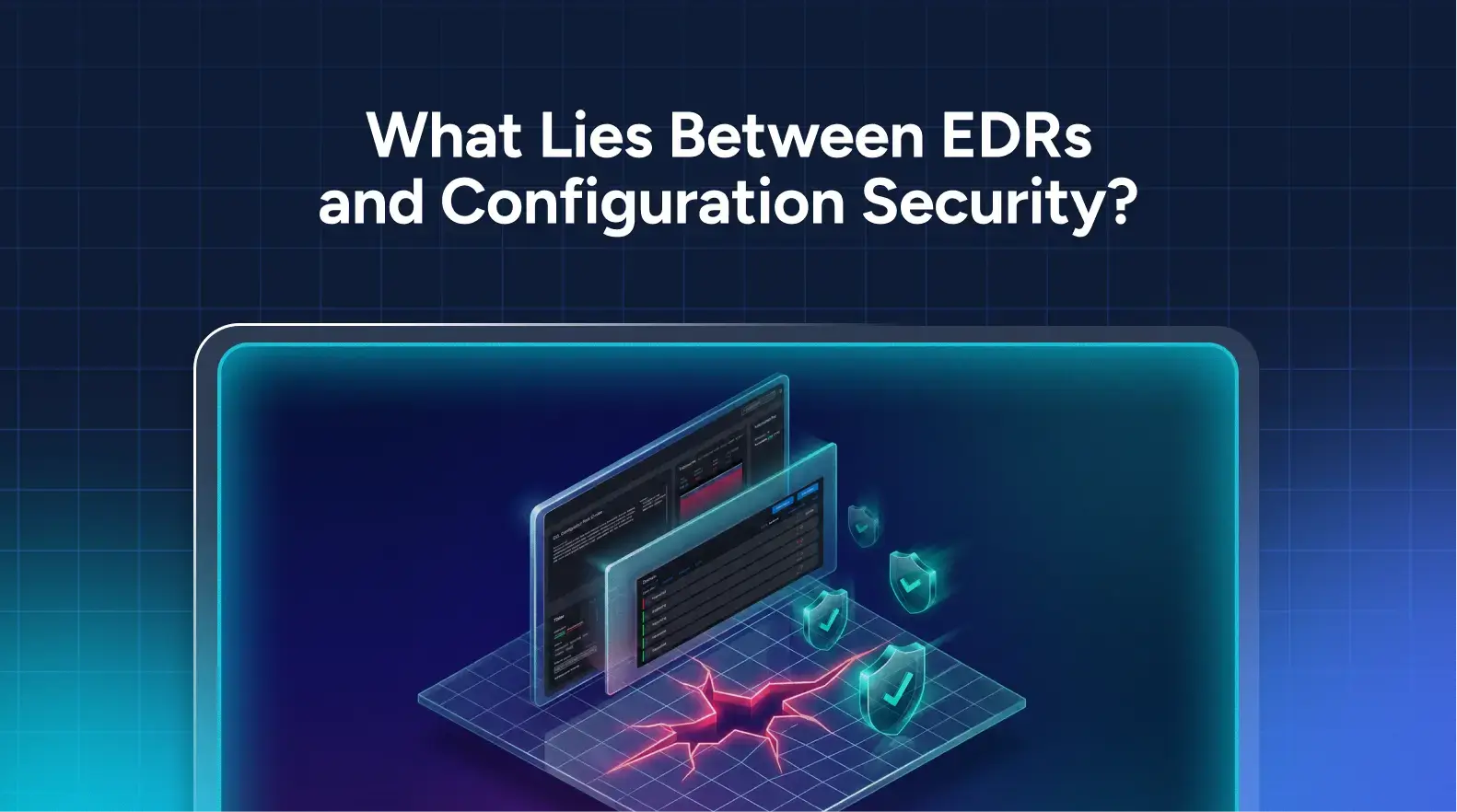
Most security teams investigate events. Attackers exploit conditions. That difference explains why organizations deploy world-class EDR platforms yet continue fighting the same classes of incidents over and over.
Detection tells you what happened. Configurations tell you why it happened. Remediation ensures it won't happen again.
Those distinctions bear relevance to your tools and their core competencies as well.
Your EDR tells you something is happening. Your configuration intelligence tells you what state made it possible and how far it can spread.
Only by integrating those coverage and control planes can you safely, sustainably, and scalably eliminate exposure.
If you run a modern security program, you already know the pattern. Your EDR fires on suspicious execution, privilege abuse, lateral movement, a risky script, an unsigned binary, a process tree that should not exist, or a network connection that does not make sense for that host.
The signal matters. The telemetry is often excellent. But the operational question that follows is usually harder:
What condition on the endpoint made this event possible, durable, or hard to contain?
That’s where too many programs still break down.
If your goal is to reduce exposure before the next alert, behavior alone is not enough. Your team also needs to know whether:
- The endpoint was hardened to the expected baseline
- Security controls were disabled, degraded, or partially enforced
- Local privileges or service permissions made abuse easier
- The EDR policy itself was misconfigured
- Compensating controls were actually present and healthy
- The same insecure state exists across similar endpoints
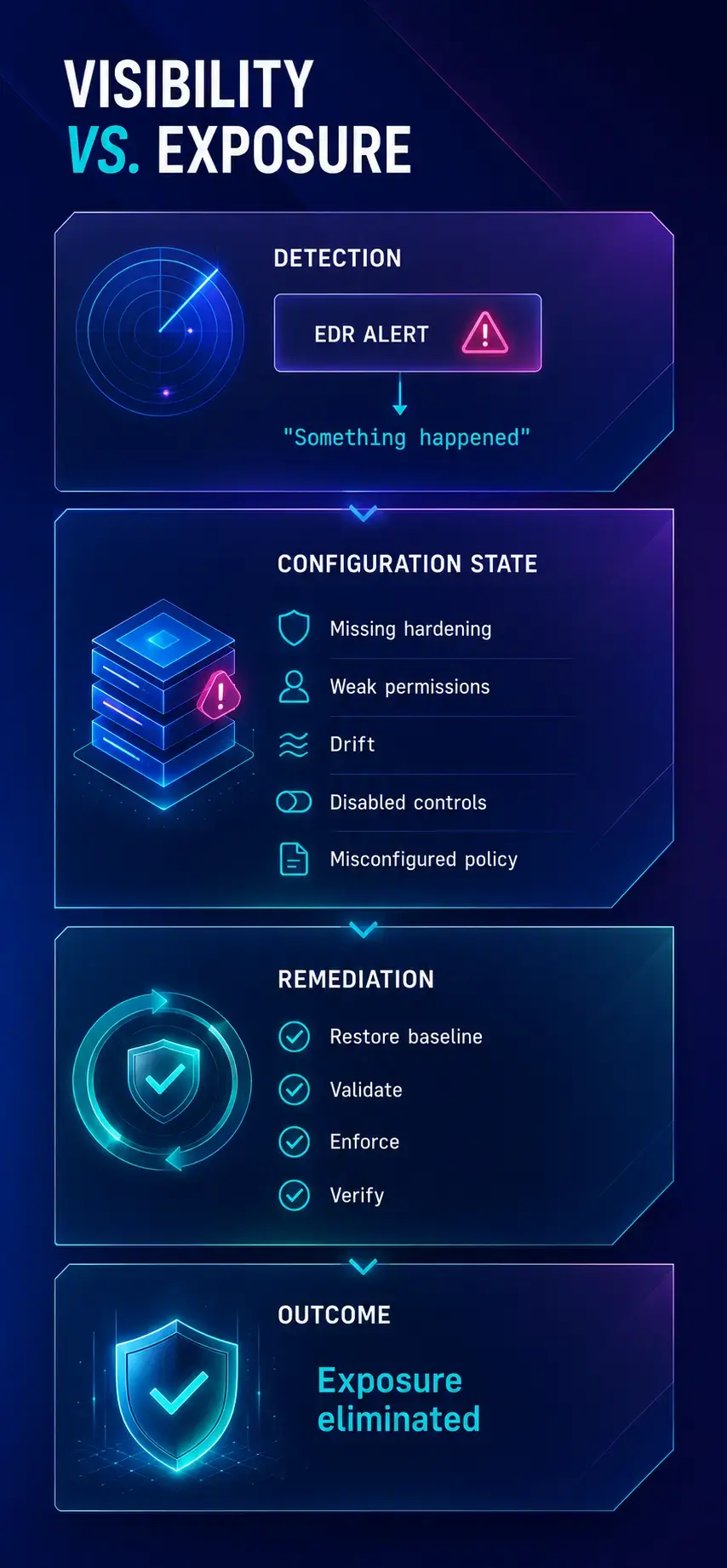
Without that context, defenders spend time investigating symptoms while the underlying state remains in place.
EDR is foundational. But it isn’t sufficient on its own. Microsoft’s Defender for Cloud guidance makes this explicit. Integrated EDR assessments look for conditions such as out-of-date signatures, turned off or inadequately configured anti-viruses, and scan recency gaps. They need to look for those conditions because deployment is no guarantee that your agent is operating as intended.
Cisco makes a similar point in its Secure Endpoint Configuration Insights for Cisco XDR, noting that misconfigured EDRs were responsible for over 25% of incidents in Talos' quarterly findings.
This is not news to the market. Operators are well aware of it. It's also not an argument against EDR.
It's an argument against treating EDR telemetry as self-sufficient.
That limitation becomes more consequential as execution shifts from human users to AI agents, autonomous workflows, browser copilots, and machine identities. These systems amplify the value of durable endpoint state because they can act continuously, inherit permissions, and execute at machine speed.
In that environment, insecure configuration is no longer just an IT hygiene problem. It becomes an automation problem.
The Cost of Mistaking Partial Protection for End-to-End Coverage
Exposure is measurable, and expensive. Every hour spent proving whether an endpoint was actually hardened, whether a control was truly enforceable, or whether an alert was tied to a repeated state condition is an hour pulled away from containment, remediation, and prevention.
Every unresolved configuration drift issue keeps the same attack path alive. Every host that appears protected but is only partially configured creates a false sense of control.
The cost shows up in places security leaders know well:
- More analyst time per investigation
- Slower containment as teams need to run manually validation
- Repeat incidents tied to the same unresolved endpoint conditions
- Escalation across teams because ownership is fragmented
- Extended audit and compliance work when effective enforcement cannot be clearly demonstrated
- Higher business risk the longer the exposure gap stays open
This is why integrated telemetry matters. It improves signal quality, but more importantly, it improves measurable outcomes. It shortens the path from alert to verified correction. It reduces recurrence. It helps security and IT operators quantify where exposure exists, how broadly it's distributed, and what it costs to leave it unresolved.
An Integrated Security Approach
The modern attack surface is too dynamic to manage through siloed tools and separate workflows.
According to XM Cyber’s State of Exposure Management report, 91% of organizations use EDR, yet average EDR coverage across in-scope devices is just 72%.
That gap matters operationally, but it matters even more strategically.
You cannot accurately prioritize if your telemetry doesn't reflect the actual control state. Similarly, you cannot claim sustained posture integrity if a meaningful share of endpoints falls outside enforceable coverage.
The same XM Cyber research found:
- Organizations typically have about 15,000 exposures across their environments
- Traditional CVE-based vulnerabilities account for less than 1% of all exposures
- 79% of organizations have credential hygiene problems involving cached domain or local credentials
That is the environment security teams actually operate in. Exposure often sits in the overlap between configuration drift, identity sprawl, uneven control coverage, and endpoint behavior.
EDRS can show some of the blast radius. Configuration security explains much of the fuel.
Building An Integrated Configuration Security and EDR Apparatus
This is not just a reporting exercise. It's not enough to place an EDR console next to a hardening dashboard and call that correlation.
Real integration means linking endpoint behavior with endpoint state control and validation so your team can answer 4 operational questions quickly and with confidence.
1. Is the alert happening on a healthy, hardened endpoint?
If the endpoint is missing required controls, running weak settings, or drifting from baseline, the same EDR event should be treated differently than it would on a fully enforced host.
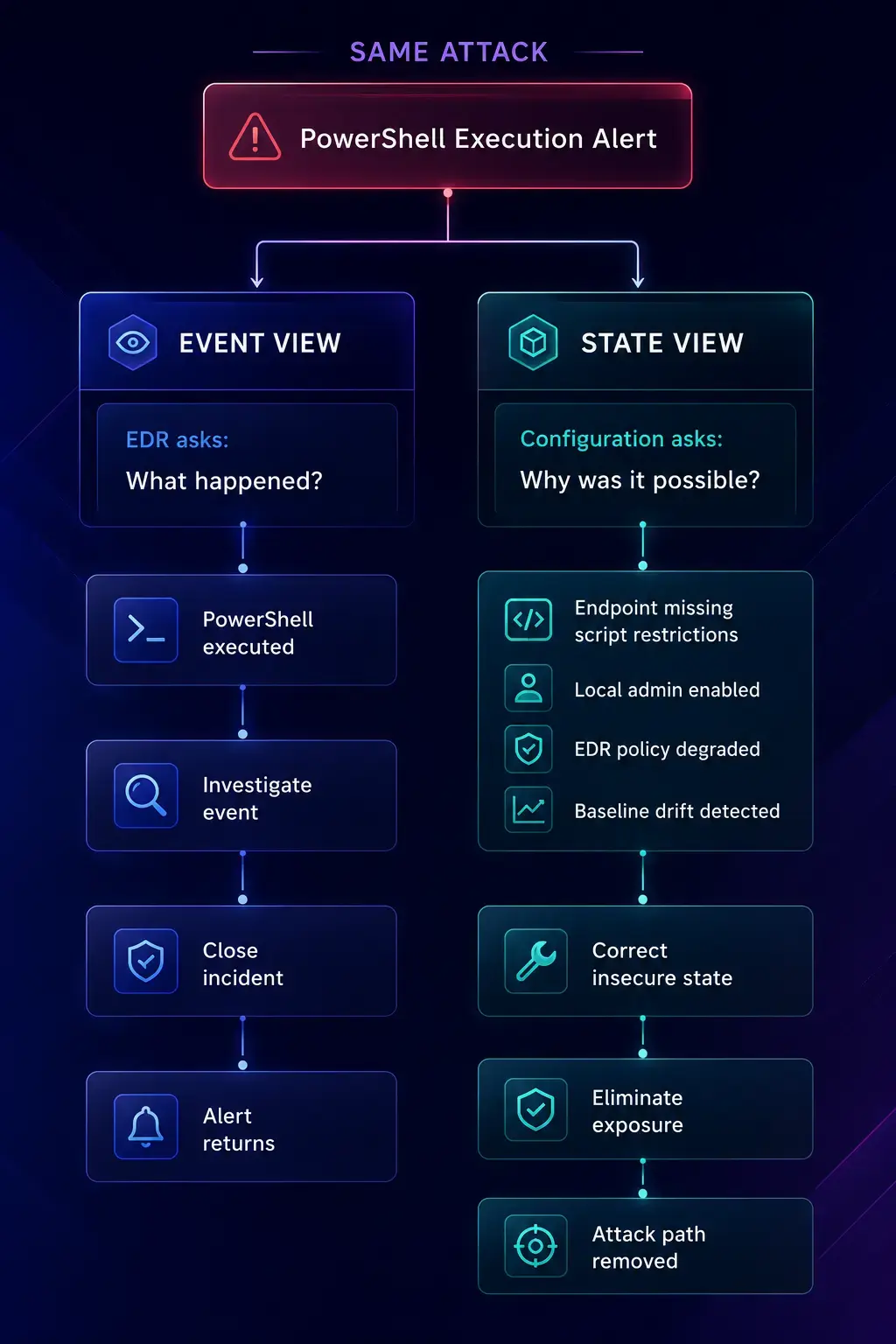
For example, a suspicious PowerShell chain on a workstation that enforces script restrictions, local admin controls, and healthy EDR policy is serious.
The same chain on a workstation with unrestricted macro execution, stale signatures, and a disabled control set is a different class of exposure entirely. The behavior may look similar. The risk is not.
2. Is this isolated or systemic?
If one alert maps to a repeated misconfiguration across hundreds of endpoints, your response should change from host-level triage to environment-level remediation.
A single service abuse event may look contained. But if the same insecure service permissions, weak registry settings, or unnecessary local admin rights exist on every endpoint in a specific business unit, then the event is not local. It is systemic. Mature programs do not just suppress the event and move on. They harden the class of exposure behind it.
3. Is the control itself trustworthy?
If the EDR agent is stale, partially configured, running in audit mode, missing prevention settings, or unable to enforce policy correctly, then a healthy-looking dashboard may be overstating reality.
That's a real problem when operators are making severity and scope decisions based on assumed control strength. If the control posture is weaker than expected, the incident assumptions are wrong from the start.
4. What is the fastest safe remediation path?
Sometimes the right response is containment. Sometimes it is patching. Sometimes it is removing a risky privilege, disabling an exposed service, reapplying a hardened baseline, or rolling back a drifted configuration. But the right answer depends on state context, not alert data alone.
That is where the distinction between visibility and control becomes practical. Visibility tells you what happened. Control tells you what to change, what to validate, and how to keep the condition from returning.
Failure Modes that Creep In When Detection Lacks State Context
You over-prioritize event volume and under-prioritize durable exposure
EDRs are event-rich by design, but event volume is not the same thing as business impact.
The 2025 SANS Detection and Response Survey found that 90% of organizations rely on automated tools for detection, yet false positives remain a leading operational burden. When you add configuration state to the picture, triage becomes more precise. You can separate activity occurring on healthy, enforceable endpoints from activity occurring on hosts with weak controls, unresolved drift, or known hardening gaps.
That's not a small improvement. It's how teams start prioritizing exposure instead of volume.
You close incidents while leaving the enabling condition untouched
A large share of repeat incidents are not random recurrences. They are repeated manifestations of the same insecure state across many assets.
CISA and NSA made this plain in their joint advisory on the most common cybersecurity misconfigurations. The advisory cited issues like default configurations, improper separation of user and administrator privileges, insufficient internal monitoring, poor patch management, weak or misconfigured MFA, and unrestricted code execution.
These are not edge cases. They are common, persistent, and broadly exploitable. If EDR findings are not linked to those enabling conditions, teams can resolve the incident workflow while leaving the same attack path open.
You trust coverage that is present, but not enforceable
A control that is installed is not the same as a control that is healthy. A dashboard that says protected is not always describing real prevention and detection strength.
Microsoft’s guidance on Defender for Endpoint misconfiguration recommendations includes conditions such as signatures out of date, anti-virus off or partially configured, and expected scan windows not being met.
Those are exactly the kinds of quiet degradations that widen the exposure gap between reported posture and actual protection.
You slow remediation because ownership is split across teams
Security sees the event. IT owns the endpoint. Another group owns policy. Another owns identity. Another owns patching. Everyone is rational. The outcome is still delay.
The SANS Detection and Response Survey shows 53% of respondents citing response time as a top challenge, while 55% acknowledge coordination between teams as a major obstacle. Integrated data will not erase those organizational boundaries, but it does give teams a shared operational language:
This event occurred because this endpoint drifted from this required state, here is the business-aware impact, and here is the safest remediation path.
That level of clarity is what turns investigation into action.
Attackers Exploit Exposure, Not Tool Categories
The strongest case for integrating configuration hardening and EDR capabilities is simple. Adversaries do not care how your controls are divided across products or teams.
Palo Alto Networks’ Unit 42 Global Incident Response Report found that identity played a role in nearly 90% of investigations, 87% of intrusions involved multiple attack surfaces, and over 90% of breaches were materially enabled by preventable gaps such as limited visibility, inconsistently applied controls, or excessive identity trust.
Most serious compromises are not created by a single missing signal. They are enabled by combinations of weak configurations, control degradation, identity misuse, delayed remediation, and partial visibility.
That's why integrated telemetry is so important. It helps teams reason across the attack path instead of looking at one slice of it at a time.
A mature approach to integrating configuration security and EDR data usually includes six capabilities.
Shared asset identity
The same endpoint should be represented consistently across configuration, detection, identity, compliance, and remediation systems. If one system calls a host compliant, another calls it unknown, and a third cannot map ownership, prioritization will always be slower than it should be.
State-aware alert enrichment
Every significant EDR event should be enriched with posture context such as baseline status, privileged access conditions, drift indicators, compensating controls, and known hardening exceptions.
This is what lets analysts decide whether an alert reflects a contained anomaly or a broader control failure.
Misconfiguration-to-detection mapping
If an endpoint deviates from policy, the platform should connect that condition to likely blind spots and MITRE ATT&CK coverage gaps where possible.
For example, if tamper protection is weakened or logging depth is reduced, the downstream investigative limitations should be visible immediately.
Environment-wide pattern recognition
One endpoint event is triage. The same state condition across hundreds of endpoints is a hardening campaign. Mature programs look for repeated root causes and use continuous visibility to convert local incidents into environment-level remediation.
Safe remediation workflows
Teams need more than findings. They need safe remediation with continuous enforcement. Rollback and validation capabilities are key to building trust. Otherwise every hardening decision becomes a negotiation between urgency and fear of disruption.
Closed-loop verification
After an incident or hardening action, the platform should confirm that the state change occurred, that it remains in place, and that the original exposure is no longer present.
Without closed-loop verification, teams fall back into the familiar cycle of detect → validate → remediate → enforce in theory, but detect → ticket → wait → drift → repeat in practice.
A Practical Starting Point
Observation alone is not a sufficient security strategy. The endpoint remains one of the most consequential places to reduce risk because it is where configuration state, identity, execution, and policy enforcement converge.
That is why integrating configuration security and EDR data and protections matters so much. EDRs are strong at surfacing suspicious behavior. But behavior without state context leaves too much ambiguity. State without execution context leaves too much urgency unresolved.
You need both if the goal is not simply to investigate exposure, but to eliminate it safely and keep it closed.
This is the last mile that too many security programs still leave open.
You don't need to rebuild the SOC overnight. But you do need to stop treating endpoint configuration and endpoint detection as unrelated disciplines.
A practical path forward looks like this:
Start with one endpoint class
Pick a high-value, high-friction segment such as servers, privileged admin workstations, or compliance-critical endpoints.
The point is not to boil the ocean. The point is to prove that state-aware operations produce better outcomes.
Normalize asset and policy identity across tools
Make sure your configuration platform and EDR platform agree on what an endpoint is, who owns it, what policies apply, and which controls are expected to be enforceable on that class of host.
Define state-aware severity
Score the same EDR signal differently depending on baseline status, privilege context, configuration drift, compensating controls, and policy health.
An alert on a hardened host should not be treated the same way as the same alert on an endpoint with known exposure.
Focus on repeated root causes
Do not just ask which detections fired most often. Ask which insecure states enabled the incidents that required the most effort, involved the widest blast radius, or recurred across the same endpoint population.
Automate safe remediation where confidence is high
Move repeatable corrections out of manual exception handling and into governed automation with validation and rollback.
This is where automated remediation processes can make a big difference. They reduce dwell time not by producing more findings, but by helping operators close exposure faster and with less coordination drag.
Measure posture integrity, not just detection volume
Track metrics such as:
- Percentage of endpoints meeting hardened baselines
- Time from alert to confirmed state correction
- Number of incidents tied to repeated misconfiguration patterns
- Rate of recurrence caused by configuration drift
- Mean effort required to validate and remediate the same exposure class
Those are the numbers that show whether the program is truly reducing attack surface or simply processing events.
The Bottom Line
Integrating configuration and EDR security is no longer an architectural improvement for later. It is an operational requirement for teams that want to reduce exposure rather than just observe it.
EDRs remains essential. But without configuration context, they only tell part of the story.
Attackers exploit conditions, not just events.
If you want better prioritization, stronger signal quality, more confident remediation, and tighter control over the endpoint attack surface, you need both sides of the picture.
That is how you move from reactive investigation to proactive posture management. That is how you shrink the exposure gap.
And that is how you make security exposure measurable, governable, and far more expensive for adversaries to exploit.


FAQ
Why isn't EDR alone enough to reduce cyber risk?
EDR excels at detecting suspicious activity and helping analysts investigate incidents, but it does not explain the underlying conditions that enabled the attack. Configuration weaknesses such as privilege misconfigurations, disabled security controls, policy drift, or missing hardening can leave the same exposure in place even after an incident is closed. Combining EDR with configuration security helps organizations eliminate the root cause rather than repeatedly responding to symptoms.
What is the difference between visibility and exposure in cybersecurity?
Visibility tells you that something happened. Exposure explains why it was possible. An EDR alert may identify malicious PowerShell activity, but configuration security reveals whether weak permissions, missing security controls, or policy drift enabled the attack. Understanding both provides a more complete picture of enterprise risk.
How does configuration security improve EDR effectiveness?
Configuration security enriches EDR alerts with endpoint state information such as baseline compliance, privilege levels, policy health, and configuration drift. This additional context helps analysts prioritize incidents more accurately, distinguish isolated events from systemic problems, and identify the safest remediation path.
Why do organizations repeatedly see the same security incidents?
Many recurring incidents stem from unresolved configuration weaknesses rather than new attacker techniques. If insecure settings, degraded controls, or excessive privileges remain unchanged after an investigation, attackers can exploit the same conditions again. Eliminating the underlying exposure reduces recurrence.
What does state-aware security mean?
State-aware security evaluates an endpoint's security posture alongside its runtime behavior. Instead of analyzing alerts in isolation, it considers factors such as baseline compliance, configuration drift, control health, privilege assignments, and compensating controls to determine both the severity of an event and the appropriate response.
How can organizations determine whether an attack is isolated or systemic?
By correlating EDR telemetry with configuration data across the environment. If multiple devices share the same insecure configuration or policy weakness, what initially appears to be a single incident may actually represent a widespread exposure that requires environment-wide remediation rather than endpoint-by-endpoint investigation.
What are the benefits of integrating configuration security with EDR?
An integrated approach improves alert prioritization, reduces investigation time, accelerates safe remediation, identifies recurring root causes, strengthens compliance reporting, and helps security teams measure whether exposures have actually been eliminated instead of simply detecting more events.
What metrics should security teams track beyond EDR alerts?
Organizations should measure operational outcomes such as hardened baseline compliance, configuration drift, recurring misconfiguration rates, time from alert to verified state correction, and the percentage of exposures that have been permanently remediated. These metrics provide a clearer picture of risk reduction than alert volume alone.
How does configuration drift affect endpoint security?
Configuration drift gradually moves devices away from their intended security baseline as policies change, software evolves, or administrators make operational adjustments. Even small changes can weaken security controls over time, creating exploitable conditions that EDR may detect only after malicious activity has already begun.
What is the fastest way to reduce endpoint exposure?
The fastest path is to combine continuous detection with automated, state-aware remediation. Security teams should identify the insecure configuration that enabled an attack, validate the safest corrective action, enforce the change, and continuously verify that the secure state remains in place to prevent recurrence.
About Author