Gartner’s How to Achieve the Minimum Viable AI Governance


Blog
Shadow AI: The New Shadow IT Threat Organizations Can’t Ignore

AI Security & Shadow AI
Risk Management
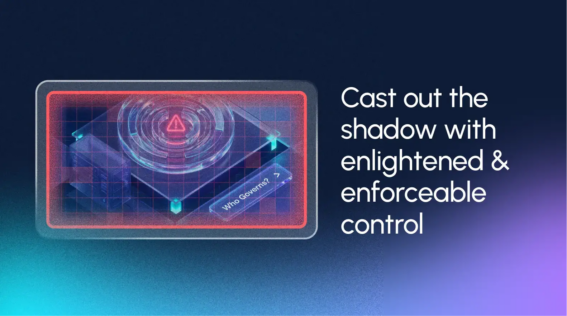
For years, security teams have treated shadow IT as a visibility problem. Employees adopted unsanctioned software. Security teams discovered it. Policies were updated. Governance eventually caught up.Shadow AI looks similar on the surface, but it represents a fundamentally different challenge.
Shadow IT allowed employees to choose technology without approval. Shadow AI allows technology to make decisions without clear governance.
That's a dangerous default to operate from. Every AI tool expands two things:
- The technology footprint
- The decision footprint
Security teams have spent years learning how to govern the first. Most organizations are only beginning to understand how to govern the second.
As generative AI, copilots, embedded AI features, coding assistants, and autonomous agents spread across the enterprise, organizations are discovering that visibility alone is no longer enough. The question is no longer simply which tools employees are using.
The more important question is: who governs the decisions those systems can make?
For many organizations, the answer remains surprisingly unclear.
The AI Race: If It's Not Governed, It's Shadow
The scale of AI adoption alone should eliminate any notion that this is still an experimental problem.
Cyberhaven’s 2026 AI Adoption & Risk Report found that one-third of employees access generative AI tools through personal accounts and that nearly 40% of interactions with AI systems involve sensitive data.
The Cloud Security Alliance (CSA) 2026 shadow AI research reports that most enterprise AI usage remains invisible to security teams, while a large majority of employees use AI tools that have never been formally approved by their organizations.
This is not fringe behavior. It is enterprise-scale adoption occurring faster than governance can keep pace.
More importantly, the conversation is no longer limited to chatbots.
Organizations are increasingly experimenting with AI agents capable of planning tasks, accessing systems, invoking tools, and taking actions with limited human intervention. Agent-building platforms are becoming common, allowing business units to create AI-powered workflows without extensive technical expertise.
This is where the comparison to traditional shadow IT begins to break down. Dropbox never made decisions on behalf of employees. An AI agent can.
The False Sense of Coverage
This is the part that should make security leaders uncomfortable.
Many organizations believe they are better protected than they actually are. They have dashboards. They have logs. They have DLP alerts. They can enumerate approved SaaS applications. They can monitor traffic to known AI domains. Some even have AI usage policies published on the corporate intranet.
That a good first step. But it's nowhere near enough. And putting too much stock in that first step can sometimes, ironically, undermine any further steps.
Modern security programs often mistake telemetry for governance. They can see the agent. They can log the prompt. They can record the API call.
But they often cannot answer more fundamental questions:
- Who approves agent authority?
- What systems can it access?
- What decisions can it make autonomously?
- What controls limit its actions?
- Who reviews its behavior?
- What happens when it gets something wrong?
In a situation like that, visibility can actually work against you – contributing to a false sense of confidence.
The awareness is there (even if the true visibility remains partial) and drives evolving strategy. But strategy can't be built on castles in the sky. It requires reliable control mechanisms. And more often than not, when it comes to enterprise AI in 2026, those controls are still lacking. So we march on, with wide eyes and architecture no longer fit for purpose.
A 2026 Cybersecurity Insiders survey found that 77% of organizations changed their security strategy in response to AI, yet only 26% said their current architecture could support AI-driven workloads without significant redesign.
According to the same report, only...
- 5% of organizations have full visibility into AI tool usage
- 14% say their GenAI policies are actively enforced and audited
- 16% can prevent sensitive data from being sent to AI services in real time.
Shadow AI Is a Decision Problem
Traditional shadow IT expanded the software footprint. Shadow AI expands the decision footprint. That makes it a different class of risk.
A public chatbot accessed through a personal account creates data exposure concerns. A coding assistant introduces source code and software supply chain risks.
An embedded AI feature within an approved SaaS platform may gain access to enterprise information under a security review that occurred before the AI capability even existed.
An autonomous agent introduces something entirely different. It can read information. It can reason over that information. It can call tools. It can trigger workflows. It can take actions. And increasingly, it can do all of those things without waiting for a human decision.
The CSA's visibility crisis paper usefully divides shadow AI into three categories:
- Unsanctioned standalone AI tools
- AI capabilities embedded inside approved platforms
- Autonomous AI agents operating with minimal oversight
A personal ChatGPT account used from a work browser is one problem.
An AI-powered customer service agent capable of accessing internal documentation, retrieving customer information, and issuing refunds is another.
The risk is no longer confined to where data goes. It now includes what systems are authorized to decide and do after receiving that data.
The Ownership Gap
This is where the governance challenge becomes most apparent. Imagine an AI-powered service agent that can access customer records, retrieve internal policies, and perform account actions.
Who approves its permissions? Who determines which decisions require human review? Who validates its outputs? Who monitors its behavior over time? Who owns the risk if it makes the wrong decision at scale?
In many organizations, those responsibilities span multiple teams:
- The business owns adoption
- IT owns the platform
- Security owns risk
- Legal owns policy
- Data teams own models
- Operations owns workflows
Everyone participates. Nobody owns the complete chain of decision authority.
The Coalition for Secure AI's Shared Responsibility Framework was created largely because this ambiguity has become operationally dangerous. The framework emphasizes that AI systems require clearly defined accountability for each component of the system.
The Cloud Security Alliance has similarly highlighted widespread conflict over AI security ownership, with many organizations assigning responsibility to security leaders without providing the authority necessary to enforce governance decisions.
That is the ownership gap. And it explains why so many AI programs reach the same plateau. They can identify risks. They can write policies. They can purchase security tools. But they struggle to establish accountability for autonomous decision-making.
Without ownership, governance becomes fragmented. Without governance, authority becomes shadow authority.
Why This Matters
In most business functions, governance ambiguity creates inefficiency. In security, it creates compounding risk.
AI does not simply increase the number of tools operating inside the enterprise.
It accelerates:
- Data movement
- Software creation
- Privilege usage
- Policy exceptions
- Non-human identity growth
- Automated decision-making
Perhaps most importantly, AI accelerates the speed at which incorrect assumptions become operational reality.
Cybersecurity Insiders found that 64% of organizations have AI agents in pilot or production, and 12% have granted them privileged access to core systems.
That is a startling number on its own. But the more important point is what comes next.
If an agent has privileged access, and the organization cannot clearly answer who approved that access, what controls constrain it, what telemetry exists, and who is accountable when something goes wrong, then the problem is no longer “AI adoption.” It's uncontrolled security delegation.
The CoSAI framework, NIST AI RMF, and the CSA governance papers all point in the same direction:
Agentic systems require explicit ownership, layered accountability, clear identity boundaries, and evidence of control.
A policy statement that says AI should be used responsibly just won't cut it.
Governance Is the New Security Control
Organizations cannot discover, block, or monitor their way out of the shadow AI problem. Knowing an AI system exists is not the same as ensuring its security and propriety of use.
The lesson from shadow IT is that adoption often outpaces policy. Shadow AI raises the stakes because adoption now comes bundled with delegated authority.
Organizations are no longer just governing systems. They are increasingly governing systems that can reason, recommend, generate, and act. As those capabilities become embedded across applications, workflows, and business processes, the question facing security leaders becomes less about technology management and more about operational oversight.
Every new copilot, embedded AI capability, and autonomous agent expands not only the organization's technology footprint but also its decision footprint.
Security leaders should begin by asking four simple questions about every AI system:
- Who owns it?
- What can it access?
- What can it decide?
- How is it monitored and controlled?
If any of those answers are unclear, governance is incomplete.
The organizations that adapt will be better positioned to realize the benefits of AI while maintaining trust, control, and resilience.
Those that don't may discover that the greatest risk of shadow AI is not the technology itself, but the assumptions organizations make about how much control they actually have over it.


FAQ
What is Shadow AI?
Shadow AI refers to AI tools, assistants, agents, or embedded AI capabilities that are used without appropriate organizational visibility, approval, or governance. That can include public generative AI services, AI coding assistants, AI features built into approved SaaS applications, or autonomous agents created by business users. The defining characteristic is not simply that the technology is unknown, but that its permissions, behavior, ownership, or decision-making authority are not being actively governed. As AI becomes embedded across enterprise software, Shadow AI increasingly represents a governance challenge rather than just an asset discovery problem.
How is Shadow AI different from Shadow IT?
Traditional Shadow IT involved employees adopting unapproved software outside IT oversight. Shadow AI introduces a more significant challenge because AI systems can analyze information, generate content, make recommendations, invoke tools, and increasingly perform actions autonomously. While Shadow IT primarily expanded an organization's technology footprint, Shadow AI expands its decision footprint. Organizations must therefore govern not only what software exists, but also what decisions AI systems can make, what data they can access, and who is accountable for their behavior.
Why are employees using unapproved AI tools?
Most employees adopt AI because it helps them work faster. They often encounter useful AI capabilities before formal procurement, governance, or security reviews can keep pace. Many AI tools are also free, easy to access through personal accounts, and increasingly embedded into everyday business applications. In most cases, Shadow AI emerges because organizational demand for productivity outpaces governance, not because employees intend to bypass security policies.
What risks does Shadow AI create?
Shadow AI can expose sensitive data, create unmanaged identities, introduce insecure integrations, and grant AI systems access to enterprise resources without adequate oversight. The greatest risk, however, is often delegated authority. As AI assistants and autonomous agents gain the ability to retrieve data, invoke APIs, execute workflows, or make operational decisions, organizations must govern not only information access but also what those systems are permitted to do. Without clear ownership and controls, AI can rapidly amplify operational and security risk.
Can organizations eliminate Shadow AI completely?
Probably not. AI adoption is evolving too quickly for organizations to expect complete elimination of unsanctioned usage. A more practical objective is continuous governance. That means maintaining visibility into AI adoption, assessing risk, enforcing appropriate controls, defining ownership, and continuously monitoring how AI systems evolve over time. Successful organizations focus on reducing unmanaged AI rather than assuming it can be completely prevented.
How should organizations discover Shadow AI?
Discovery should extend well beyond identifying visits to public AI websites. Organizations should continuously inventory AI applications, browser-based AI services, coding assistants, embedded AI features within SaaS platforms, locally installed AI software, autonomous agents, browser extensions, and AI-related integrations such as MCP servers and connectors. Effective discovery also includes understanding what data AI can access, what permissions it holds, and which actions it is authorized to perform. Continuous discovery is essential because AI capabilities are frequently introduced into existing applications without separate deployments.
What's the difference between governing AI and blocking AI?
Blocking AI attempts to prevent its use. Governing AI enables organizations to use AI safely by defining ownership, controlling permissions, monitoring behavior, enforcing acceptable configurations, and continuously validating compliance. Because AI capabilities are increasingly embedded into approved enterprise software, blocking alone is rarely practical. Governance allows organizations to realize AI's business value while maintaining security, accountability, and operational control.
Why are AI acceptable use policies alone insufficient?
Policies establish expectations but do not enforce them. Organizations also need technical controls that discover AI systems, validate configurations, manage permissions, monitor behavior, and detect governance drift over time. AI environments change continuously as vendors release new capabilities, employees create new workflows, and autonomous agents gain additional integrations. Without continuous technical governance, policies quickly become disconnected from operational reality.
Should AI coding assistants be considered Shadow AI?
They should be considered Shadow AI whenever they are deployed or used without organizational governance. AI coding assistants may access proprietary source code, internal documentation, development environments, package repositories, and cloud credentials. Even approved coding assistants should be governed through policies covering data access, model configuration, plugin usage, permission boundaries, and ongoing monitoring to ensure they remain aligned with organizational security requirements.
How often should organizations reassess their AI inventory?
AI inventories should be maintained continuously rather than reviewed on a quarterly or annual basis. New AI features are frequently added to existing software, employees regularly adopt new AI tools, and autonomous agents can gain additional permissions or integrations over time. Continuous discovery, combined with ongoing governance and configuration validation, provides a far more accurate view of enterprise AI exposure than periodic inventory exercises.
About Author