Gartner’s How to Achieve the Minimum Viable AI Governance


Blog
The Critical Unauthenticated RCE Vulnerability In CircleCI’s MCP Server

Risk Management
Vulnerabilities
Zero-Days
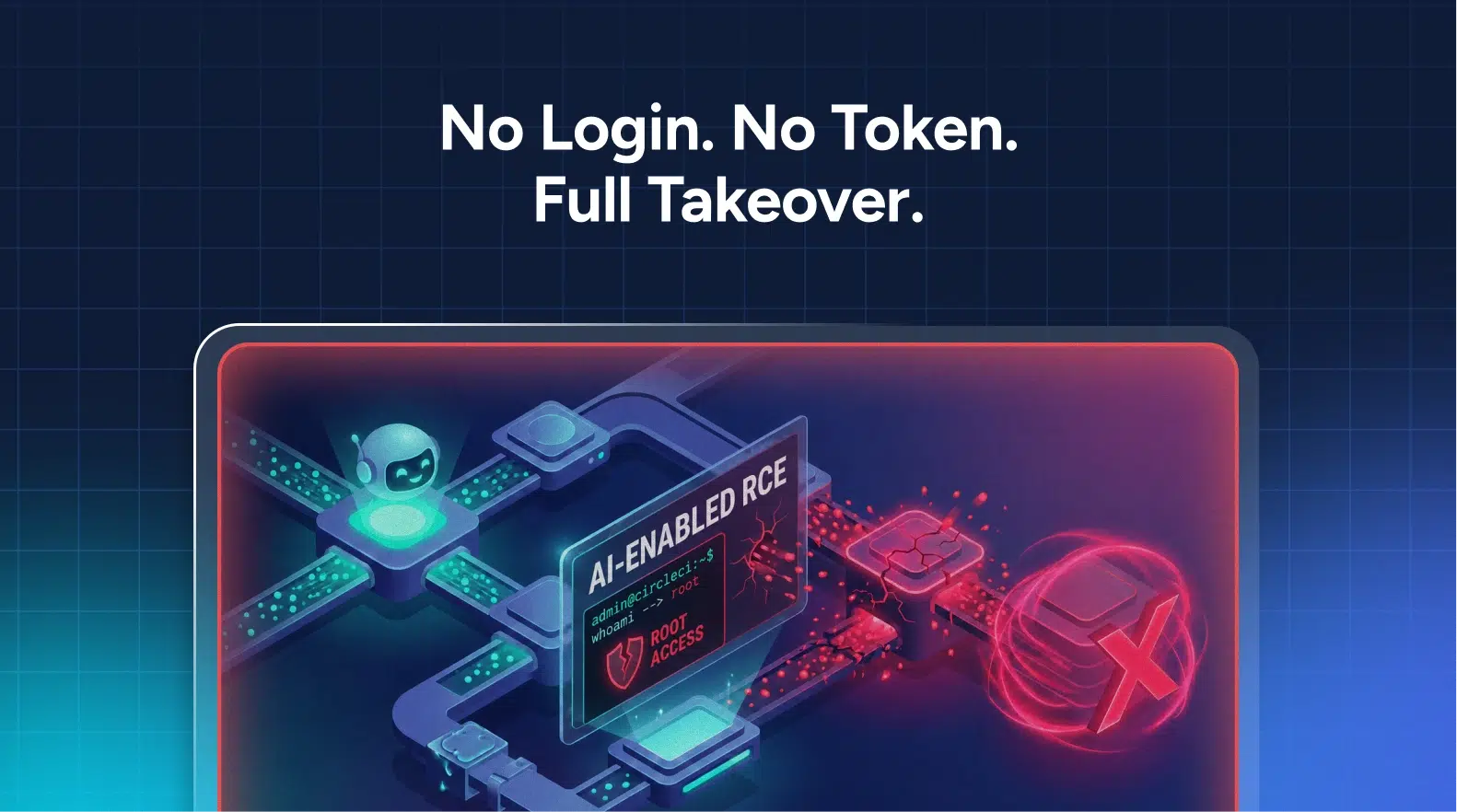
Picture this: No password needed. There's no API token. Nothing. With one well-placed request, an attacker achieves an unauthenticated RCE in your CI/CD pipeline, taking full control of your build secrets and cloud identities.
That's not an imaginary scenario. It's a real security bug we found in CircleCI's MCP server. Critically severe, fully unauthenticated remote code execution. It’s a worst-case scenario and it’s all too real.
Expected CVSS3.1 designation: 10.0, Critical (AV:N/AC:L/PR:N/UI:N/S:C/C:H/I:H/A:H)
CVE has been requested and is pending assignment.
How It Works
The CircleCI MCP server can run as a shared, network-reachable service, allowing a whole team - or their AI agents - to access one instance. In this mode, the server carries the organization's API token to complete its tasks. To keep things safe and block sketchy browser-based attacks, a check is run on the request's Host and Origin headers.
That’s great in theory. In practice however, the attacker can set those headers. So, the safeguard consists of inspecting a lock that the attacker already has the key to. Send a simple http request that says Host: localhost in the http header with no Origin, and you get right through. No credentials, no problem.
Once in, you can freely communicate with connected tools. Call the "run pipeline" tool, hand it the pipeline configuration you wrote, and add a step to run your commands. CircleCI executes it using the organization's token.
That’s all it takes to get your code running inside the entire organization's CI, including access to its secrets, environment, and identity. Game over.
What the Attack Looks Like
It shouldn’t be that easy. But when the only thing standing in your way is two small checks, it is.
(src/lib/auth/originValidation.ts):
export function isOriginAllowed(origin: string | undefined, allowed: Set<string>): boolean {
// Non-browser clients (mcp-remote, curl) send no Origin – allow them.
if (!origin?.trim()) return true;
return allowed.has(origin.trim().toLowerCase());
}
export function isHostAllowed(host: string | undefined, allowed: Set<string>): boolean {
return !!host?.trim() && allowed.has(host.trim().toLowerCase());
}
Those headers are set by the client, potentially with an attacker behind it. localhost is on the allowed-hosts list, and a missing Origin is explicitly waved through. So sending Host: localhost with no Origin results in both checks passing. On top of that, by default, the server listens on every interface.
(src/transports/unified.ts):
const bindHost = process.env.MCP_BIND_HOST || '0.0.0.0';
app.listen(Number(port), bindHost, () => { /* ... */ });
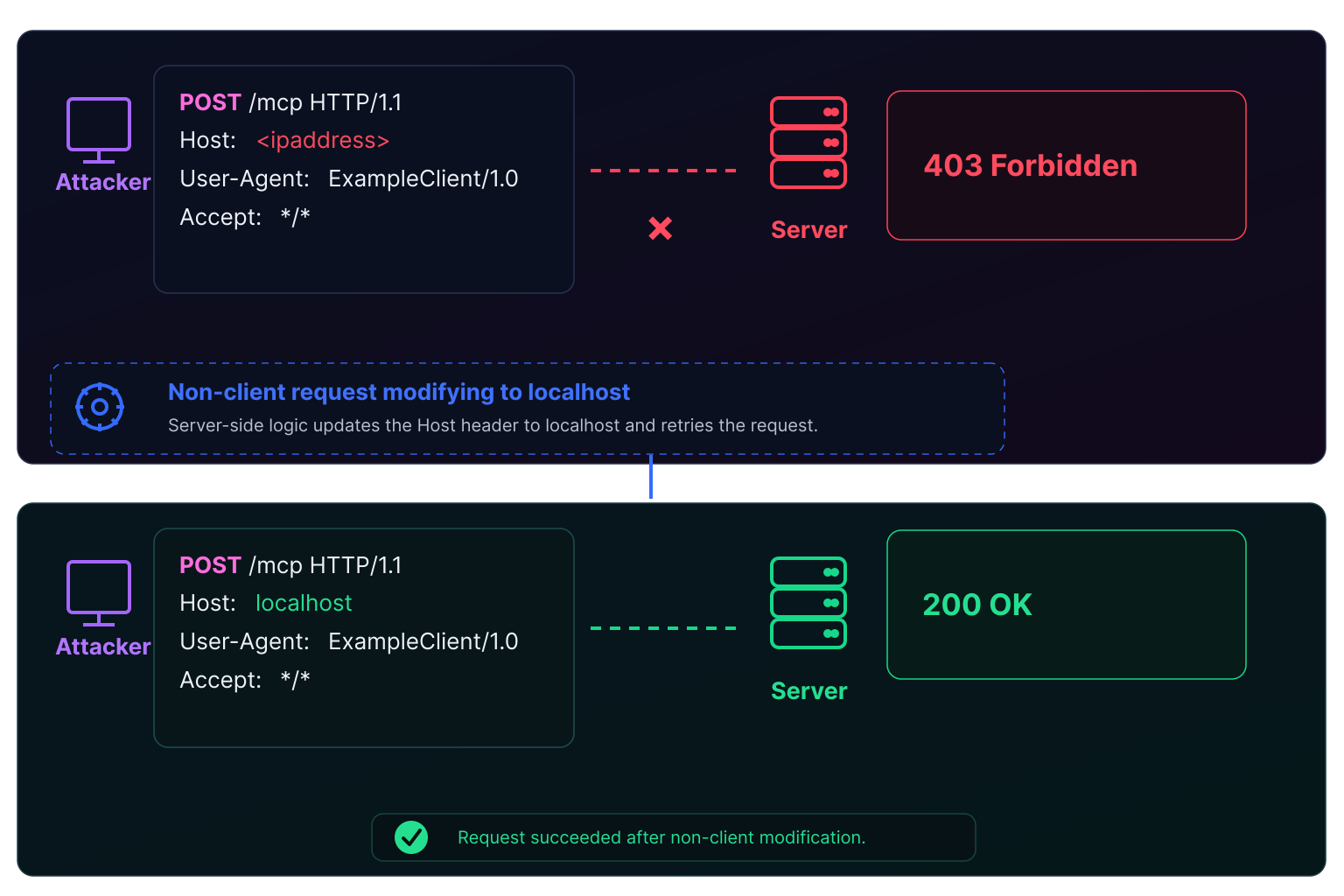
From there it's one call to the run_pipeline tool: you hand it a pipeline config with your own run: step; It could either dump the environment secrets or pop a shell. From there, CircleCI compiles it and runs it under the organization's token - giving you the ability to execute code inside their CI.
Two moves total: one spoofed header, one tool call. Unauthenticated RCE. It doesn't get much worse than that.
MCPs Are A Mess
Here's the uncomfortable truth: CircleCI's bug wasn't a freak one-off. It's a symptom. Right now, the MCP ecosystem is, to put it bluntly, a security mess. We’ve been watching the same broken pattern play out again and again.
We’ve pulled apart dozens of the most popular MCP servers out there - the little connectors that let AI agents actually do things: run commands, kick off pipelines, read your files, hit your databases. Across them all, we see the same thing: the no questions asked rubberstamped operability that opens up security risks is not a bug, but a feature of MCPs. It’s the intended functionality that makes them valuable to low-skill users. And that’s what makes them so dangerous.
Sit with that for a second. The dangerous part is a feature.
Which is why, in MCP land, an authentication bypass is basically a free RCE. In a normal app, getting past the login is just the start of a long climb; you still have to find something worthwhile on the other side. Here, the tools waiting behind that login are already loaded guns. Slip past the gate and the server runs your code for you.
That's exactly what happened with CircleCI: the "auth bypass" and the "code execution" were practically the same move.
Now the good news. CircleCI handled it exactly right. We reported it, and instead of the usual runaround, their security team took it seriously, shipped a clean fix fast (version 0.19.2), and published a public advisory (GHSA-xv5j-cwgj-22r4). Quick, professional, complete.
That's how coordinated disclosure is supposed to work, and honestly it's rarer than it should be. Kudos to them for that.
Unfortunately, not every vendor reacts the way CircleCI did. We’ve reported these sorts of vulnerabilities before only to be told "we don’t see that as a problem." When that happens no advisory is issued and nobody outside the company ever finds out. Except for attackers, of course. They’ll find it just like we did. And when the vulnerability allows adversaries to run code in production environments without authentication, such a cavalier attitude is deeply irresponsible and downright dangerous.
The Takeaway
MCPs are used everywhere because they’re useful and easy to use. But the emerging ecosystem currently lacks appropriate policies and mitigations. So, please be careful every time you plug one of these servers into your stack. It’s not always a harmless, read-only helper; it’s often an execution engine straight into your AI. Treat it as a production attack surface because that's exactly what it is.
Ask the uncomfortable questions before you ship. Is it truly authenticated, or merely presumed to be? Is it accessible from the network? And if someone gets past the gate, what can it actually run?
At Remedio, that last question looms large in all we do. We specialize in finding and fixing the security gaps that would otherwise be overlooked - including in AI tooling. If you have or are considering deploying MCP servers, we can help you better understand their reach and the security implications of that reach.
Disclosure Timeline
30 July 2026→ Reported to CircleCI Security
6 August 2026→ Fix shipped (v0.19.2)
10 August 2026→ Public advisory published (GHSA-xv5j-cwgj-22r4)
A big thank you to the CircleCI security team for their quick and professional response.
FAQ
How can security teams determine whether an MCP server compromise reached the CI/CD environment?
Correlate MCP access logs, tool invocation records, configuration modifications, and secret-access events. Investigators should look for pipelines created outside normal development workflows, unusual command steps, unexpected environment-variable access, and jobs launched from unfamiliar network sources. MCP telemetry alone is insufficient because the consequential activity may appear in the downstream CI platform.
Should organizations rotate CircleCI secrets after patching the MCP server?
Yes, if the vulnerable service was reachable by an untrusted network or suspicious activity cannot be conclusively excluded. Patching prevents future exploitation but does not invalidate credentials already exposed through earlier pipeline execution. Prioritize project tokens, cloud credentials, signing keys, package registry credentials, and secrets shared across multiple CircleCI contexts.
What is the safest way to expose an MCP server to multiple users or AI agents?
Place it behind a hardened access layer that authenticates every caller, authorizes individual tool actions, and records attributable activity. Use workload identity or short-lived credentials where possible. Network location, request headers, and possession of an MCP endpoint should not establish trust. High-impact tools should also require narrower permissions or explicit approval.
How should MCP tools that can trigger CI pipelines be permissioned?
Treat pipeline execution as privileged code execution, not ordinary automation. Separate read-only inspection tools from mutation and execution tools, constrain accessible projects and contexts, and prevent untrusted callers from supplying unrestricted pipeline definitions. The decisive control is downstream capability containment – limiting what the invoked job can execute and which secrets it can inherit.
What logs should be retained to investigate MCP-driven attacks?
Retain authenticated caller identity, source network information, requested tool, sanitized parameters, authorization outcome, response status, and correlation identifiers. Those records should connect to CI job IDs, source-control events, cloud audit logs, and secret-manager access. Avoid recording secret values, but preserve enough metadata to reconstruct the path from MCP request to downstream action.
Can network segmentation compensate for weak MCP authentication?
No. Segmentation can reduce reachability, but it cannot establish who is making a request or whether that caller may invoke a specific tool. Internal networks routinely contain compromised endpoints, shared services, and overly broad east-west access. Use segmentation as a containment layer while enforcing authentication and authorization at the MCP service itself.
How should enterprises classify MCP servers in their threat models?
Classify them according to the most powerful connected tool, not the apparent simplicity of the protocol endpoint. An MCP server that can trigger pipelines, execute shell commands, access production data, or retrieve secrets belongs in the same risk tier as other privileged automation infrastructure. The useful mental model is delegated authority: the server concentrates the permissions of every system it can instruct.
What should an enterprise MCP security review test beyond authentication?
Review tool-level authorization, credential scope, network binding, tenant separation, input handling, command construction, logging, secret propagation, and failure behavior. Test whether missing or malformed identity signals cause denial, whether callers can reach unintended tools, and whether downstream systems impose their own controls. The review should follow the full execution chain rather than stopping at the MCP endpoint.
How can Remedio help?
Any unauthorized or malicious MCP server becomes an instant supply-chain backdoor into your environment.
Remedio continuously scans every endpoint to detect unapproved MCP server entries across all AI agent configurations, flagging rogue or unrecognized servers before they can be exploited.
With one-click remediation, security teams can remove unauthorized MCP servers from user and project configs, or enforce an allowlist policy so only IT-approved integrations are ever loaded.
The result: full visibility and control over your AI agent attack surface - at the endpoint level, in real time, across your entire fleet.
Remedio continuously scans every endpoint to detect unapproved MCP server entries across all AI agent configurations, flagging rogue or unrecognized servers before they can be exploited.
With one-click remediation, security teams can remove unauthorized MCP servers from user and project configs, or enforce an allowlist policy so only IT-approved integrations are ever loaded.
The result: full visibility and control over your AI agent attack surface - at the endpoint level, in real time, across your entire fleet.
About Author