Gartner’s How to Achieve the Minimum Viable AI Governance


Blog
Why Mythos Makes Safe Remediation a Strategic Security Priority

Autonomous Remediation
Endpoint Hardening
Risk Management
Vulnerabilities

For years, security teams operated under an implicit assumption: finding serious flaws was hard, slow, and expensive. That assumption shaped everything downstream. Detection stacks grew. Triage workflows expanded. Ticket queues became normal. Patch windows stretched.
And the gap between knowing about risk and actually removing it became something organizations learned to live with.
That world is ending.
Mythos is not just another story about AI doing vulnerability research better. It is evidence that the economics of cyber offense have shifted. Vulnerability discovery is getting cheaper, faster, and more scalable. Anthropic reported that Mythos Preview helped surface more than 10,000 high- or critical-severity vulnerabilities across critical software.
In a separate technical write-up, Anthropic said Mythos Preview found and exploited zero-days across major operating systems and browsers, and described that capability as a watershed moment for security.
That's significant, but what makes it even more significant is that it renders the old remediation model (detect, prioritize, ticket, wait) obsolete. With the newfound speed of attack path discovery and ease of exploitation, manual, brittle, and low-confidence remediation processes simply cannot keep pace.
That is the real lesson of Mythos.
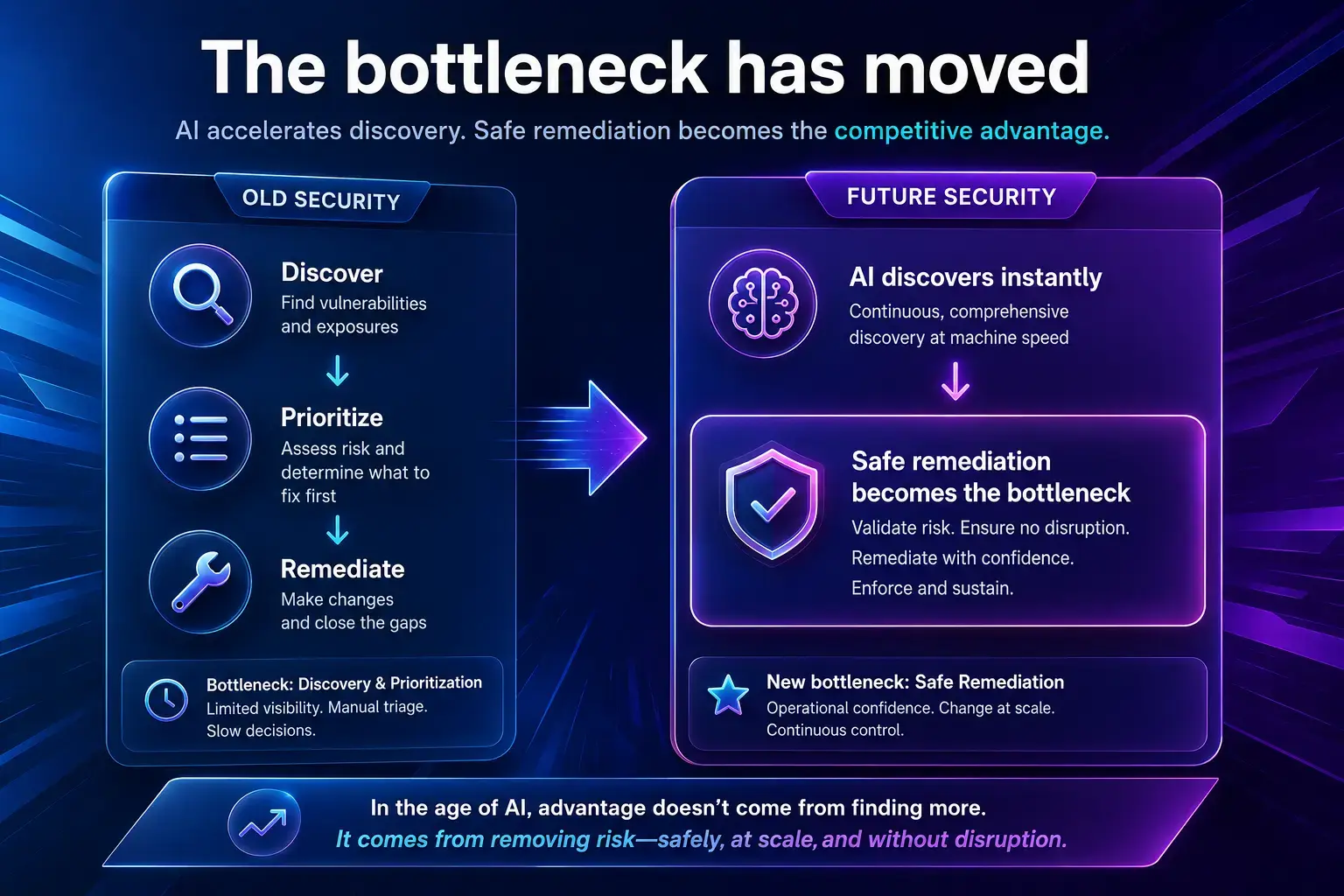
The Bottleneck Has Moved
The speed of offensive innovation continues to accelerate. Google's Threat Intelligence Group has documented a steady increase in the exploitation of zero-day vulnerabilities over recent years, with enterprise technologies becoming an increasingly attractive target.
As AI lowers the cost of vulnerability research, defenders should expect that discovery timelines will continue to compress, leaving even less margin for slow operational response.
Attackers are not waiting for your next change window. AI-assisted discovery does not slow down because remediation is operationally inconvenient. And the more defenders rely on fragmented workflows, disconnected ownership, and risky manual change processes, the more valuable safe remediation becomes.
This is where the conversation needs to mature. Detection still matters. Threat intelligence still matters. Exposure management still matters. But in a world were offensive cyber efforts are increasingly AI-powered, those processes that put you in position to act are only as valuable as the actions they leads to are quick and effective.
AI doesn't make defenders slower. It makes waiting more expensive. So speed is everything. And speed is impossible without confidence. That's the crux of the problem.
AI doesn't present an intelligence problem. It presents an operational confidence problem.
AI Security Doesn’t End In the Model. It Ends On the Endpoint.
A lot of discussion around Mythos has been framed through software vulnerabilities, patching pressure, and exploit development. But the exploit path does not end in the model or the codebase. It ends in a real environment. If that environment isn't exploitable, Mythos can't hurt you.
Every major improvement in offensive AI shifts value further downstream. First, vulnerability discovery becomes faster. Then prioritization becomes automated. Eventually, identifying risk becomes a commodity.
The remaining competitive advantage is operational execution: the ability to validate, remediate, enforce, and sustain secure configurations without disrupting the business.
This is why endpoint hardening, configuration control, application control, and AI governance have become all the more vital. Hardening endpoints reduces the number of viable paths an attacker can use after initial discovery. Application control limits what can execute. Governance over AI applications constrains unauthorized tools and unsanctioned behavior. Continuous enforcement reduces the slow drift that reintroduces exposure after a fix is applied.
As AI becomes embedded across the enterprise, the number of systems capable of introducing configuration change, software change, and policy change will only continue to grow. Verizon’s Data Breach Investigations report, for example, found that 15% of employees were routinely accessing generative AI services on corporate devices, and that many were doing so with non-corporate emails or without integrated authentication controls.

That is not just an AI policy issue. It is an endpoint and control issue. In that situation, shrinking the attack surface becomes paramount.
The Main Cyber Gap Is No Operational Confidence
The unmistakable irony in this is that, despite the discovery impact of offensive AI, what has many organizations most worried is not new exposure. It's the exposure they already about and that they haven't acted on for lack of operational confidence.
So you're aware of a security gap. Great! But can you push the necessary change(s) without breaking a business-critical workflow? Can you validate impact before rollout? Can you stage enforcement safely? If something unexpected happens, can you roll it back before any damage is done? Can you prevent the same issue from drifting back a week later?
Those are not secondary questions anymore. They're fundamental to enabling.
The absence of SMB signing creates an attack path. The security team already knows the fix. Great, right? But what do you do when you can't be sure that enabling SMB signing will break legacy functionality?
Or say you find an exposed administrator account. The risk is obvious. Identity abuse is a preferred entry point for attackers. Thankfully, removing it is easy. But what do you do when you don't know if it's used by a forgotten backup process?
In that equation, waiting to respond until everything is fully certain is understandable. But it's also potentially devestating. not caution. It is delay.
Delayed remediation not only contributes to increased breach probability, but analysis paralysis, exception sprawl, deferred hardening, and a widening gap between policy intent and actual endpoint posture.
This is why safe remediation needs to be treated as strategic infrastructure. Not an operational afterthought. Not an add-on to detection. Not a downstream IT chore. Strategic infrastructure.
"Patch Faster" Is Not A Strategy
Mythos isn't really a story about vulnerability research. It's another link in the chain pulling security impact further downstream. First, visibility became commoditized. Next, prioritization became automated. Now vulnerability discovery is accelerating.
The remaining differentiator is execution. The organizations that can continuously validate, remediate, and enforce their secure states without disrupting operations will increasingly outperform those that simply identify more issues.
Naturally, that realization leads many to over-index on patching. Of course organizations do need to shorten patch cycles. But “patch faster” is not a complete strategy.
Not every risk is solved by a patch. Not every patch can be deployed immediately. Not every production environment tolerates urgent change the same way. And not every exploit path begins and ends with vulnerable software versions.
Configuration weakness, excessive permissions, exposed management pathways, unmanaged AI applications, and endpoint drift all expand what an attacker can do even after a specific CVE is addressed.
That is why the security posture conversation has to widen. In practice, the organizations that will handle the AI-accelerated threat landscape best are not just the ones that discover more. They are the ones that can:
- Harden endpoints continuously,
- Validate changes before broad rollout,
- Enforce secure baselines over time,
- Control what AI applications can run,
- Reduce configuration drift,
- Reverse safely when business conditions require it.
Today's research preview becomes tomorrow's commodity capability. And smart organizations will build around the assumption that every attacker will eventually have equivalent capability.
No tickets. No delays. No blind pushes. Just controlled execution.
From Risk Visibility to Change Viability
For years, we've been optimizing for visibility. More dashboards. More prioritization. More scoring. More alerts. But visibility does not equal security. Today, AI has widened the gap between observation and operationalization to a dangerous degree.
Mythos should be read as a wake-up call. But the right response is not panic. It's posture. Organizations should assume that vulnerability discovery will continue to accelerate. They should assume that exploit development will get faster. They should assume that attackers will keep combining exposed software, weak identity controls, unmanaged AI adoption, and configuration drift into practical attack paths.
Then they should build for that world, working to:
- Continuously reduce the attack surface
- Treat endpoint hardening as a frontline control, not hygiene theater
- Bring AI governance and application control into endpoint security
- Replace manual remediation with safe automation wherever possible
- Measure success by exposure reduction rather than tickets created.
For modern enterprise organizations, the north star is no longer the ability to identify the most exposure, but to safely remove the most exposure.
Operators need to be able to effectuate change at the endpoint level in a way that is fast, business-controlled, and persistent. To get there, you need operationally intelligent dependency mapping, automated hardening, continuous governance & enforcement, and drift control.
In practice, that means moving from a detect → prioritize → ticket → wait model to a detect → validate → remediate → enforce model.
Remediation changes a system. Enforcement keeps it changed. In an environment where software, policies, AI agents, and administrators are all introducing constant change, that distinction becomes the difference between temporary fixes and lasting risk reduction.
That is the lesson that Mythos makes impossible to ignore. Visibility is no longer the goal. Now it's the infrastructure. Safe execution is what's needed for an effective and cyber strategy in 2026 and beyond.

FAQ
What is "safe remediation" in cybersecurity?
Safe remediation is the ability to apply security changes quickly while minimizing operational risk. It involves validating dependencies before changes are made, staging deployments, providing rollback capabilities, and continuously verifying that security controls remain in place. Safe remediation allows organizations to reduce exposure without disrupting business operations.
What is Anthropic's Mythos, and why does it matter to enterprise security?
Mythos is Anthropic's AI-powered vulnerability research system that demonstrated how AI can discover complex, high-severity software vulnerabilities at unprecedented speed and scale. For enterprise defenders, the significance extends beyond faster vulnerability discovery. It signals that attackers will increasingly have access to similar capabilities, making rapid, safe remediation a strategic necessity rather than an operational optimization.
How should security teams respond to advances like Mythos?
Organizations should assume vulnerability discovery and exploit development will continue to accelerate. Rather than relying solely on more detection tools or faster patching cycles, they should invest in capabilities that enable safe, continuous remediation, including dependency-aware change validation, endpoint hardening, configuration management, application governance, and automated enforcement. The goal is to reduce exposure as quickly as AI can identify it.
Is patching enough to reduce cyber risk?
No. Many attack paths involve insecure configurations, excessive privileges, unmanaged applications, identity weaknesses, or configuration drift that patches alone cannot address. Effective exposure reduction requires secure configurations, endpoint hardening, application governance, and continuous enforcement alongside traditional vulnerability management.
What is configuration drift, and why does it matter?
Configuration drift occurs when systems gradually move away from their intended secure state because of software updates, administrative changes, new applications, or policy modifications. Even after a vulnerability is fixed, drift can reintroduce exploitable conditions. Continuous validation and automated enforcement help ensure security improvements remain in place over time.
How does endpoint hardening improve resilience against AI-powered attacks?
Endpoint hardening reduces the number of opportunities attackers can exploit by enforcing secure configurations, limiting unnecessary privileges, controlling which applications can execute, and continuously correcting deviations. As AI accelerates attack development, reducing the available attack surface becomes increasingly important.
What does the article mean by "the bottleneck has moved"?
Historically, discovering vulnerabilities was the slowest part of cybersecurity. Today, AI is dramatically accelerating discovery, prioritization, and exploit development. The new constraint is an organization's ability to safely execute remediation. Security programs increasingly succeed or fail based on how efficiently they can operationalize change rather than identify new issues.
How should organizations measure cybersecurity success in the age of AI?
Metrics focused solely on findings, alerts, or tickets provide only part of the picture. Organizations should also measure how quickly exposure is eliminated, how much attack surface is reduced, how effectively secure configurations are sustained, and how safely changes can be deployed without disrupting business operations.
About Author