Gartner’s How to Achieve the Minimum Viable AI Governance


Blog
The Value of Unified Vulnerability and Configuration Management

Autonomous Remediation
Endpoint Hardening
Exposure Management & CTEM
Patch Management
Risk Management
Vulnerabilities
You can spend millions on detection and still lose the fight in the last mile. That’s not a theoretical problem. It’s very real. Security teams today have more scanners, more telemetry, and more dashboards than ever. Yet the exposure gap between identifying a problem and actually eliminating it is still wide - and in many environments, getting wider.
Vulnerabilities are tracked in one place. Configuration drift is tracked in another. Patching sits with IT. Hardening sits with someone else. Exceptions live in spreadsheets. And operators are left trying to connect all of it while the attack surface keeps changing underneath them.
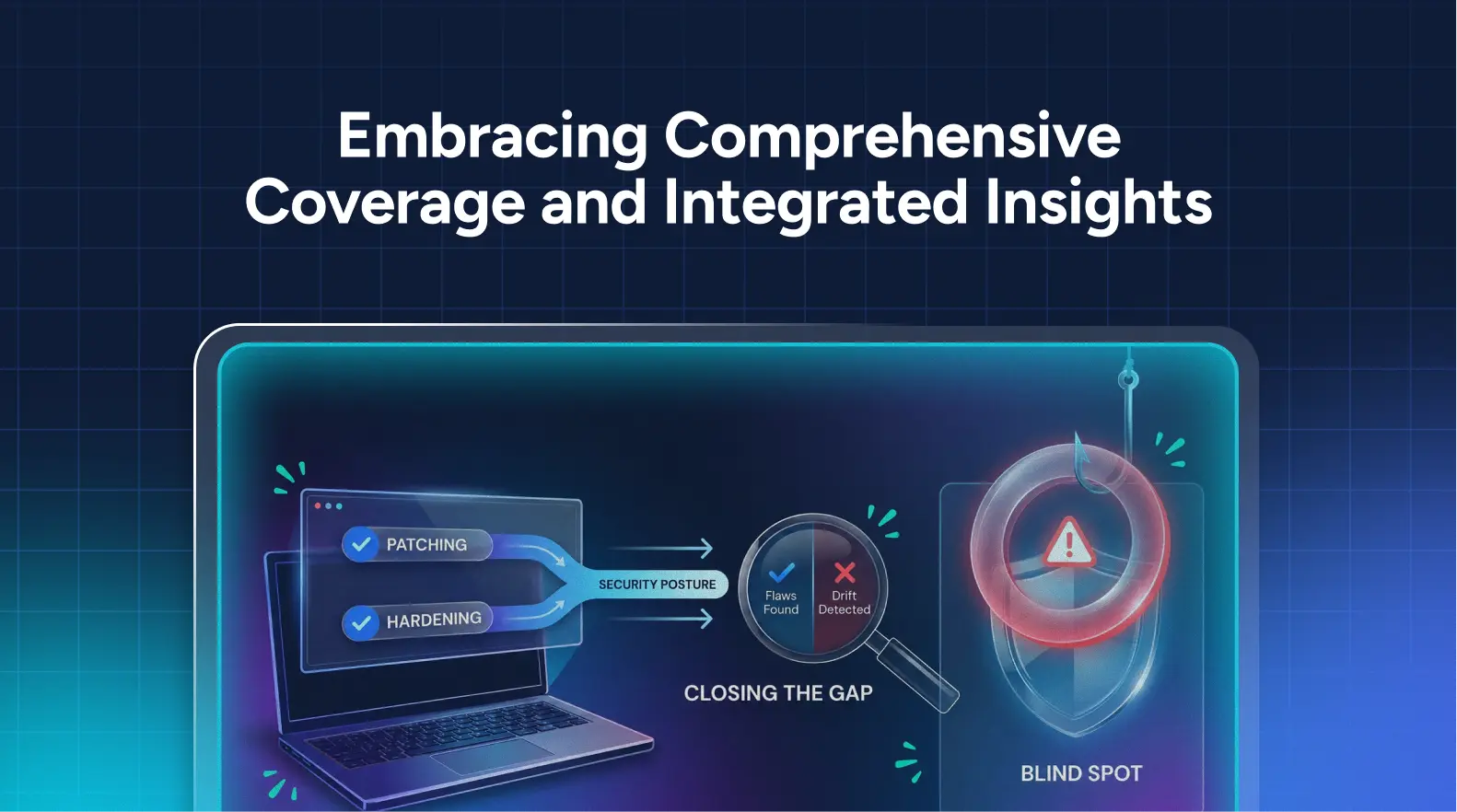
Unified vulnerability and configuration management is the practical answer to that fragmentation. It brings two disciplines together that have been treated separately for too long: managing software flaws and managing the system states that make those flaws exploitable, persistent, or dangerous.
Why the Old Split No Longer Works
Most organizations still run vulnerability management and configuration management as related but separate programs.
On paper, that sounds reasonable. Vulnerability management finds missing patches, outdated packages, exposed services, weak libraries, and known exploitable software flaws. Configuration management defines and enforces the secure state of systems - hardening settings, service exposure, privilege boundaries, firewall rules, password policies, audit settings, and baseline controls.
In production, though, the fine line that separates the two fades and the space between them creates operational drag.
A vulnerability may be technically present but not materially exploitable because the surrounding configurations block the relevant attack path. The reverse is also true. A medium-severity CVE on an internet-facing system may pose more immediate risk than a higher-CVSS issue on an isolated host.
According to Verizon's Data Breach Investigations Report, vulnerabilities are exploited in 20% of breaches. More shocking still, Orca’s State of Cloud Security Report found that 58% of organizations have at least one vulnerability older than 20 years!
And if you think that exposure is unique to legacy infrastructure, think again.
Orca also found that cloud assets carry an average of 115 vulnerabilities, while 32% of cloud assets are in a neglected state, and 76% of organizations have at least one public-facing cloud asset that enables lateral movement.
That’s not solely a speed problem. It might not even be mainly a speed problem.
Unify vulnerability intelligence & configuration state Manage exposure like you mean it
See What's At Stake
The inability to maintain a secure, enforced, business-aware device states over time points squarely to a posture and persistence problem. Which is why the industry needs to start taking more seriously the idea of unifying vulnerability management and configuration management.
The DevOps Precedent: Eliminate the Handoff
Cybersecurity is not the first technology discipline to consider that process siloization may be needlessly compromising throughput in the name of control.
Before DevOps, Development and Operations were organized around different incentives. Developers were rewarded for shipping features. Operations teams were accountable for stability. Code crossed the boundary through tickets, change requests, scheduled releases, and manual approvals. When something failed, the work traveled back in the other direction.
Each team could perform its assigned function correctly, but inefficiencies and misalignments compounded. Delivery became a slog and reliability was treated as a problem for another day - to be resolved after the fact.
DevOps changed that by collapsing the distance between building software and operating it. Shared workflows, infrastructure as code, automated testing, continuous delivery, production telemetry, and rapid rollback turned software delivery into a closed feedback loop.
Developers did not become system administrators, and Operations teams did not stop protecting production. The disciplines retained their expertise while sharing the machinery required to move safely from intent to production state.
DORA’s study of more than 25,000 technology professionals found that organizations using mature DevOps practices deployed 200X more frequently, saw a 2,555X reduction in change lead time, suffered 3X fewer failed changes, and achieved 24X faster failure recovery.
The same research found that DevOps-forward organizations also spent 22% less time on unplanned work and rework while creating 29% more capacity for new work.
Those are jaw-dropping numbers, to be sure, and they explain perfectly why so many enterprises spent so much of the 2010s feverishly transitioning to a DevOps model. The results stood as a powerful rebuttal to the assumptions upon which traditional operating models were built. Speed and stability, as it turned out, were not opposing outcomes. Small, automated, observable, and reversible changes improved both.
That lesson from business history is eminently relevant to security stakeholders today. The same pattern is now playing out in the inefficient handoffs between vulnerability and configuration management processes.
Consider a common enterprise sequence. A scanner identifies a critical vulnerability. Security validates the finding and creates a ticket. Infrastructure determines whether a patch exists. The application owner evaluates compatibility. A change window is requested. Operations deploys the patch. Security waits for the next scan to confirm closure.
Every participant may follow the established process. Yet the organization remains exposed while context, authority, and evidence move between systems.
The configuration path is often worse. A team hardens a service to mitigate a vulnerability, but the change is later reversed by an aging image, a local administrator, a policy conflict, or an emergency deployment. The ticket remains closed while the exploitable state returns.
What Unified Vulnerability & Configuration Management Actually Means
Think of vulnerability management as understanding what is wrong with the software. Think of configuration management as understanding whether the system is positioned to be exploited, contained, or recovered cleanly.
Those are connected functions, but they are clearly distinct. And clearly you need both. The idea of more thoroughly and thoughtfully integrating the processes behind those functions just makes sense.
It's why NIST SP 800-40 Rev. 4 frames patch management as preventive maintenance for technology and NIST SP 800-128 frames configuration security in the same vein. They're two sides of the same coin. Accordingly, each must consider the other to achieve consistent and resilient security while supporting business functionality. And both must be treated as continuous control exercises rather than occasional fire drills.
You cannot expect to achieve any meaningful vulnerability and configuration management unification by just putting two dashboards next to each other. It needs to cut deeper. You need a single, coordinated process that can:
- Detect software vulnerabilities and insecure configurations across the environment
- Validate which issues matter most based on exploitability, exposure, business context, and operational dependencies
- Remediate using the right control type - patching when needed, hardening when faster, safer, or more practical
- Enforce the desired state continuously so the issue doesn’t quietly come back through configuration drift, rollback, or inconsistent implementation
Detection requires shared asset intelligence. Security and IT must be working off of the same source of truth across endpoints, servers, cloud instances, and network-connected assets. And there must be a clear accounting of present exposure. That includes known vulnerabilities, insecure services, weak settings, drift from baseline, privilege issues, and internet-facing assets.
Validation requires risk-based prioritization. Issues should be ranked based on exploitability, exposure, blast radius, business criticality, and environmental context - not CVSS alone. This means you need to be able contextually prioritize each finding in view of CISA KEV status, EPSS, exposure, privilege, lateral movement potential, business criticality, and system dependencies.
Remediation requires identifying and assessing different remediation paths. Teams should have all relevant information before them to choose between patching, hardening, temporary mitigation, or isolation based on what is practical and safe in production. Patch when patching is the best answer. Harden when hardening is faster or safer. Use compensating controls when operational constraints are real. But always aim for an actual state change.
Of course, to actually realize those changes operators need to have confidence that remediations are safe and will not disrupt the business. Changes must be tested, staged, reversible, and visible. Ultimately, remediations will not be enacted at speed and scale if operators feel they are gambling with uptime.
Enforcement requires continuous monitoring and verification. Baseline states must not be defined once and forgotten. They need to be regularly reviewed and confirmed to prevent drift and unreached edge cases.
In modern environments, state changes constantly. New assets come online. Policies get overridden. Gold images age. Emergency changes bypass process. Operators install tools that alter local settings. Devices drift from baseline. Cloud workloads scale in and out. Identity systems evolve. AI tools and agents introduce yet another layer of endpoint and application sprawl.
Enforcement, therefore, must be complete, it needs to consistent, and it needs to be continuous. If you're only checking periodically, you're not controlling the environment, you're just intermittently reporting on it.
Finally, it's important that Security, IT, Compliance, and Operations are aligned around measurable outcomes: reduced exposure windows, fewer exploitable paths, faster remediation, and cleaner audit evidence.
How to Start Without Boiling the Ocean
You do not need to redesign your entire operating model in one quarter. But you do need to stop treating vulnerability management and configuration management as parallel tracks.
The goal is moving from fragmented visibility to governed automation that leads to measurable outcomes. A practical starting point looks like this:
Step 1: Pick one high-friction area
Choose a domain where patching, hardening, and ownership conflicts already collide; internet-facing servers, privileged endpoints, legacy Windows estates, cloud workloads with public exposure, or compliance-critical systems.
Step 2: Unify the data model
Bring vulnerability findings, asset context, configuration state, exposure, and ownership into a common operating view. This allows teams to evaluate each issue in its actual environment rather than relying on severity scores alone.
The model should show what is vulnerable, whether it is exposed, which controls are already in place, who owns the affected system, and what remediation options are available. Security and IT can then prioritize from the same evidence and carry that context through execution and verification.
Step 3: Define remediation decision logic
Establish how the organization will select the appropriate response to each exposure. The decision should account for exploitability, asset criticality, external reachability, privilege pathways, existing controls, patch availability, technical dependencies, operational impact, and the risk of making the change.
Translate these considerations into explicit decision rules. Define when a patch is mandatory, when a configuration change can sufficiently reduce exposure, and when a compensating control is justified. Specify who can approve each action, what evidence is required, and how long exceptions may remain open.
Then operationalize the logic through policy-based workflows. The same rules should determine prioritization, route approvals, select remediation actions, enforce rollout safeguards, and trigger post-change validation. This turns risk assessment from a recurring debate into a consistent and auditable process.
Step 4: Focus on state change metrics
Finding more issues, generating more tickets, or completing more scans does not necessarily reduce exposure. Measure whether the workflow changes the state of the affected system, how quickly that change occurs, and whether it remains in force.
Define closure as a verified control change rather than an updated ticket status. Then track:
- Time to validation
- Time to remediation
- Time to sustained enforcement
- Percentage of issues closed through actual control changes
- Recurrence caused by drift
Step 5: Build safe workflows
Remediation fails at scale when every change is treated as an isolated production event. Build repeatable workflows that account for technical dependencies, business criticality, maintenance windows, and the potential impact of failure before execution begins.
Test changes against representative systems, deploy first to a controlled group, and expand only when predefined health checks are met. Establish halt conditions, approval requirements, rollback triggers, and clear ownership for responding to failures. Security and IT should share visibility into what changed, where it changed, whether it succeeded, and what risk remains.
The objective is not to remove operational control. It is to encode that control into a workflow that allows remediation to move faster without making production less reliable.
Step 6: Expand gradually
Once the workflow produces reliable results in one domain, extend it to adjacent asset groups and remediation use cases. Reuse the decision rules, approval paths, deployment controls, and validation criteria that have already proven effective, adapting them only where the operating context differs.
Expand based on evidence rather than asset count. Confirm that remediation succeeds consistently, rollback works when needed, ownership is clear, and changes remain enforced before increasing scope. Each expansion should strengthen the operating model, not introduce a new collection of exceptions and manual processes.
The Bottom Line
Unified vulnerability and configuration management is not a category slogan. It is a more realistic way to reduce exposure.
It reflects how attacks actually happen. It reflects how modern environments actually drift. And it reflects how overburdened teams actually need to work if they want to move from visibility to control.
The lesson from DevOps is not that organizational boundaries must disappear. It's that the feedback loop must survive those boundaries. Detection, validation, execution, rollback, verification, and continuous enforcement must operate as one integrated process. Context must remain intact across every handoff.
Remedio brings vulnerability intelligence and configuration state into the same remediation loop. DevOps shortened the distance between code and production. Remedio shortens the distance between exposure and enforced remediation.
Remedio shows operators what is present, evaluates the surrounding exposure, and supports the control action appropriate to the environment. That action might be a patch. It might be a hardening change, service restriction, compensating control, or isolation step.
Looking at all the available options, the system surfaces the optimal intervention path and tees it up for push-button execution. Remedio then validates the resulting state and continues monitoring it for recurrence.
That’s how you close the exposure gap. That’s how you manage the attack surface like you mean it.


FAQ
How should teams choose between patching and configuration hardening?
The decision should be based on residual exposure, not the presumed superiority of one control. Patching is appropriate when the update is available, operationally safe, and closes the relevant weakness. Hardening may be preferable when a patch cannot be deployed quickly or when disabling a service, restricting access, or removing privileges blocks the attack path more safely. The selected action must still be validated against the actual system state.
Can a configuration change fully remediate a software vulnerability?
A configuration change can sometimes prevent exploitation without removing the vulnerable code. Disabling an affected feature, closing an exposed port, restricting privileges, or isolating the asset may reduce exposure sufficiently. However, the vulnerability remains technically present. Teams should record the control as a mitigation, validate that it blocks the relevant attack path, and reassess it when the environment or threat conditions change.
Who should own a unified vulnerability and configuration management workflow?
Ownership should follow the exposure through closure rather than transfer at each technical boundary. Security can define risk and control requirements, while infrastructure and application owners retain authority over production changes. One accountable owner should remain responsible for ensuring that an accepted action is executed, verified, and sustained. Without end-to-end accountability, a unified platform can still reproduce the same ticket-driven handoffs it was intended to eliminate.
How should remediation exceptions be managed?
An exception should identify the affected assets, residual exposure, compensating controls, accountable owner, expiration date, and conditions that would invalidate the decision. Exceptions should be treated as time-bound control states, not administrative permission to ignore a finding. Continuous monitoring is important because exposure, asset criticality, exploit availability, or the effectiveness of a compensating control may change before the exception expires.
What evidence proves that an exposure has actually been remediated?
A closed ticket or successful deployment job proves that an action was attempted. It does not prove that exposure was removed. Strong evidence includes confirmation that the intended patch or configuration reached every targeted asset, the vulnerable state is no longer present, relevant services remain healthy, and the control persists after reboot, policy refresh, or subsequent administrative change.
How can organizations automate remediation without increasing outage risk?
Safe automation depends on bounded execution. Changes should be checked for dependencies, tested against representative systems, released first to a controlled cohort, and expanded only when health criteria remain within tolerance. Halt conditions and rollback triggers must be defined before deployment. Automation becomes dangerous when it accelerates execution without also accelerating observation, containment, and recovery.
How should teams handle conflicts between patching tools and configuration enforcement systems?
Each control should have a declared source of authority. Otherwise, one system may apply a remediation while another restores the previous state, creating a loop that appears as recurring drift. Teams should map policy precedence, maintenance windows, reboot behavior, and rollback ownership before automating either path. Conflicting changes should be surfaced as control-plane failures rather than repeatedly reopened as endpoint findings.
What is the best way to evaluate a unified remediation pilot?
Select a recurring exposure with clear ownership, measurable operational friction, and more than one viable remediation path. Establish the current time from detection to verified closure, the number of handoffs, recurrence rate, failure rate, and operator effort. The pilot succeeds when it produces faster, durable state changes without increasing service disruption. A cleaner dashboard alone is not evidence of improvement.
About Author