Gartner’s How to Achieve the Minimum Viable AI Governance


Blog
How Remedio Fortify Redefines Automated Vulnerability Remediation

Company & Product News
Risk Management
Vulnerabilities
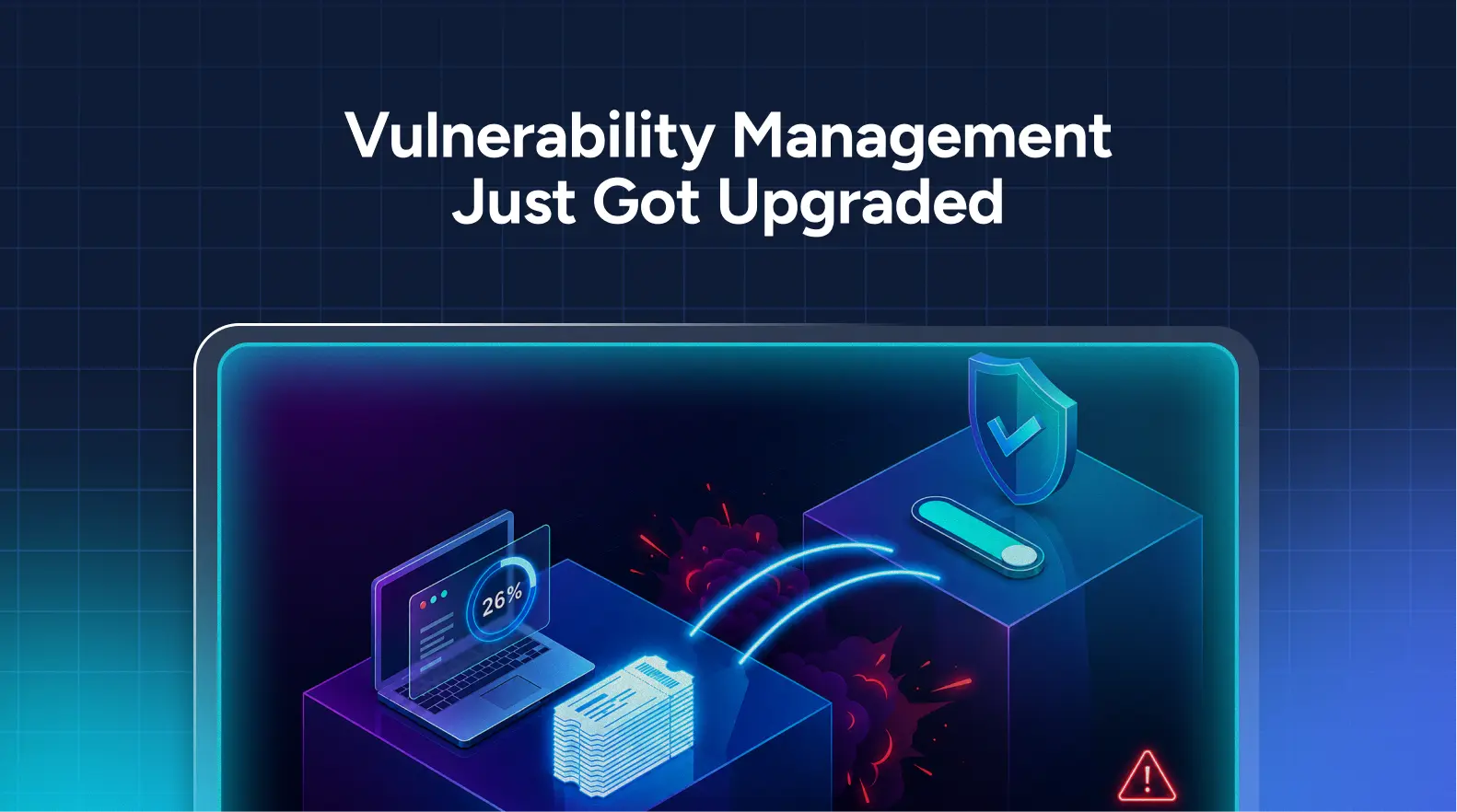
Enterprise vulnerability management has become efficient at producing evidence and unreliable at producing state change. A vulnerability can be discovered, scored, assigned, and reported while the affected endpoint remains exposed. The record reflects intent. The endpoint reflects reality. Remediation fails in the gap between the two.
The industry has automated scanning, analysis, threat intelligence, and prioritization. The work still tends to terminate in a ticket, a handoff, a maintenance window, and a person asked to make a change in another system.
We built Remedio Fortify around a different premise:
The useful unit of vulnerability management is not the finding. It is the verified state transition from exposed to remediated.
With the release of automated patch management in Remedio Fortify, that principle now becomes operational. Fortify can connect a known vulnerability to the affected fleet, carry the necessary context into a controlled remediation action, and verify the resulting endpoint state within the same platform.
This is more than an additional patching capability. It closes one of the most persistent gaps in vulnerability management: the operational distance between knowing that exposure exists and proving that it has been eliminated.
The Handoff Is Where Exposure Becomes Operational Debt
Patching is often treated as a downstream activity. Vulnerability management identifies the issue. IT operations deploys the update. Security checks a report later.
That model creates a seam between knowledge and action. And in that seam, context is lost.
The vulnerability scanner knows the CVE. The deployment system knows the patch package. The endpoint management system knows the device. The change management process knows the approval.
But no individual system knows the complete path from one to the other.
A patch can affect an application dependency. A configuration change can interrupt a business process. Removing software can break an undocumented workflow.
These consequences land on the same operators who are expected to respond quickly to security findings. Hesitation under those conditions is rational. But that rationality doesn't remove the risk.
And that problem extends even to the vulnerabilities organizations prioritize most urgently. Verizon’s 2026 DBIR publication found that 35% of CISA Known Exploited Vulnerability (KEV) instances remained open 28 days after detection. These are vulnerabilities known to be actively exploited in the wild and specifically prioritized for remediation.
If organizations are struggling to keep pace with the vulnerabilities at the very top of the list, the rest of the backlog has little chance. The problem is not simply prioritization. It is remediation capacity.
Bridge the gap from detection to verified state Eliminate Vulnerability Exposure
Get the Guide
When one team discovers the exposure and another team owns the change, the organization depends on manual translation:
- Which devices are affected?
- Which patch applies to this fleet?
- Is the asset still in service?
- What depends on the software?
- Has the patch already been attempted?
- Did the change succeed?
- If the change failed, why?
- If the patch cannot be deployed, what other remediation is available?
Every unanswered question adds delay. Every delay extends the exposure window. Every handoff creates another opportunity for the record to drift away from the environment.
To break those bottlenecks, operators need to be able to maintain 3 key capabilities in parallel:
- Relevance: Identify which vulnerabilities affect the organization’s actual fleet, not just which vulnerabilities are severe in the abstract.
- Capacity: Apply remediation at a volume that human coordination alone cannot absorb.
- Confidence: Assess dependencies before the change, control how it lands, verify the outcome, and provide a reliable rollback path.
Without confidence, teams will not authorize automation at the pace required to reduce exposure. Without capacity, the backlog remains. Without relevance, operators spend their time working from a theoretical list instead of the conditions that exist in their environment.
Machine-Speed Adversaries Change the Equation
Traditional vulnerability management is all about triage. If an organization could only remediate a fraction of its findings, it needed to decide which fraction deserved attention first. Severity scores, exploit intelligence, asset criticality, and attack-path analysis all improved that decision.
Prioritization still matters. But prioritization alone cannot solve a capacity problem.
The operating assumption behind the old model was that attackers were constrained too. An attacker might have known about a vulnerability, but exploiting it still required time, attention, and a sequence of deliberate actions.
That assumption is becoming less reliable.
In July 2026, Hugging Face published a technical reconstruction of an autonomous AI-driven intrusion that covered approximately 17,600 attacker actions across a 4.5-day campaign.
For anyone paying attention, that incident made one thing clear: a long tail of unresolved exposure is no longer merely a backlog to prioritize. It is a collection of opportunities that machine-speed adversaries will actively probe.
Where Vulnerability Management Meets Verified State Management
A scheduled patch is not a closed vulnerability. A ticket marked complete is not proof that the affected endpoint changed. A successful deployment is not necessarily evidence that the original exposure is gone.
The organization can only confirm the intended security outcome after applying the appropriate remediation actions to the targeted endpoints under defined controls and verifying the resulting state.
Even then, closure is only meaningful if the exposure remains eliminated rather than returning through configuration drift or an incomplete rollout.
Security programs need field state monitoring that tracks conditions all the way through its lifecycle. Otherwise, the organization is maintaining two versions of reality: what the security system says should happen and what the environment actually looks like.
To bridge that gap, organizations should ask:
- Can we identify the exact endpoints affected by a vulnerability?
If the answer is only a severity score or a general asset count, the work is not yet fleet-relevant. - Can we move from finding to scheduled action without rebuilding context by hand?
Every manual translation between systems extends the exposure window. - Can we define what closure means before we execute?
Closure should include a verified endpoint state, not merely a completed task. - Can operators understand impact and reverse the action?
Confidence is built through dependency awareness, controlled execution, verification, and rollback. - Can we see when the secure state drifts?
Continuous validation detects when a remediated endpoint returns to an exposed state. Where policy permits, enforcement can reapply the approved corrective action.
Being able to confidently answer those questions is the difference between exposure documentation and exposure elimination.
What Remedio Fortify Changes
The release of automated patch management represents a significant expansion of Remedio Fortify. Security and IT teams can now move from vulnerability intelligence to controlled patch execution without breaking the chain of context between the finding, the affected endpoint, and the resulting state.
For organizations accustomed to managing remediation through tickets, exports, and disconnected deployment systems, that changes the operating model in five important ways.
1. Prioritization starts with the fleet
A severity score describes the vulnerability. It does not tell you how many endpoints in your environment are affected or which devices should be addressed first.
Fortify surfaces the patches that apply to the organization’s fleet and shows the affected devices. This shifts the starting point from a global scoreboard to an actionable local condition.
2. The vulnerability-to-fix path stays connected
Fortify takes operators from a specific vulnerability to the devices carrying it and then to a scheduled remediation action without requiring an export to another system.
The result flows back into the vulnerability record.
That means the record can reflect what happened rather than what someone intended to happen. A remediation action can be tracked through execution, completion, and verification. Stalled cycles can be surfaced while they are still correctable.
The vulnerability record therefore becomes evidence of execution and verification, not merely evidence that work was assigned
3. Reversibility turns remediation into an authorized action
The concern about patches that break production is legitimate. A security program that ignores business dependencies will eventually lose the trust required to operate at speed.
Fortify is designed around controlled change:
- Assess dependencies before execution.
- Apply the selected remediation under defined controls.
- Verify the resulting state.
- Revert the action when conditions require it.
Rollback gives operators a way back when an exception appears, a dependency was missed, or a business condition changes.
4. Patching is only one path to remediation
A patch tool has one primary answer: deploy a patch.
A remediation platform can select among multiple ways to retire an exposure. Depending on the condition, the right action may be to:
- Apply a patch.
- Reconfigure the endpoint.
- Uninstall software that should not be present.
- Apply a compensating control.
- Revert a change that creates an operational conflict.
Fortify adds patching to a broader remediation decision. It does not reduce every security problem to a patch queue.
5. Progress becomes operationally visible
Fortify provides remediation progress, rolling backlog trends, and overdue detection. Those signals help operators identify cycles that are slowing down before the delay becomes an audit finding or a persistent exposure.
The metric that matters is not how many tasks entered the system. It is how many exposures moved to a verified, sustained state.
Fortify closes the loop between a vulnerability and a verified patch action in one platform. It provides the context and safety controls needed for operators to act with greater confidence. The human trigger remains in place today.
Stop Managing Exposure. Start Eliminating It.
Imagine this. You sit at your desk with your morning coffee and log in to the Remedio portal. There you see an alert telling you that you're vulnerable to CVE-2022-37967 across 380 endpoints. The system also informs you that patching would impair required application functionality on 22 of those assets.
A dialogue box lets you schedule (and auto-reapply) patching for the remaining 358 devices deemed operationally safe to remediate. After you click to apply, the system verifies the post-change state and allows you to roll back the change should anything change.
Just like that, you've eliminated 94% of your CVE-2022-37967 exposure; in just one minute and without any operational disruption.
For the remaining 22 devices, Remedio pinpoints the downstream dependencies so you can follow up with speed and precision. If those dependencies can't be disentangled, Remedio let's you put those devices in their own security group, simplifying the application and management of any needed air-gapping or compensatory controls.
That is the foundation for machine-speed security, with policy-bound automations operating within boundaries defined by the organization, with dependency awareness, validation, continuous enforcement, and rollback.
Remedio Fortify gives security and IT operators a closed-loop path from vulnerability to affected device to scheduled remediation and verified outcome. It is the first step toward a model where remediation capacity can scale without abandoning business-aware control.
Vulnerability management creates security value only when it converts known exposure into a verified and sustained endpoint state.

FAQ
What is automated vulnerability remediation?
Automated vulnerability remediation is the controlled use of software to identify affected assets, select and apply an appropriate corrective action, verify the resulting state, and report whether the exposure was actually closed. The strongest implementations include dependency awareness, operator control, rollback, and continuous validation.
How is Remedio Fortify different from a patch tool?
A patch tool primarily deploys patches. Remedio Fortify treats patching as one remediation method within a broader decision process. Depending on the exposure and operating context, remediation may involve patching, reconfiguration, or software removal.
Is Remedio Fortify fully autonomous?
Not yet. The current capability provides closed-loop patch management while retaining an operator-triggered action. It establishes the safety controls and verified workflow required for the next stage of machine-speed remediation.
Why is rollback important for vulnerability remediation?
Rollback gives operators a controlled way to reverse a remediation action if it creates an unexpected operational conflict or if business conditions change. That reversibility increases confidence and makes faster remediation more acceptable in production environments.
What should organizations measure beyond vulnerability counts?
Organizations should measure exposure eliminated, time to verified remediation, affected-device coverage, remediation backlog trends, overdue cycles, recurrence caused by configuration drift, and the operational impact of security changes. Activity metrics matter, but sustained posture integrity is the stronger measure of security value.
About Author