Gartner’s How to Achieve the Minimum Viable AI Governance


Blog
Security Tool Sprawl: Why Bigger Security Stacks Increase Exposure

Autonomous Remediation
Exposure Management & CTEM
For years, enterprise security strategy followed a familiar logic: if one control is good, more controls must be better.
More EDR. More cloud tooling. More scanners. More posture dashboards. More identity analytics. More compliance checks. More AI governance overlays.
And yet exposure keeps growing.
Security teams can identify more exposures than ever before, but exposure isn't reduced when a finding appears in a dashboard. It's reduced when the underlying condition is fixed and stays fixed.
As security stacks grow and AI accelerates the speed of attack, the gap between detection and remediation is becoming one of the biggest sources of enterprise risk. Organizations that can continuously validate, remediate, and enforce controls will outperform those that simply add more tools.
The fact is most environments are still built around a model that assumes humans can keep up with machine-scale complexity. They can’t. Not anymore.
According to Gartner, 61% of security leaders experienced a breach in the last 12 months due to failed or misconfigured controls. The issue isn't a lack of security investments. It's a lack of confidence that those controls operate effectively in production.
That statistic highlights a problem many security teams are confronting today: exposure is growing faster than organizations can manage it.
Security programs have become exceptionally good at finding risk. They're far less effective at eliminating it.
The Control Effectiveness Gap
Most modern security stacks are built to answer one question: What's wrong?
They identify vulnerable systems, misconfigured controls, risky identities, exposed cloud resources, unauthorized applications, and policy violations.
That visibility is valuable. But visibility alone doesn't reduce risk. A dashboard doesn't close an exposure. A finding doesn't harden a system. A ticket doesn't change a configuration.
Exposure only decreases when the underlying state changes. A risky setting is corrected. Excessive privileges are removed. A vulnerable application is eliminated. A misconfigured control is restored to its intended state.
That distinction matters because many organizations have invested heavily in identifying problems while still relying on manual processes to resolve them. The result is a growing gap between control presence and control effectiveness.
As environments expand, that gap becomes harder to manage. Consider a common example.
A security platform identifies hundreds of privileged accounts that haven’t been used in months. The visibility is there but so is the risk. At least until those privileges are removed or validated.
Discovery describes the exposure. Remediation reduces it.
Every new tool introduces additional policies, configurations, dependencies, and operational assumptions. Every new cloud service, SaaS application, AI tool, or endpoint increases the number of settings that must remain correctly configured over time.

The security challenge is no longer deploying controls. It's ensuring those controls continue to work as intended. Without that last mile, most programs are just producing a more detailed map of unresolved exposure.
Stack Sprawl Complicates Exposure Management Efforts
Tool sprawl is often discussed as a cost problem or an analyst fatigue problem. It's actually an exposure problem. Each additional control introduces:
- Another configuration surface
- Another source of drift
- Another policy framework
- Another dependency chain
- Another set of remediation tasks
For example, a cloud workload might be monitored by a CSPM platform, protected by endpoint controls, governed by identity policies, and assessed by a vulnerability scanner.
Each tool may surface a different finding, but resolving the issue often requires coordinated action across multiple teams and systems. The paradox is that organizations often add tools to reduce risk while simultaneously increasing the operational complexity required to maintain them.
Cisco's Cybersecurity Readiness Index found that 77% of organizations believe excessive cybersecurity tooling slows their ability to detect, respond, and recover from incidents.
Security teams aren't struggling because they lack information. They're struggling because turning information into action requires coordination across multiple teams, systems, and business stakeholders.
If you can't translate findings into safe, validated, continuous remediation, then each new tool adds not just insight, but additional backlog potential. That is why exposure can grow in direct proportion to tooling growth. The more complex the environment becomes, the larger the execution burden grows.
It's the Fixing Not the Finding that's Jamming Teams Up
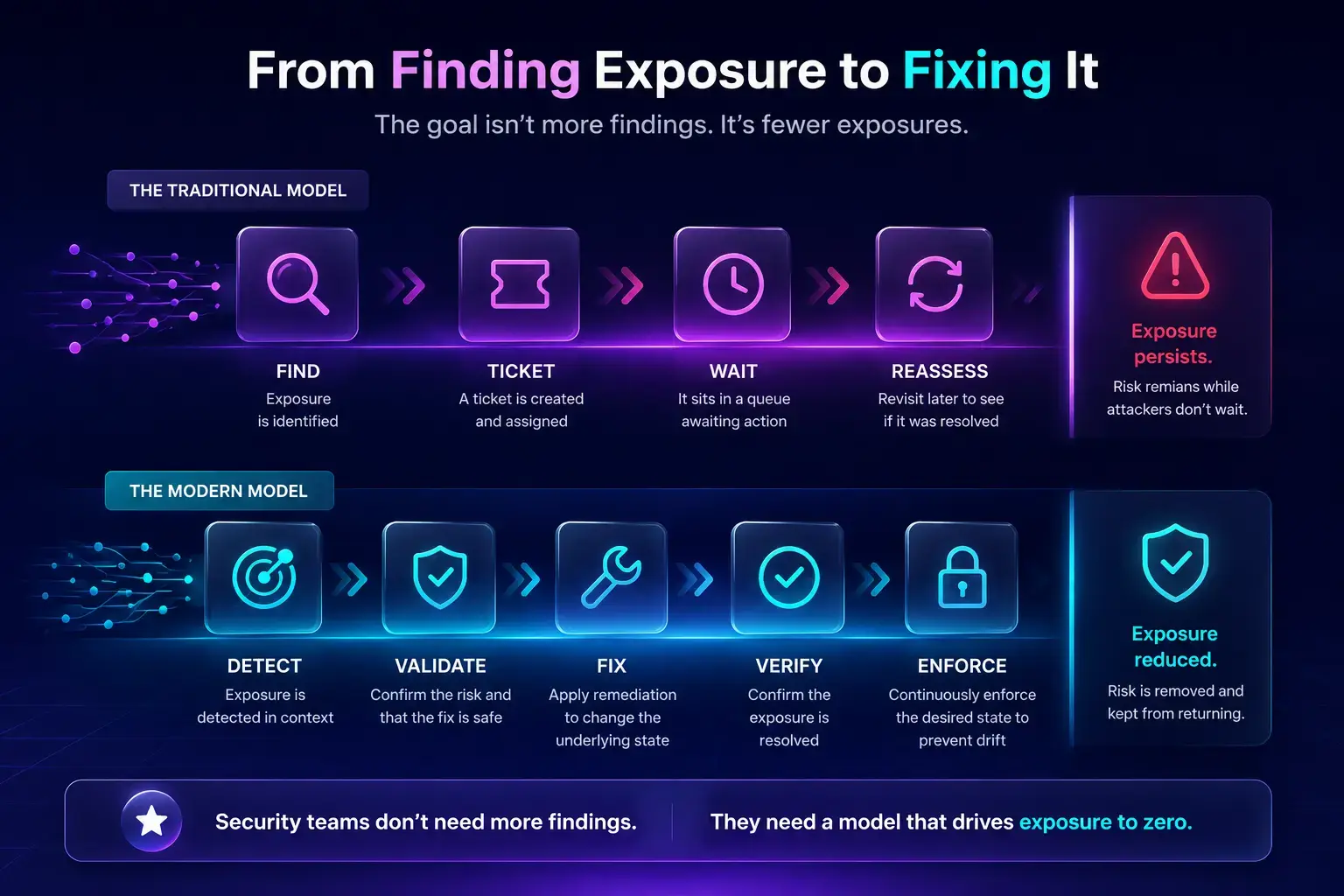
For years, exposure management has largely followed a find-first model:
Find → Ticket → Wait → Reassess
A risk is identified. A finding is generated. Work is routed to another team. Remediation enters a queue. Security waits for confirmation and reassesses later.
That model was already under pressure before AI adoption accelerated. Now the window between exposure discovery and potential exploitation is shrinking.
According to Accenture, 90% of organizations lack the maturity needed to defend against modern AI-driven threats, while only 36% of technology leaders even acknowledge that generative AI is outpacing their security capabilities.
That disconnect is dangerous.
It means many organizations are absorbing AI risk faster than they are building AI-secure operating models. It also means defenders are trying to manage a machine-speed threat landscape with workflows that still rely on human queue management, manual validation, and cross-team follow-up.
Not good.
And the pressure isn’t coming from one domain. It’s coming from all of them at once. Enterprises are introducing AI copilots, browser assistants, autonomous agents, and embedded model capabilities into environments that are already difficult to govern.
Cisco's Cybersecurity Readiness Index found that 86% of organizations reported an AI-related security incident during the previous year.
The implication is clear. Organizations are increasing operational complexity together with the attack surface while continuing to rely on remediation processes designed for a slower era.
A more effective approach is a fix-first model:
Detect → Validate → Fix → Verify → Enforce
- Detect exposure in context.
- Validate that corrective action is safe and appropriate.
- Fix the underlying condition.
- Verify that the exposure has actually been removed.
- Enforce the desired state so drift doesn't reopen the gap.
The difference is subtle but important. The goal is no longer to document exposure more efficiently. The goal is to eliminate exposure more consistently.
Security teams understand that changes made in production carry risk. Disable the wrong protocol and business services can fail. Restrict the wrong policy and users lose access. Remove the wrong application and operations are disrupted.
Imagine discovering that PowerShell logging is disabled across thousands of endpoints. The exposure may be obvious, but enabling it isn't always a simple switch. Teams must assess performance impact, compatibility concerns, operational dependencies, and rollback options before making a change at scale.
Optimal security configuration is not set-and-forget, and best practices alone often fail because they don’t account for business context, system dependencies, or operational tolerances.
As a result, many findings remain open not because organizations don't care about remediation, but because remediation itself introduces uncertainty.
Anything less than certainty will lead to action deferred; because the downside of getting it wrong feels immediate while the downside of exposure still feels probabilistic. Which is exactly why so many findings remain open.
Metrics to Help Move the Needle
If you’re serious about reducing exposure, some of the traditional metrics stop being enough. Counting findings, dashboards, or coverage maps won’t tell you whether posture is actually improving.
A better question is:
How long does known exposure remain exploitable in your environment?
From there, better outcome-driven measures start to emerge:
- Mean time to detection and mean time to repair
- Percentage of endpoints with fully optimized protective configurations
- True positive rate in threat detections
This aligns with Gartner’s broader push toward outcome-driven metrics and control optimization, rather than simply validating whether a product exists in the stack.
The bottom line is simple: Measure exposure removal, not exposure description.
What A Modern Defensive Model Needs
If machine-powered attackers are the reality, then machine-assisted defense can’t stop at analytics. It has to extend into execution. That means the modern security operating model needs:
1. Unified visibility across domains
Not just endpoints. Not just cloud. Not just identity. Exposure builds across the seams.
2. Context-aware prioritization
Static severity is not enough. Operators need to understand business impact, dependency chains, exploitability, and feasibility of action.
3. Safe remediation
Not blind changes. Not policy push for its own sake. Safe remediation with pre-checks, rollout controls, and rollback.
4. Continuous enforcement
If drift reopens the gap next week, then you didn’t really close it.
5. AI-aware device & application governance
AI exposure increasingly shows up where operators work, not just in sanctioned model infrastructure.
This is where security needs to move: from observation to control, from visibility to state change, from periodic review to continuous enforcement.
This is exactly the gap Remedio is built to close. Not by asking you to rip out the rest of your stack. And not by pretending that one platform replaces every category you already rely on.
Remedio acts as the execution layer across the environment – bringing together continuous visibility, context-aware prioritization, and safe remediation so exposure doesn’t sit in a queue waiting for someone to get to it.
That matters because the security problem in front of most teams is no longer just “Can we find it?” It’s:
- Can we validate what matters?
- Can we act without breaking the business?
- Can we close the loop quickly enough?
- Can we keep the gap from reopening?
That is the real test. And it's exactly where manual models fall short.
The Future Demands Machine Speed
The industry is moving past its detect and pat yourself on the back era. You can see it in Gartner’s emphasis on control effectiveness. You can see it in rising concern over stack complexity. You can see it in cloud security research showing fragmented visibility and response. And you can certainly see it in AI security, where adoption is outrunning governance almost everywhere.
The old assumption was that adding more controls would eventually produce more safety. The new reality is harsher than that.
If your controls still depend on slow, manual, fragmented follow-through, then every new layer in your stack can expand your exposure right along with it.
That doesn’t mean you need fewer controls at any cost. It means you need a way to make the controls you already have actually enforceable. Because machine-powered attackers aren’t waiting for your ticket queue. And your defense model can’t either.


FAQ
Does adding more security tools always improve security?
Not necessarily. Additional security tools can improve visibility into different types of risk, but they also introduce more configurations, policies, integrations, and operational dependencies. If an organization cannot efficiently validate and remediate the findings those tools generate, more visibility simply creates a larger backlog. Security improves when controls operate effectively and exposures are consistently eliminated, not simply because more products have been deployed.
How does security tool sprawl increase operational risk?
Every new security product adds another management layer, another configuration surface, and another potential source of drift. Teams must maintain integrations, reconcile conflicting findings, and coordinate remediation across multiple platforms. As operational complexity grows, issues take longer to resolve and configuration mistakes become more likely, increasing rather than reducing overall cyber exposure.
Why does tool fragmentation slow remediation?
Different security tools often identify different parts of the same problem. A single exposure may involve endpoint, identity, cloud, and vulnerability teams working from separate consoles with different priorities. Before corrective action can begin, organizations frequently spend more time coordinating ownership than fixing the underlying issue. The more fragmented the workflow, the longer known risks remain exploitable.
What is security stack complexity?
Security stack complexity is the operational burden created by managing numerous security technologies, integrations, policies, and workflows simultaneously. Complexity is determined less by the number of products than by the effort required to keep them aligned, validate findings, coordinate remediation, and maintain secure configurations over time.
How can organizations simplify their security architecture?
Simplification does not necessarily mean removing tools. It means reducing unnecessary overlap, consolidating operational workflows, and introducing common execution layers that connect detection with safe remediation. Organizations benefit most when security products share context, automate routine corrective actions, and continuously enforce desired security states instead of relying on manual coordination.
Why is integration becoming more important than individual product capability?
Most enterprises already have strong security products in place. The challenge is ensuring those products work together to reduce exposure. A best-of-breed tool that operates in isolation often delivers less value than a well-integrated platform that enables coordinated validation, remediation, and continuous enforcement across the existing security stack.
Can AI make security stack complexity worse?
Yes. AI introduces entirely new technologies to govern, including copilots, autonomous agents, browser extensions, local models, APIs, and AI-enabled SaaS applications. If organizations respond by adding disconnected AI security tools without integrating them into existing operational workflows, they increase both management overhead and remediation complexity. AI should accelerate security operations, not create another isolated management silo.
What signs indicate an organization has too many security tools?
Common indicators include multiple products reporting the same issue, remediation requiring coordination across several teams, growing backlogs of unresolved findings, inconsistent security policies between platforms, and difficulty determining which tool owns a particular risk. If adding another product increases operational effort more than it improves risk reduction, stack complexity has likely exceeded its value.
About Author