Gartner’s How to Achieve the Minimum Viable AI Governance


Two ArangoDB Bugs, One Root Cause

Risk Management
Zero-days
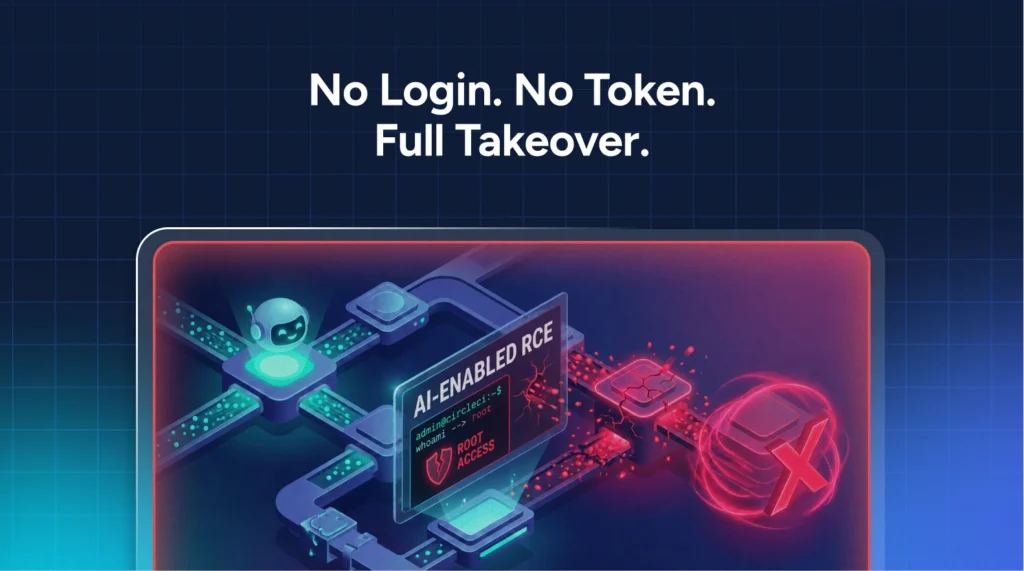
Picture this: No password needed. There's no API token. Nothing. With one well-placed request, an attacker achieves an unauthenticated RCE in your CI/CD pipeline, taking full control of your build secrets and cloud identities.
That's not an imaginary scenario. It's a real security bug we found in CircleCI's MCP server. Critically severe, fully unauthenticated remote code execution. It's a worst-case scenario and it's all too real.
Expected CVSS3.1 designation: 10.0, Critical (AV:N/AC:L/PR:N/UI:N/S:C/C:H/I:H/A:H)
CVE has been requested and is pending assignment.
How It Works
The CircleCI MCP server can run as a shared, network-reachable service, allowing a whole team - or their AI agents - to access one instance. In this mode, the server carries the organization's API token to complete its tasks. To keep things safe and block sketchy browser-based attacks, a check is run on the request's Host and Origin headers.
- Automatic validation before and after changes
- Instant revert if something goes wrong
- Full transparency into every action
export function isOriginAllowed(origin: string | undefined, allowed: Set<string>): boolean {
  // Non-browser clients (mcp-remote, curl) send no Origin – allow them.
  if (!origin?.trim()) return true;
  return allowed.has(origin.trim().toLowerCase());
}
export function isHostAllowed(host: string | undefined, allowed: Set<string>): boolean {
  return !!host?.trim() && allowed.has(host.trim().toLowerCase());
}
What the Attack Looks Like
The AI Arms Race
AI accelerates reconnaissance, exploit chaining, and lateral movement beyond human speed. Detection-first models cannot keep up.

Figure 1. A non-client request is rewritten to localhost and succeeds — see the full disclosure timeline.
- Automatic hardening and drift control
- Configurations are enforced continuously, not just audited
- Configurations are enforced continuously, not just audited
- Configurations are enforced continuously, not just audited
- Real-time compliance
- CIS, NIST, ISO, and internal frameworks enforced live
And now, the loop is closing completely with the addition of vulnerability management, patch management, application control, and network scanning.
About the Author
FAQ
How is this different from configuration monitoring?
Remedio doesn’t just detect drift—it safely fixes it under policy with rollback.
Can I control what gets auto-remediated?
Yes. Policies decide which findings are fixed automatically and which wait for approval.
Will this disrupt production systems?
Every change is validated before and after it runs, and reverts instantly if something goes wrong.
How does Remedio deploy?
A lightweight agent plus a cloud console; most teams are running within a day.
Is there an audit trail?
Every action is logged with who approved it, what changed and when.
Can we start in monitor-only mode?
Yes. Start by observing, then turn on remediation policy by policy.