
Gartner’s Top Strategic Technology Trends for 2027


Continuous Configuration Drift Management
Stop Configuration Drift. Keep Security Enforced.
Remedio autonomously detects configuration drift, assesses operational impact, and safely restores secure baselines across endpoints, servers, and hybrid environments.
Detect unauthorized changes and policy deviationsAutomatically restore secure configurations with built-in safeguardsPrevent recurring drift through continuous validation and enforcement
A Defined Baseline Is Not an Enforced Baseline
Software updates, troubleshooting, and conflicting policies continuously introduce configuration drift that put systems at risk. Detecting those deviations is straightforward. Correcting them without disrupting applications or critical services is harder.
Remedio keeps your secure baselines intact with…

Continuous Drift Detection
Identify deviations from approved configurations as environments change.

Business-Safe Remediation
Restore secure settings with dependency awareness and rollback.

Lasting Policy Enforcement
Verify corrected states and prevent recurring configuration drift.
Every Endpoint. Every OS.
Manage configuration posture across Windows, macOS, and Linux endpoints and servers, including legacy systems and specialized workstations.

Consistent Security Across Environments
Extend configuration visibility and control across on-premises, cloud, and hybrid infrastructure, with supported agentless assessment for network and operational technology environments.
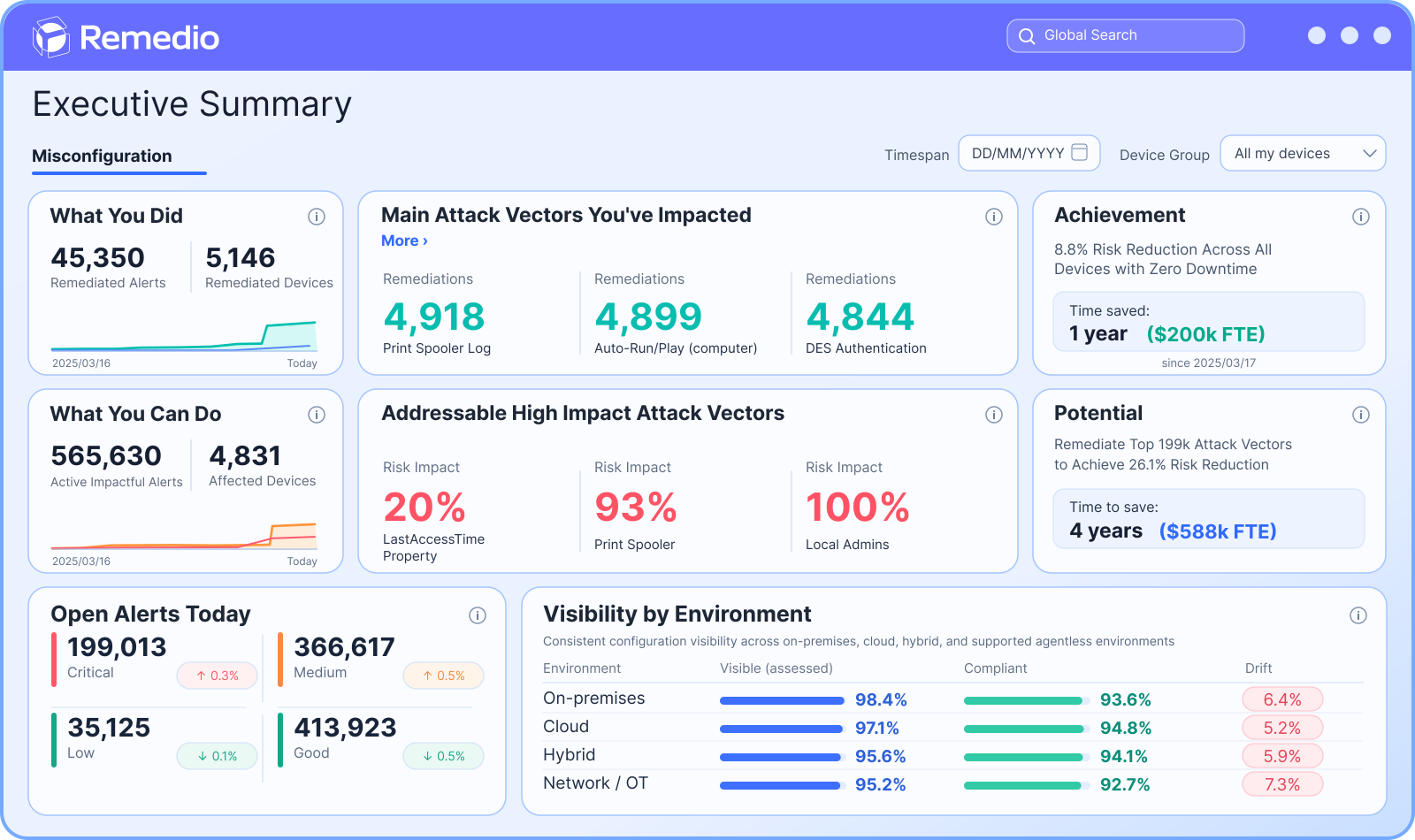
Continuous Configuration Control. Built for Production.
Remedio combines continuous assessment, dependency-aware remediation, and autonomous enforcement to safely restore approved configurations and prevent recurring drift.

Know When Configurations Drift
Continuously detect insecure settings, unauthorized changes, and deviations from approved baselines.

Preview the Blast Radius
Assess dependencies to identify safe corrections and flag potential disruption to applications, services, and workflows.

Restore Security Sans Disruption
Automatically correct drift with policy-based safeguards, staged rollout, and rollback to protect operational stability.

Keep Corrected Settings Correct
Verify remediation outcomes, monitor for recurring drift, and automatically reapply approved controls.
How It Works
The Continuous Configuration Integrity Loop

01. Reveal
Continuously inspect device configurations and compare their effective state with approved baselines. Surface misconfigurations, policy conflicts, and deviations across the managed environment.

02. Reassess
Determine the security significance of each deviation and assess the potential operational consequences of correction. Distinguish straightforward hardening opportunities from changes requiring additional validation or coordination.

03. Remediate
Apply policy-controlled corrections to restore secure configurations. Use automated remediation for suitable changes and staged execution or human approval where operational dependencies require greater caution.

04. Verify
Validate that the intended setting has been applied and that the device has returned to its approved security state. Retain evidence of the remediation and its outcome.

05. Revert/Reapply
Roll back changes when necessary to protect operations. Continue monitoring the corrected configuration and reapply approved controls when subsequent changes reintroduce drift.
Continuous
Detection of configuration drift
Safe
Automated correction with rollback
Persistent
Enforcement of approved baselines
What Security Leaders Say


Remedio gives us the ability to fix problems in our environments without impacting our operations; it’s a real game-changer.


Remedio has helped me deploy a Technical Security Baseline to all my endpoint devices globally.


Remedio gives our team incredibly detailed visibility into our global computing environment.


Remedio helps me close security gaps – including those I didn’t know I had.
Frequently Asked Questions About Configuration Drift Management
What is configuration drift?
Configuration drift occurs when the effective settings of a device, system, or service diverge from an approved baseline. It can result from software updates, administrative changes, conflicting policies, troubleshooting, temporary exceptions, or other routine operational activity.
How does Remedio detect configuration drift?
Remedio continuously assesses supported device configurations against approved security baselines and organizational policies. It identifies settings that no longer match the required state, including insecure configurations and policy deviations introduced after initial deployment.
How is drift remediation different from configuration monitoring?
Configuration monitoring identifies deviations. Drift remediation corrects them. Remedio combines continuous detection with policy-controlled remediation, validation, and rollback so organizations can restore and maintain secure configurations rather than simply generating additional findings.
Can Remedio automatically correct configuration drift?
Yes. Remedio supports automated and guided remediation, with policies governing which changes can be applied and where additional oversight is required. Dependency awareness, controlled execution, and rollback help teams manage operational risk.
How does Remedio prevent configuration drift from recurring?
Remedio continues inspecting device state after remediation. When a previously corrected setting deviates again, the platform can identify the recurrence and reapply the approved configuration according to the organization’s enforcement policies.
How does Remedio work with Group Policy and Microsoft Intune?
Remedio complements existing configuration-management infrastructure by validating the effective security state of managed devices. This helps teams identify settings that were not successfully applied, have been overridden, or no longer align with approved policy.
Can configuration drift remediation disrupt business applications?
Configuration changes can affect dependent applications and services. Remedio reduces this risk through dependency assessment, pre-execution validation, controlled rollout, and rollback. Changes with uncertain operational consequences should receive additional testing or approval before wider enforcement.
Does Remedio support CIS Benchmarks and DISA STIGs?
Remedio supports configuration assessment and hardening aligned with recognized security baselines, including CIS Benchmarks and DISA STIGs, as well as custom organizational policies. Available controls and remediation actions depend on the applicable platform and configuration.
Can Remedio be deployed without adding operational overhead?
Yes. Remedio uses a lightweight sensor architecture for supported endpoints, with agentless deployment options where appropriate. This enables continuous configuration assessment and remediation with minimal resource consumption and operational disruption.
Does Remedio integrate with existing endpoint and configuration management tools?
Yes. Remedio complements Active Directory, Group Policy, Microsoft Intune, and existing security and IT operations platforms. It validates effective configurations, identifies policy deviations, and streamlines remediation without requiring organizations to replace their existing management infrastructure.