Gartner’s How to Achieve the Minimum Viable AI Governance


Blog
Pushing the Boundaries of Automated Patch Management

Autonomous Remediation
Vulnerabilities
Most enterprise security programs already know how to scan for vulnerabilities. Many have invested in patching tools. Virtually all of them have dashboards, workflows, and maintenance windows. Yet known weaknesses still remain open for weeks, months, and sometimes longer.
Not because teams do not care. And not because they do not understand the risk. Because closing the window between detection and safe remediation remains messy and complex. Implementing automated patch management isn't just about applying fixes faster; it's about building execution confidence across your infrastructure.
A patch can be urgent and still be unsafe to deploy blindly. It may require a restart, conflict with a business application, alter a dependency, or lack a reliable rollback path. Conversely, forcing every low-risk update through manual review creates delay without creating meaningful safety.
The real design problem is therefore not whether to automate patching. It is where to place the automation boundary: which changes can proceed automatically, which require staged evidence, and which must remain under explicit human control.
Not every patch is immediately applicable and making that determination can be quite complex, requiring a good deal of context, including:
- Criticality of affected assets
- Operational dependencies
- Exploitation status
- Environmental compatibility
- Reboot requirements
- Service health monitoring
If it sounds complicated, that's because it is. And that complexity translates directly to delayed intervention and protracted exposure.
Patching Is Too Slow
CISA's Known Exploited Vulnerabilities catalog is specifically intended to help organizations prioritize remediation around vulnerabilities that are actively exploited in the wild, rather than treating all findings equally.
That guidance is a direct result of the fact that most organizations do not suffer from a lack of findings. To the contrary, they suffer from too many findings, too little confidence, and too much friction between prioritization and action.
The queue is long. Asset ownership is inconsistent. Patches exist, but deployment is gated by testing, approvals, bandwidth limitations, maintenance windows, business dependencies, or fear of disruption.
And the exposure gap stays open. The 2025 Edgescan Vulnerability Statistics Report found average remediation times of:
- 74.3 days for high/critical vulnerabilities across the full stack
- 72.11 days for high/critical device and network vulnerabilities
- 109.4 days for vulnerabilities with EPSS > 0.7
Think about that for a moment. Highly exploitable vulnerabilities can still sit open for months in real enterprise environments.
The attack surface is too large, the patch cadence is too frequent, and the human coordination burden is too high.
This results in critical delays at three distinct points of the remediation chain.
- Decision latency – time between detection and selecting an action.
- Deployment latency – time between approval and patch installation.
- Closure latency – time until the vulnerable condition is verified as removed.
These delays accumulate rather than operate independently. A fast deployment mechanism creates little value when action selection remains blocked or validation occurs days later.

That is the difference between automating patch execution and governing patch autonomy.
The Real Bottleneck Is Execution Confidence
The hard part of automated patching is not installation. It is establishing enough confidence to let a specific change run without human intervention on a specific asset.
Teams are not only worried about whether a patch exists, but whether deploying it will break business-critical workflows, create support load, trigger rollback, or destabilize systems they do not fully understand.
If vulnerabilities come back after remediation, then speed alone is not enough. You need persistence. You need enforcement. You need confidence that the environment will hold its intended state rather than drift back into exposure.
To ensure actions taken achieve and maintain the desired effect, context is key. To translate findings into clear, programmatic action directives, you need an understanding of urgency, safety, and effect.
Urgency
- KEV status
- Exploit availability
- Internet exposure
- Business criticality
Change safety
- Patch availability and compatibility
- Known dependencies
- Reboot and maintenance requirements
- Expected disruption
- Rollback reliability
- Observable service health
Outcome assurance
- Post-change validation
- Recurrence detection
- Enforcement mechanism
That provides more of the context we're after. The same context that CISA targets with it’s risk-based KEV guidance. The updated document reframes vulnerability response around risk, not just severity. That means factoring in exploit activity, exposure, impact, and operational context rather than treating all vulnerabilities or all systems equally.
That's the context that's needed to provide actual understanding. With it, you should have everything you need to place every vulnerability into one of four automation-confidence classes.
The devil is in the details of those last two classes - as they define where automation should not be applied. These exceptions must become governed work rather than permanent backlog entries.
Corresponding to those 4 automation-confidence classes, you have 4 related automation classes:
- Assisted – recommend the patch and required controls.
- Approved – execute after human authorization.
- Policy-driven – execute automatically within bounded conditions.
- Adaptive – expand or halt deployment based on observed results.
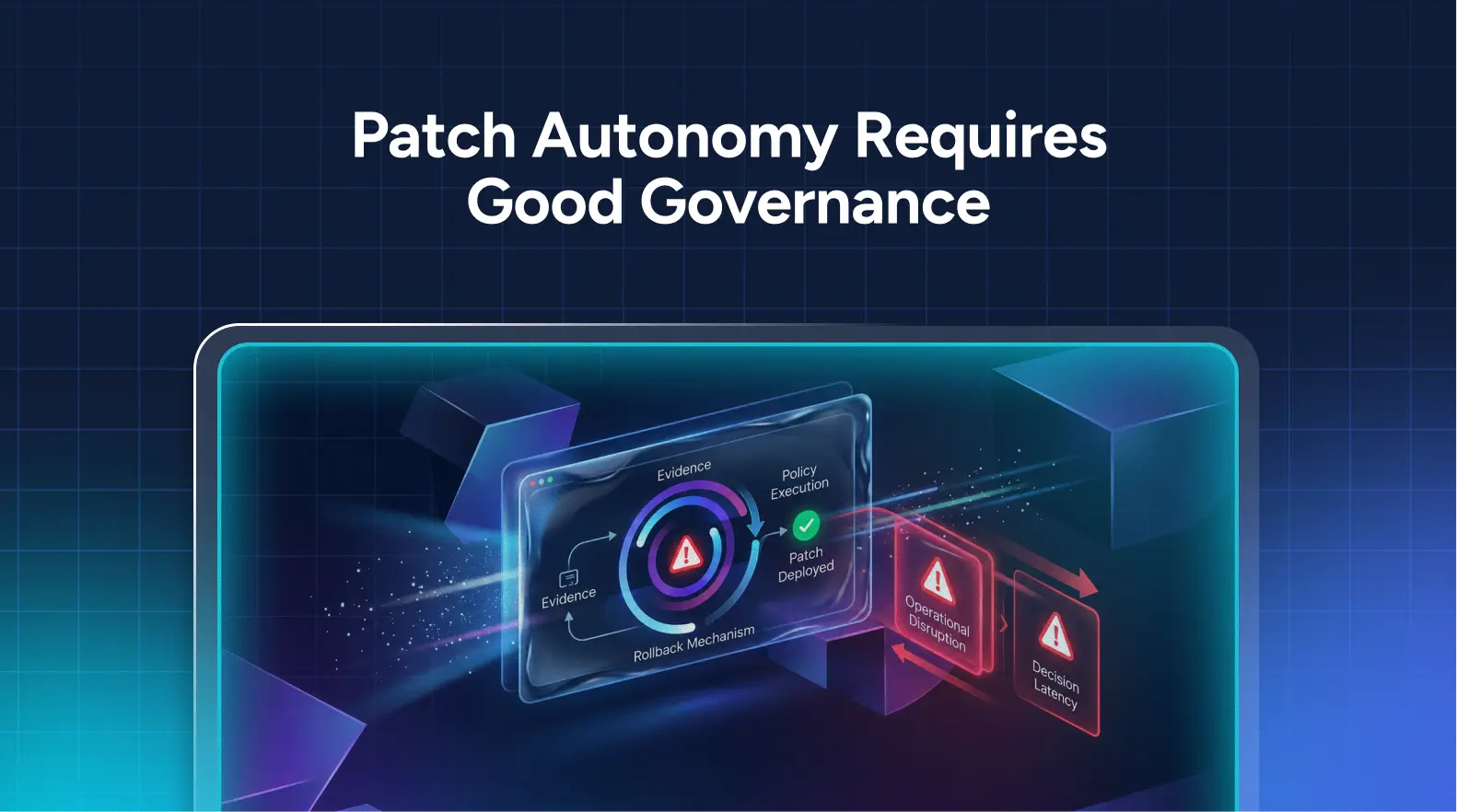
Together, these controls provide the foundation for governed patch autonomy. Autonomy is not a product setting. It is a level of authority earned through deployment evidence.
To operationalize the model, you need only add mechanisms for:
- Target scoping
- Pre-change state capture
- Separation of policy authorship, approval, and execution authority
- Maintenance-window and reboot orchestration
- Canary deployment
- Application or service health checks
- Rollback triggers
- Deployment halt thresholds
- Immutable records of target selection, approvals, actions, validation results, and rollback events.
The Bottom Line
Automated patching should not mean sending every available update directly into production. It should mean removing human delay where the evidence supports safe execution and preserving human judgment where uncertainty remains.
Begin with low-risk, high-volume applications that have known dependencies, observable health signals, and reliable rollback. Use the resulting deployment evidence to expand the policy boundary gradually.
The mature program does not measure success by how many patches ran unattended. It measures how much deployment latency was removed without increasing change failures, rollbacks, or unverified closures.
Patch autonomy should be earned through evidence, bounded by policy, and reversible by design.


FAQ
How should an organization set the initial automation boundary for patching?
Start with changes that combine low operational uncertainty with strong recovery evidence. Good candidates have known dependencies, representative test coverage, observable health signals, predictable reboot behavior, and a rollback path that has been exercised. Asset criticality alone is a poor boundary. A critical but standardized workstation fleet may support more automation than a nominally low-priority server with an unknown owner and undocumented dependencies.
What evidence should be required before a patch moves from approved deployment to policy-driven deployment?
Promotion should depend on accumulated deployment evidence, not a fixed number of successful installations. Useful evidence includes success across representative device cohorts, stable application and service health, absence of material performance regression, acceptable rollback rates, and consistent post-patch verification. Evidence should also decay when the operating system, application version, infrastructure pattern, or dependency graph changes.
How should canary groups be designed for enterprise patch deployment?
A canary group should represent operational diversity, not simply a small percentage of endpoints. It needs coverage across hardware models, operating system builds, application dependencies, network locations, user profiles, and business workflows. A statistically small but representative cohort provides better failure evidence than a larger group composed of nearly identical systems. Mission-critical assets may also need a separate canary path with tighter health checks.
Which signals should automatically halt a patch rollout?
Halt conditions should be defined before deployment and tied to business-relevant failure modes. Examples include service-health degradation, elevated crash or authentication failure rates, loss of endpoint telemetry, abnormal reboot loops, application launch failures, rollback thresholds, or a meaningful rise in support incidents. Missing telemetry should itself trigger a pause because an unobservable deployment cannot produce trustworthy evidence of safety.
How can teams verify that a vulnerability is actually closed after patch installation?
Installation status is weak closure evidence. Verification should confirm the patched version or configuration, retest the vulnerable condition, validate that the affected service loaded the corrected component, and identify systems that missed or reversed the change. Some patches require a reboot, service restart, package cleanup, or configuration adjustment before exposure is removed. Closure therefore belongs to the vulnerability record, not merely the deployment job.
When should compensating controls take priority over applying a patch?
A compensating control is appropriate when the available patch creates unacceptable operational risk, cannot be deployed within the exposure window, or does not fully address the relevant attack path. The control should interrupt a specific exploitation condition through measures such as service isolation, feature disablement, access restriction, configuration hardening, or application-layer filtering. It also needs an owner, validation method, expiration condition, and tracked path back to permanent remediation.
How should emergency patching differ from routine automated patching?
Emergency patching should compress decision time without discarding operational controls. Pre-authorized policies can define eligible asset classes, mandatory canaries, shortened observation periods, reboot authority, rollback triggers, and executive escalation thresholds for actively exploited vulnerabilities. The objective is controlled acceleration. Removing staging, validation, or recovery safeguards may reduce deployment latency while increasing the chance of an enterprise-wide outage.
What metrics show whether patch autonomy is reducing risk safely?
Track the full exposure interval: time to decision, time to deployment, and time to verified closure. Pair those measures with change-failure rate, rollback frequency, failed or unobserved validations, vulnerable-state recurrence, exception age, and the percentage of assets covered by reliable health telemetry. Patch volume is an activity measure. The stronger outcome is less exploitable time without a corresponding increase in operational failure.
About Author