Gartner’s How to Achieve the Minimum Viable AI Governance


Blog
Autonomous Remediation Is Coming Fast. Trust Will Decide Who Wins.

Autonomous Remediation
Exposure Management & CTEM
Risk Management
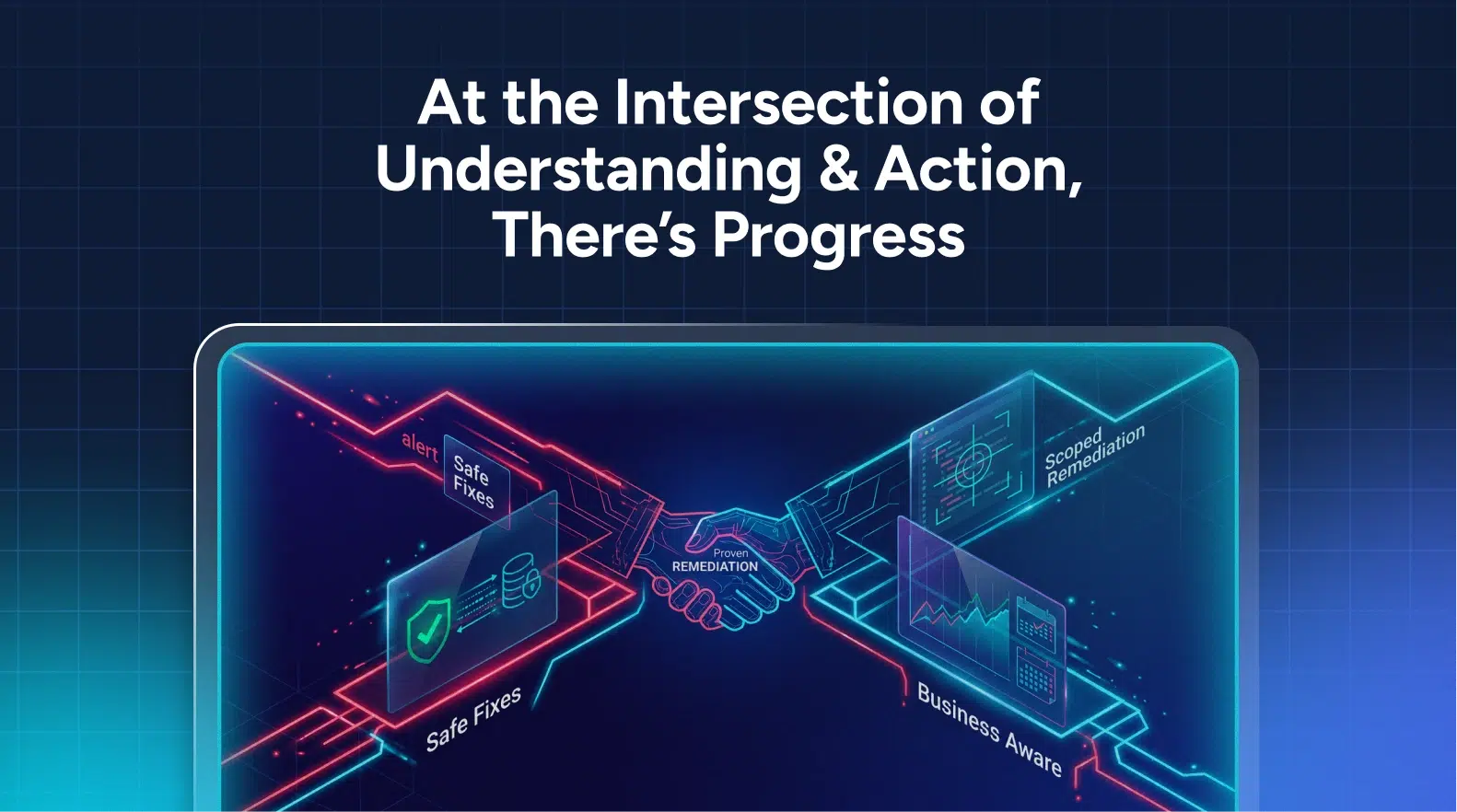
Security teams don’t distrust automation. They distrust unpredictable change. That’s why most "autonomous remediation" initiatives fail before the technology is even evaluated.
At the same time, autonomous remediation is no longer a fringe idea. Remedio is recognized in the 2026 Gartner® Emerging Tech: Autonomous Remediation Is the Next Frontier of Exposure Management report.
Positioning autonomous remediation as the next frontier of exposure management, the report makes a blunt prediction:
“By 2029, 60% of unified exposure management solutions will incorporate domain-specialized automated mitigation, remediation, and threat containment capabilities to neutralize threats before they can manifest.”
The report also states that, “By 2028 AI agents and assistants will remediate 70% of software code vulnerabilities, up from 10% in 2025, by either updating dependencies or suggesting code fixes.”
Those are aggressive numbers. They should get your attention. But they should not tempt you into the wrong conclusion.
Autonomous remediation does NOT mean automating everything. Such an interpretation of the concept not only lacks imagination, but is doomed to fail.
Automation executes predefined workflows. Autonomy decides which workflow should execute.
Rather than blanket automation, this category will be defined by the streamlined implementation of smart changes, pushed to the right assets, at the right times. The best systems will be selected with enough context to predict the impact, constrain the blast radius, and reverse safely if needed.
Autonomous remediation succeeds or fails on operational trust: confidence that every automated action is both correct and safe.
Autonomous Remediation Is A Response to a Backlog Economy
For years, the security industry optimized for detection, prioritization, and reporting.
Findings piled up. Owners multiplied. Ticket queues grew. Security teams got better at explaining exposure, while the actual exposure grew in place.
The data keeps pointing to the same operational truth. In Tamnoon’s 2026 analysis of 14.86 million CNAPP detections across hundreds of enterprise environments, 53% of all detections remained open, with critical alerts staying open for 150 days on average, and vulnerabilities taking an average of 282 days to close.
That is not a scanning problem. That is not a prioritization problem. That is exposure gap in plain sight.
And it’s not unique to CNAPP either. Verizon found that software vulnerabilities now surpass stolen credentials as the top initial access path in breaches. That’s a clear sign that exploitable technical debt is becoming a more direct route into the environment.
And it’s why the next phase of cybersecurity will be driven by platforms that can close the loop between identification and elimination.
Detection is simply not enough. The real challenge has always been the last mile: getting from validated exposure to safe, non-disruptive action in the production environment.
The Operating Model Behind Adoptable Autonomous Remediation
To be clear, security leaders are not asking for autonomous remediation because autonomy sounds impressive. They are asking for a solution to the fact that manual remediations don’t scale against machine-speed exploitation.
But that does not mean the goal is zero-touch change for every exposure.
“Every fix has a cost, risk and complexity associated with it. Autonomous exposure remediation does not mean autofixing everything. Successfully executed autonomous remediation is where AI has enough context to assess these factors to suggest the best remediation or mitigation path to address the exposure.“
Putting that vision to practice requires at least four things:
- Validation that the exposure is real and relevant
- Environmental context to understand dependencies and business impact
- A governed execution path with human oversight as needed
- Continuous verification that the remediation actually held
If one of those pieces is missing, what you have is not autonomous remediation, but accelerated uncertainty.
For real, reliable, and safe autonomous remediation, you need understanding. At the first order, the system needs to understand the asset, the dependency chain, the control stack, and the likely blast radius. At the second order, the system needs to understand the owner model, the available compensatory controls, and the difference between a clean fix and an acceptable mitigation.
As such, the best autonomous remediation platforms will not behave like universal patch cannons. They will behave more like governed execution systems.
They will know when to:
- Remediate directly
- Mitigate through an adjacent control
- Propose a change but hold for approval
- Stage a change gradually
- Validate in advance
- Roll back to a prior state
- Catch and correct any consequential drift
That last point matters more than many teams realize.
A large share of enterprise exposure does not come from a dramatic new exploit. It comes from drift, inconsistency, weak defaults, broken policy enforcement, and controls that were technically deployed but operationally ineffective.

In a recent piece of Ponemon research, 51% of respondents cited cloud misconfigurations as a key source of organizational vulnerability.
You do not solve that class of problem with better tickets.
You solve it with continuous visibility, continuous enforcement, and safe remediation that can hold posture in place over time.
What Trustworthy Autonomous Remediation Looks Like
If autonomous remediation is on your roadmap, the evaluation criteria need to get sharper.
Five Questions Every CISO Should Ask About Autonomous Remediation
Do not start with the demo. Start with the questions that determine whether the platform deserves operational trust.
1. Can it prove exploitability or just repeat scanner output?
Real risk reduction requires a strong foundation in validation, including exploitability and reachability. If a platform cannot separate actionable exposure from generic findings, it will simply automate noise.
That is why Remedio is built around validated, actionable posture issues rather than alert-only workflows. The goal is not to generate another queue. The goal is to identify the exposures that actually warrant action, then move decisively.
2. Can it predict impact before making a change?
The category will stall if operators believe every autonomous action could trigger disruption or even downtime.
This is one of the clearest places where Remedio’s philosophy matters. Safe remediation comes before aggressive remediation. Context-aware dependency mapping, rollback controls, and governed execution are not embellishments. They are the foundation that makes autonomous remediation usable in real environments.
3. Does it support semiautonomous adoption?
The best platforms will let you begin with low-risk issues, preview changes, stage deployment, and gradually widen autonomy as trust is earned. Human-in-the-loop is not a weakness. It is how real enterprises adopt operational automation.
Remedio’s Quick Wins view, for example, helps operators identify immediate action opportunities that can be pushed with no risk of disruption while still delivering meaningful security uplift.
That gives teams a practical place to start: low-friction, high-confidence remediations that build trust early. From there, once a remediation policy has been reviewed and approved by a human gatekeeper, the platform can continue enforcing it automatically over time; through manual changes, third-party updates, and changing group memberships.
4. Can it validate closure and sustain the result?
A completed task is not the same thing as reduced exposure. The system should confirm that the remediation worked and keep monitoring for recurrence. If the issue comes back next week, the risk was not removed. It was postponed.
This is another reason endpoint and configuration security deserve a larger role in the market’s understanding of autonomous remediation. Much of the current conversation is centered on code and cloud. Those matter.
But enterprise attack surfaces are still full of drifted endpoint settings, incomplete hardening, weak controls, local policy inconsistencies, inherited misconfigurations, and exploitable operational shortcuts. Those exposures are persistent, high-volume, and deeply tied to real-world business operations.
Remedio’s emphasis on continuous enforcement addresses the recurrence problem directly instead of treating remediation as a one-time event.
5. Does it improve measurable outcomes?
Security teams should be able to show fewer recurring findings, shorter time-to-repair, less operator effort per remediation, better control efficacy, and more stable posture over time.
For it’s part, Remedio helps users achieve 50%+ faster mean time-to-repair, on average, while delivering a 30%+ attack surface reduction, and 25%+ higher labor productivity.
Those are the kinds of metrics that translate autonomous remediation out of theory and into operational and financial terms. The board does not need another activity metric. The board needs evidence that exposure is going down, work is getting done faster, and the business is not paying for that progress through disruption.
That is why autonomous remediation must be grounded in a few non-negotiables:
- Safe remediation before aggressive remediation
- Context-aware dependency mapping before blind change execution
- Continuous enforcement before periodic cleanup
- Measurable outcomes before vanity metrics
- Governed automation before automation for its own sake
A Look Forward
In the near term, autonomous remediation will be sold as innovation. Soon after, it will be expected.
The market is moving beyond the false dichotomy of "control" vs. "autonomy." Security teams are perfectly willing to adopt automation when the operating model respects reality. That means:
- Validating what matters
- Selecting the least disruptive path
- Executing the change
- Verifying the result
- Continuously re-enforcing the secure state
That model is practical. And more importantly, it is adoptable.
Everyone knows remediation has to get faster. They also know that pushing updates blindly is not a security strategy.
The autonomous remediation platforms that shape this market will be the ones that let operators move decisively without asking them to suspend judgment.
That is the real promise of the category. Not hands-free security. But trusted, business-aware systems that reduce exposure at machine speed while preserving operational integrity.
The winners won’t be the platforms that automate the most.
They’ll be the ones enterprises trust enough to let operate at machine speed.
________
Source: Gartner Research, Emerging Tech: Autonomous Remediation Is the Next Frontier of Exposure Management. By Elizabeth Kim, Charanpal Bhogal.
GARTNER is a trademark of Gartner, Inc. and/or its affiliates. Gartner does not endorse any vendor, product or service depicted in its research publications, and does not advise technology users to select only those vendors with the highest ratings or other designation. Gartner research publications consist of the opinions of Gartner’s research organization and should not be construed as statements of fact. Gartner disclaims all warranties, expressed or implied, with respect to this research, including any warranties of merchantability or fitness for a particular purpose.


FAQ
What is autonomous remediation in cybersecurity?
Autonomous remediation is the ability for a security platform to determine, execute, validate, and sustain the safest corrective action with minimal human intervention. Unlike traditional automation, it makes context aware decisions based on risk, dependencies, business impact, and operational safety rather than simply running predefined workflows.
How is autonomous remediation different from security automation?
Security automation executes predefined tasks when specific conditions are met. Autonomous remediation evaluates multiple remediation options, predicts operational impact, selects the most appropriate action, and verifies that the exposure remains resolved over time. It is a decision making capability rather than simply workflow execution.
Why is trust the biggest barrier to autonomous remediation?
Security teams rarely object to automation itself. They object to unpredictable change. Organizations will only adopt autonomous remediation when they trust that every action has been validated, considers business dependencies, can be rolled back safely, and produces measurable reductions in exposure without causing operational disruption.
What capabilities should an enterprise autonomous remediation platform provide?
A mature platform should validate that an exposure is actionable, understand environmental dependencies, predict the impact of proposed changes, support staged or semi autonomous deployment, provide rollback capabilities, continuously verify successful remediation, and automatically correct future configuration drift.
Can autonomous remediation work without human approval?
Not always. Effective autonomous remediation supports multiple operating models. Low risk, high confidence changes may be executed automatically, while higher risk actions can be proposed for approval, staged gradually, or mitigated through alternative controls. The goal is governed autonomy rather than removing human oversight entirely.
Why is continuous verification important after remediation?
Completing a remediation task does not guarantee that risk has been eliminated permanently. Configuration drift, policy changes, software updates, and operational changes can recreate the same exposure. Continuous verification confirms that the secure state persists and automatically detects or corrects recurring issues.
What metrics demonstrate successful autonomous remediation?
Organizations should focus on measurable security outcomes rather than activity metrics. Useful indicators include attack surface reduction, recurring finding rates, mean time to repair, remediation success rates, sustained policy compliance, operational impact, and improvements in productivity resulting from reduced manual effort.
Does autonomous remediation replace vulnerability management or EDR?
No. Vulnerability management identifies weaknesses, while EDR detects and investigates active threats. Autonomous remediation complements both by safely eliminating validated exposures, maintaining secure configurations, and reducing the likelihood that attackers can exploit known weaknesses in the first place.
About Author