Gartner’s How to Achieve the Minimum Viable AI Governance


Blog
The Shift to Risk-Aware Operational Trust

Autonomous Remediation
Exposure Management & CTEM
Risk Management
Moving faster only helps when security teams can trust the resulting changes in production. This is where the constraint shifts from remediation capability to confidence in execution; a transition driven by operational trust.
Risk-aware operational trust is the evidence-backed confidence that a specific security change can be executed under defined conditions without creating unacceptable operational risk.
In Risk-Aware Operational Trust Will Drive Adoption for Autonomous Remediation Technologies (Gartner ID: G00825668) 1, Gartner® identifies operational trust as key to overcoming the "fear of self-inflicted downtime." Remedio is mentioned in the report as a provider of the context-aware intelligence and policy-bounded execution needed to establish operational trust.
Of course, autonomous remediation does not exist in isolation. Gartner® outlines the broader security architecture required in its Emerging Tech Impact Radar: Preemptive Cybersecurity (Gartner ID: G00858165) 2 report:
"Preemptive cybersecurity shifts security from solely reactive defense to an offensive posture that acts before attacks occur and denies adversaries opportunities to initiate their objectives."
For years, the standard security operating model has been discovery, triage, ticketing, approval, and scheduled change. It assumes defenders have enough time to investigate an issue, establish ownership, wait for an acceptable change window, apply a fix, and verify the result afterward. It's an assumption that no longer holds.
Visibility still matters. Prioritization still matters. Detection still matters. But there's now a growing realization that those those are only means to an end and not themselves the end goal. That realization puts pressure on operators and their operating models; pressure that they are in turn applying to technology vendors.
Which is why we're now beginning to see a new, more trust-focused operating model emerge. That trust is the currency that keeps things moving, preventing the interdepartmental friction, endless impact analyses, and change reviews that grind progress to a halt.
It provides the confidence required for risk-aware remediation. It tells decision makers which fixes can be safely executed, how, and with what human intervention.
That trust is a direct result of context-aware intelligence and policy-bounded execution. Proposed changes are validated against their dependencies and likely impact before they are made, verified against the intended security state afterward, and backed by a controlled path to reversal if conditions change. The upshot is not simply faster remediation, but a defensible basis for deciding when security can act without sacrificing operational control.
The Exposure Clock Is Getting Shorter
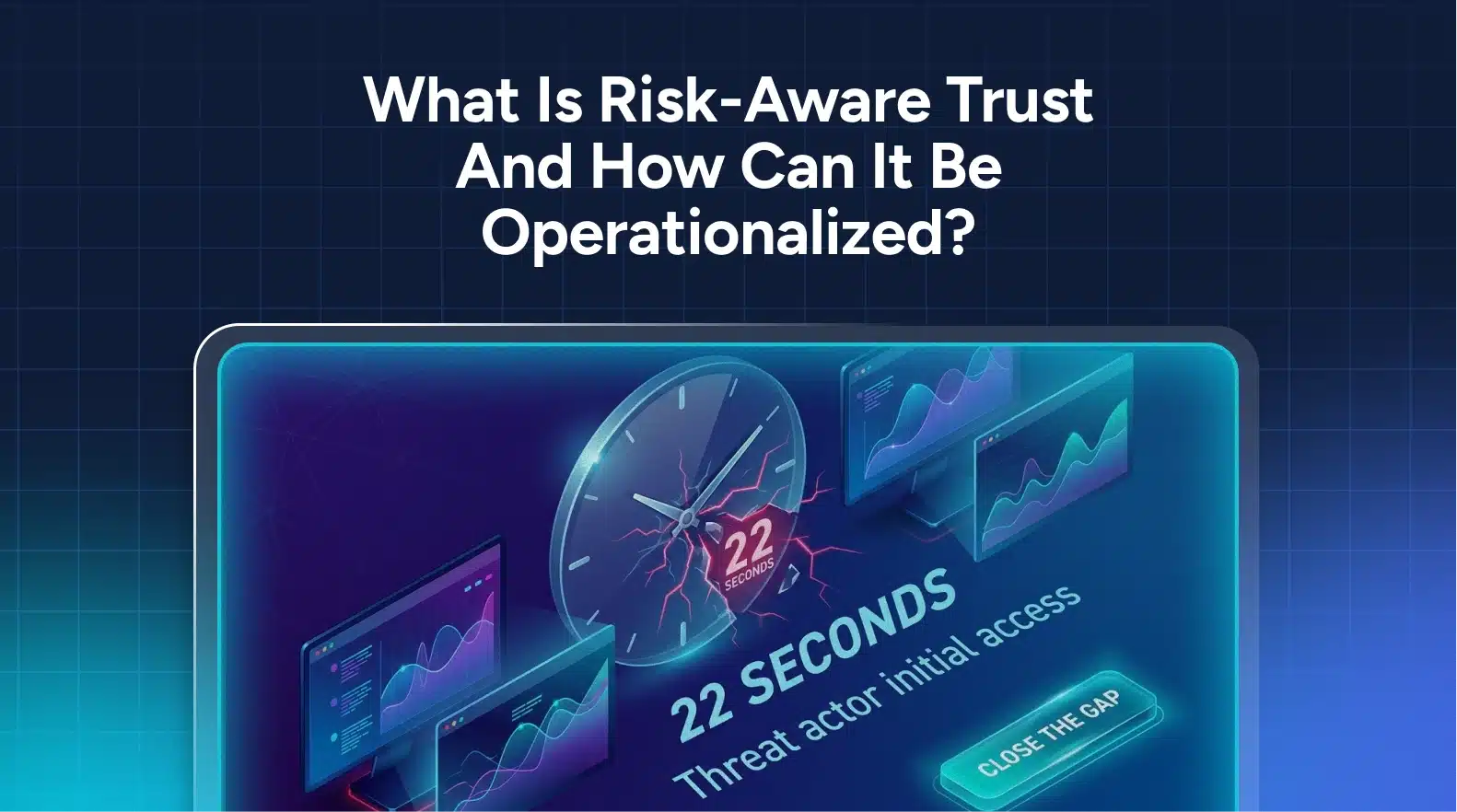
The pressure behind this shift is measurable. Mandiant’s M-Trends 2026 research found that the median time from initial access by one threat actor to handoff to a secondary group fell from more than eight hours in 2022 to just 22 seconds in 2025.
Attackers have historically exploited vulnerabilities faster than defenders close them. Now that asymmetry is accelerating and breaking the operating standards and norms of the security world. Teams can no longer trust that their findings will sit quietly in a queue while the organization builds consensus around it.
At the same time, it would be irresponsible to automatically execute every remediation. Organizations need to know, in advance, which changes can move without manual intervention, which require evidence-based approval, and which still require human judgment. As the exposure window contracts, organizations have less time available for organizational uncertainty.
The operating model must be able to rapidly determine the correct course of action and seamlessly support its implementation.
Preemptive Cybersecurity Changes What "Done" Means
A vulnerability can be identified in seconds and still remain exploitable for weeks. The same is true of a misconfiguration, excessive privilege, or unauthorized application. Detection tells you the condition exists. Risk is reduced only when that condition is corrected or effectively contained.
"To be truly preemptive, automated or autonomous action must actively interdict or disrupt an attack path before exploitation."
But interdiction alone does not define a successful outcome. Autonomous remediation requires deep environmental and runtime intelligence to avoid self-inflicted downtime.
As such, you need the exposure to be neutralized, the intended security state to be verified, and the production changes to not create any unacceptable operational impact.
Consider SMBv1. An alert identifying it as enabled provides information. Disabling it moves toward an outcome. But the remediation is not truly complete until there is evidence that SMBv1 has been safely disabled, dependent applications remain functional, and the insecure configuration cannot silently return.
The same standard applies elsewhere. An identity with excessive privilege is a finding; a validated reduction of that privilege without breaking the business process is an outcome. An unpatched endpoint identified by a vulnerability assessment is a finding; a successfully patched endpoint, verified in the intended security state, is an outcome.
This raises the bar for what operators should expect from their security stacks. The job does not end with identifying the right action. Increasingly, the stack must help determine whether that action can be executed safely, carry it through, verify the result, and maintain the corrected state.
In a preemptive operating model, therefore, “done” has a stricter definition: the risky state is gone, the intended secure state is verified, business function remains intact, and the corrected state persists.
In many organizations, this is where the "mobilization gap' becomes operationally visible: the last mile still runs through tickets, ownership handoffs, scripts, approvals, and maintenance windows. Automating those steps does not resolve the trust problem.
For that, the Emerging Tech Impact Radar: Preemptive Cybersecurity report recommends implementing confidence thresholds, escalation paths, human involvement for higher-impact decisions, and rapid rollback as mechanisms for expanding automation without surrendering operational control.
This is also the design problem Remedio addresses through dependency awareness, pre-execution validation, post-change verification, and rollback: not merely executing a remediation, but establishing whether it can proceed safely and whether the resulting state is correct.
Operational Trust Is Not the Same As Approval
If approvals are already part of the process, what exactly does operational trust add?
It's a fair question and the answer is revealing. The difference lies in what each one actually establishes. Approval records a decision. Operational trust establishes whether the decision is safe to execute.
It should go without saying that changes cannot be made without approvals. And for most organizations, approvals should be fairly straight-forward by now. But operational trust is a lot less common and serves as the key to unlocking autonomous remediation in practice. For that, you need “deep environmental and runtime intelligence to avoid self-inflicted downtime.”
Of couse, part and parcel of that trust, is a carefully maintained balance between pre-determined governance and manual intervention:
"Effective governance relies on controlled autonomy and not slow manual approvals."
To assist in developing a framework for controlled autonomy, Gartner® suggests establishing dynamic confidence thresholds and escalation paths, with low-risk changes automated and higher-impact decisions routed to humans.
The report specifically identifies rapid rollback as a mechanism for building trust and gradually expanding the scope of automation.
The reason becomes clear in a complex environment. The person approving a change may not know:
- Which business processes depend on the affected setting.
- Whether a service account relies on the current permission.
- Whether an application still requires an older protocol.
- Whether the endpoint participates in a high-availability cluster.
- Whether another management plane will overwrite the change.
- Whether the condition will return after an update or redeployment.
Operational trust depends less on approval-centric security than on evidence-centric security.
Approval-centric security establishes who reviewed and authorized the change. Evidence-centric security establishes what will change, what could be affected, what evidence supports safe execution, how success will be verified, and how quickly the change can be reversed if necessary.
Before execution, dependency and impact analysis establish whether the proposed change is safe. After execution, verification establishes whether the intended security state was actually achieved. If it was not, rollback provides a controlled recovery path.
Together, these mechanisms provide the evidence needed to determine when remediation can safely proceed. Humans define the operating envelope, automation operates within it, and evidence determines when that envelope can safely expand.
The operating envelope is not a blanket permission to automate. It is defined for each class of action by the conditions under which execution is considered safe – affected assets, dependencies, business criticality, expected impact, validation requirements, recovery paths, and confidence thresholds. A repeatable, reversible change with strong validation may execute autonomously. A change with uncertain dependencies or material business impact may require human review.
This makes autonomy progressive rather than binary. Every proposed action has to earn its execution path through evidence. Successful execution and verification can justify broader autonomy over time.
Autonomy is not granted once. It is continuously earned through evidence.
From Remediation Queues to Governed Execution
The conventional remediation model is a relay. A security tool identifies an exposure, security triages it, a ticket is created, ownership is negotiated, IT or engineering evaluates operational impact, a change is scheduled, the change is applied, and verification happens later – inconsistently.
Every handoff creates latency. Every handoff also loses context. The longer the chain, the harder it becomes to determine whether the action ultimately taken addressed the original exposure and whether the corrected state persisted.
Gartner’s Risk-Aware Operational Trust Will Drive Adoption for Autonomous Remediation Technologies points toward a different model: integrated execution with existing IT and DevOps workflows and “repeatable, automated scan-fix-verify loops.”
In practice, remediation starts to look less like a relay and more like a control loop:
- Exposure is identified.
- Business and technical context are assembled.
- An appropriate change is proposed with confidence and impact evidence.
- The action is routed to the appropriate autonomy level.
- The change is executed.
- The resulting state is validated.
- The secure state is continuously enforced.
The control loop helps determine whether a proposed action should execute automatically, require approval, or stop. Severity alone cannot make that decision. A critical exposure may have a straightforward, reversible fix, while a lower-severity issue may touch a legacy application, sensitive business process, or poorly understood dependency.
Consider a common endpoint-hardening action: removing local administrator rights from accounts that no longer have a legitimate requirement for them. The security objective is straightforward. The execution decision is not.
On one endpoint, the change may be low risk: the account has no administrative dependencies, the user operates entirely through managed applications, and elevation is already handled through an approved mechanism. On another, the same change could disrupt a legacy application, scheduled task, service, support workflow, or administrative process that still depends on those privileges.
The security finding alone cannot distinguish between those cases. Safe execution requires context around the affected identity, endpoint, applications, dependencies, existing controls, and expected impact. That context then dictates the execution path: remediate automatically where confidence is high, require review where dependencies introduce uncertainty, or hold the change where the operational consequence cannot yet be established.
Verification matters just as much. Removing the privilege is not the end state if the application stops functioning, another policy restores the account to the administrators group, or an alternative privilege path leaves the original exposure effectively intact. The remediation is complete only when the excessive privilege is gone, the required business function remains healthy, and the corrected state persists.
The operating envelope introduced earlier provides the governance boundary. Once those boundaries can be expressed as policy and evaluated against live environmental evidence, remediation no longer has to move through the organization as a sequence of handoffs.
For each class of remediation, teams define the conditions under which automation can act: eligible assets, dependencies, risk tolerances, confidence thresholds, validation criteria, rollback conditions, exceptions, and escalation paths. Each proposed action then has to carry enough context to make that governance executable. The system needs to know the exposure being addressed, the intended target state, affected scope and dependencies, business context, proposed action, confidence evidence, validation criteria, recovery path, and ownership.
Changes with greater uncertainty or potential business impact require specific approvals. Ambiguous, irreversible, or safety-sensitive actions remain human-led.
Without that, automation is simply executing a corrective command. With it, remediation becomes governed execution.
A script returning success is not evidence that risk has been reduced. The exposure must no longer be present, the intended control must be active, relevant business function must remain healthy, and the resulting state must persist.
This is where operators should look to close the trusted remediation loop:
Identify the risky state → determine the corrective action → establish whether it can execute safely → apply it within defined controls, verify the outcome → ensure the corrected state persists.
Humans still define policy, risk tolerances, exceptions, recovery requirements, and escalation paths. What changes is where human judgment is applied. Instead of manually reconciling every routine remediation, practitioners establish the conditions under which execution can occur and intervene when evidence falls outside those conditions.
Human judgment defines the boundaries. Evidence determines what can safely happen inside them.
Measuring Operational Trust: Metrics That Matter
A risk-aware operating model also changes what success looks like. Patch volume, findings closed, SLA attainment, and tickets completed measure throughput. They do not tell you whether exposure was actually reduced, whether the change was safe, or whether the result lasted.
Activity metrics measure whether the workflow moved. Trust metrics measure whether the environment actually became safer.
Consider the following KPIs:
- Time to neutralization
- Remediation durability
- Change confidence
- Rollback performance
- Operator effort
- Risk removed per unit of effort
Together, they answer a more consequential set of 6 key questions:
- How long did it take to remove the exploitable condition?
- Is the corrected state still in effect?
- How much evidence was invoked to support the change?
- Could the environment recover cleanly should something go wrong?
- How much human effort was required through the process?
- What measurable risk reduction was achieved?
The objective is not to maximize automated actions. It is to increase the amount of known risk that can be removed safely, quickly, and durably – while progressively increasing the share of remediation that can be trusted to execute with less human intervention.
Autonomous Remediation Raises the Standard for Security Operations
Gartner’s Emerging Tech Impact Radar does not treat Autonomous Exposure Remediation as an isolated automation feature. It places AER within a broader preemptive-security architecture alongside Preemptive Exposure Management, Unified Exposure Management Platforms, and Autonomous Cyber Defense Systems. Gartner® rates AER’s potential impact as high and places it 3-6 years from crossing into early-majority adoption.
AER is defined around closed-loop remediation that can generate, validate, and deploy security fixes across code, supply chain, and infrastructure. But Gartner® identifies a familiar constraint on that progression: trust. Fully autonomous remediation remains limited by governance requirements, concerns about business disruption, and what Gartner® describes as a “trust deficit and fear of self-inflicted downtime.”
The response is not simply better automation. It requires stricter runtime guardrails, context-aware reasoning, auditable decision logic, simulation and shadow-run capabilities, adjustable human oversight, and automatic rollback when post-remediation health checks fail.
In practice, that means treating the corrective action as only one part of remediation. Dependency awareness and pre-execution validation establish whether a proposed change is appropriate for the environment. Controlled execution bounds the action. Post-execution verification determines whether the intended security state was reached. Rollback provides a recovery path when it was not. Continuous validation accounts for the reality that secure state can decay.
Security teams do not need to automate everything. They need a defensible way to determine what can execute automatically, what warrants human approval, and what should remain human-led.
The objective is not to remove humans from remediation. It is to remove humans from decisions that no longer require human judgment. Operational trust is the evidence that security can make that change without losing control of it.
And as security moves toward preemptive risk neutralization, that trust becomes less a prerequisite for autonomy alone than a prerequisite for the operating model itself.
_____
*
Gartner does not endorse any vendor, product or service depicted in its research publications, and does not advise technology users to select only those vendors with the highest ratings or other designation. Gartner research publications consist of the opinions of Gartner’s research organization and should not be construed as statements of fact. Gartner disclaims all warranties, expressed or implied, with respect to this research, including any warranties of merchantability or fitness for a particular purpose.
*
*
GARTNER is a registered trademark and service mark of Gartner, Inc. and/or its affiliates in the U.S. and internationally and is used herein with permission. All rights reserved.
- Gartner, Risk-Aware Operational Trust Will Drive Adoption for Autonomous Remediation Technologies, 21 August 2026
- Gartner, Emerging Tech Impact Radar: Preemptive Cybersecurity, 11 September 2026


FAQ
What is risk-aware operational trust?
Risk-aware operational trust is measurable confidence that a security action is safe to execute in a specific environment. It combines technical and business context, dependency awareness, confidence in the proposed action, validation, rollback or recovery, ownership, and continuous enforcement.
The objective is not confidence in automation generally. It is confidence in a particular change under known conditions.
How does operational trust relate to preemptive cybersecurity?
Preemptive cybersecurity requires security controls to move beyond identifying threats and exposures toward disrupting, mitigating, or neutralizing them before exploitation.
Operational trust supplies the execution boundaries and evidence required to take those actions without introducing unacceptable operational risk.
What is Autonomous Exposure Remediation?
Gartner defines Autonomous Exposure Remediation as the use of generative AI to orchestrate fully autonomous, closed-loop remediation at scale, including the generation, validation, and deployment of security fixes. Gartner positions AER within the broader move toward preemptive cybersecurity.
Does risk-aware remediation eliminate human approval?
No.
It applies human judgment where judgment materially changes the decision and removes repetitive approval from routine, well-understood actions that operate inside predefined boundaries.
Humans define policies, risk tolerances, thresholds, exceptions, recovery requirements, and escalation paths. Automation executes within that operating envelope.
How is risk-aware operational trust different from autonomous remediation?
Autonomous remediation describes the ability to take corrective action with limited human intervention.
Risk-aware operational trust describes the conditions that make that autonomy defensible: context, dependency awareness, validation, reversibility, bounded execution, and measurable outcomes.
Autonomy is a capability.
Operational trust is the basis for deciding when to use it.
Is patching becoming obsolete?
No.
NIST continues to describe enterprise patch management as a core preventive-maintenance discipline encompassing identification, prioritization, acquisition, installation, and verification. (NIST SP 800-40 Rev. 4)
But patching cannot address every exploitable state. Misconfigurations, excessive permissions, unnecessary services, identity weaknesses, unauthorized software, insecure AI settings, and other security conditions may require different forms of remediation.
How should organizations measure remediation success?
Useful measures include verified time to neutralization, remediation durability, recurrence, change confidence, rollback performance, operator effort, and business risk reduction.
Finding counts and ticket closure rates remain useful workflow metrics.
They should not be mistaken for evidence that risk was actually removed.
About Author