
Gartner’s How to Achieve the Minimum Viable AI Governance


Blog
Mean Time to Remediate: The Metric That Closes the Exposure Gap

Endpoint Hardening
Exposure Management & CTEM
Risk Management
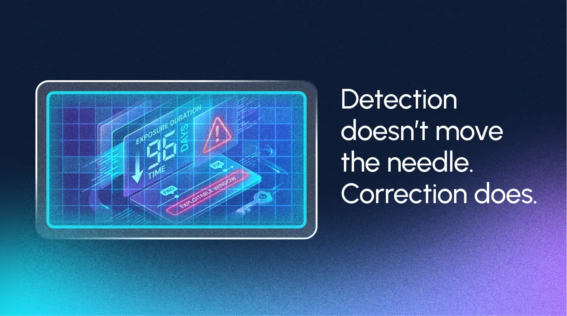
Security teams love metrics. They track vulnerability counts, patch compliance rates, incident volumes, endpoint coverage, and compliance scores. Yet many organizations overlook a metric that may be more important than all the others combined: How long does known risk remain exposed?
Ultimately, it would be a mistake to measure your security state or progress by what you've discovered. It must be measured in terms of what remains exploitable, for how long, and with what potential impact.
Visibility Is Not Control
Over the past decade, organizations have invested billions of dollars into visibility.
Vulnerability scanners identify weaknesses across infrastructure and endpoints. EDR and XDR platforms detect suspicious behavior. Configuration management tools surface drift and policy violations. Compliance platforms continuously evaluate systems against regulatory frameworks.
Most mature organizations are no longer struggling to find risk. In fact, many are overwhelmed by the amount of risk they see.
After all, a vulnerability discovered but not remediated remains a vulnerability. A misconfiguration identified but left unresolved remains a misconfiguration.
Knowing about risk doesn't reduce exposure. It requires controls that are actually enacted and enforced. Many organizations assume visibility and control are closely related. They're not.
Visibility answers the question:
"Do we know there's a problem?"
Control answers a different question:
"Can we ensure the problem is corrected and stays corrected?"
This distinction matters because discovering an issue and eliminating an issue are fundamentally different activities. One is an information problem. The other is an operational problem.
And operational problems are often much harder to solve.
Measuring the Exposure Window
At first glance, measuring exposure seems straightforward. A vulnerability appears. A vulnerability is fixed. The elapsed time between those two events represents exposure.
In practice, however, things become more complicated. For one thing, security teams don't always agree on how remediation time should be measured. Some define MTTR as the time between detection and verified remediation. Others define it as the time between the appearance of an exposure and its remediation.

Both approaches are valid, but they answer different questions. The first measures operational efficiency. The second measures actual exposure duration.
The challenge is that the true moment an exposure first appears is often difficult to determine with precision. A vulnerability may have existed for days or weeks before it was discovered. A misconfiguration may have been introduced by a software update, policy change, or administrative action long before monitoring tools detected it.
As a result, many security programs use two complementary metrics:
- Mean Time to Detection (MTTD) to understand how quickly they discover risk.
- Mean Time to Remediation (MTTR) to understand how quickly they remove risk after discovering it.
Together, these metrics provide a practical view of what we might call the exposure window: the period between the introduction of risk and its successful elimination.
This distinction matters because organizations have made tremendous progress improving detection. Modern security tools can identify vulnerabilities, misconfigurations, and policy violations faster than ever before.
Remediation, however, often remains constrained by operational processes, change management requirements, resource limitations, and competing priorities.
In most environments today, the majority of the exposure window is no longer spent discovering risk. It's spent waiting for risk to be removed. The problem isn't just that remediation is slow. It's that its architecture is broken and increasingly disconnected from detection.
That's the problem we put under the microscope in our latest report, Endpoint Security Assurance: Closing the Exposure Gap Across Configuration, Vulnerabilities & Control. We look at why exposure persists despite unprecedented visibility and what organizations can do to move from reactive remediation toward continuous assurance.
The Metrics Security Leaders Often Confuse
For years, security programs have emphasized MTTD. MTTD measures how quickly a security team identifies a problem after it appears.
If a vulnerability enters the environment on Monday and is detected on Tuesday, the time-to-detection is one day. Collect those numbers across all known exposures and you can calculate your MTTD.
The sooner a threat is discovered, the sooner a response can begin. But detection alone will get you nowhere.
That's why MTTR is critical. MTTR measures how long it takes to successfully eliminate a security issue after it has been identified.
MTTD tells you how quickly you find the problem.
MTTR tells you how quickly you eliminate the problem.
One measures awareness. The other measures action. Both influence exposure.
While detection is a necessary precursor to remediation, it doesn't really move the needle on its own. If you're looking for a sports metaphor, you can think of it in terms of first downs and touchdowns.
Finding Risk Is Easy. Fixing It Is Hard.
The cybersecurity industry has spent years making detection easier. Unfortunately, remediation hasn't seen the same progress.
Part of that is the result of the natural order of the two processes: detection, by definition, must come before remediation. But part of it is also the result of complexity.
Finding a problem is binary: you see it or you don't.
Fixing a problem is much more complicated. You disable a dangerous protocol and say goodbye to that exposure, right? But what if disabling that protocol knocks required functionality offline? You've just traded one problem for another. And with each problem having a distinct potential impact radius, how does that factor in? What if a problem isn't entirely eliminated, but largely mitigated? How do you measure that?
Correcting a configuration may require change approvals, testing, maintenance windows, and coordination across multiple teams.
Security teams often identify the problem in minutes, but take weeks or months to actually deal with them. In fact, some 37% of known vulnerabilities discovered remain unresolved for a year or more.
Attackers are faster than ever, with automation accelerating reconnaissance, exploitation, and lateral movement. Security teams can no longer afford remediation cycles measured in weeks or months. Yet removing risk safely, consistently, and at scale remains operationally difficult.
A typical workflow looks like this:
Risk is introduced → Risk is detected → Finding is logged → Ticket is created → Prioritization occurs → Remediation is scheduled → Change is implemented→ Validation happens later, or not at all.
Every handoff increases delay. Every delay increases exposure. This is why organizations can simultaneously have excellent visibility and poor security outcomes.
Imagine two organizations.
Organization A detects a vulnerability within six hours but requires forty-five days to remediate it.
Organization B detects the same vulnerability within twenty-four hours but remediates it within five days.
Which organization is actually safer? The answer is obvious. Yet many security programs continue to celebrate detection metrics while paying comparatively little attention to remediation performance.
To unbreak our remediation architecture and achieve better outcomes, we need to streamline the process by integrating detection and correction, while also bringing the context-awareness needed to understand and safeguard operational impact.
This should evolve the above workflow into something more closely resembling the following:
Risk is introduced → Risk is detected → Operationally safe fix is recommended→ Remediation is enacted, automatically validated and perpetually enforced and auto-validated.
Measuring MTTR Correctly
MTTR is relatively straightforward to calculate. For every vulnerability, misconfiguration, policy violation, or endpoint exposure:
- Record when the issue was detected.
- Record when remediation was initiated.
- Record when remediation was completed.
- Validate that the issue has actually been resolved.
- If edge cases leave some exposure in place but appropriate isolation and compensatory controls are implemented, it may be treated as completely resolved.
- Calculate the elapsed time from detection to verified remediation.
Average those results across your environment. That's your operational MTTR.
It's critical that you not overlook the validation stage. A remediation shouldn't be considered complete simply because a change was attempted. It should be considered complete when the exposure has been verified as eliminated.
Validation becomes increasingly vital as environments grow more dynamic. Systems drift. Policies change. Software updates introduce new configurations. Users modify settings.
Without validation, organizations may believe risk has been removed when exposure still exists.
It should also be noted that the more you aggregate MTTR numbers across categories and teams, the less meaningful they come. The most valuable insights also come from segmentation.
Measure MTTR separately for:
|
|
|
|
|
|
|
|
Many organizations discover that certain categories of exposure remain unresolved far longer than others.
Those delays often reveal process bottlenecks, ownership gaps, dependency challenges, or resource constraints that would otherwise remain hidden.
Closing the Exposure Gap
Security leaders who continue measuring success solely through visibility metrics may gain awareness while remaining exposed.
Organizations that prioritize remediation gain something far more valuable: Reduced opportunity for attackers. Reduced operational risk. Reduced exposure. And ultimately, better security outcomes.
Because security isn't defined by how quickly you discover risk. It's defined by how quickly risk disappears.


FAQ
What is MTTR in cybersecurity?
Mean Time to Remediation (MTTR) measures how long it takes to eliminate a security issue after it has been identified. Effective MTTR should end with verified remediation, not simply a change being attempted. Measuring from detection to validated resolution provides a more accurate picture of how long risk remained in the environment.
Why is MTTR often a more meaningful metric than MTTD?
MTTD measures how quickly security teams discover problems, while MTTR measures how quickly they remove them. Fast detection has limited value if vulnerabilities, misconfigurations, or policy violations remain unresolved for weeks or months. Organizations reduce exposure by shortening the time between discovery and verified remediation.
How should organizations calculate MTTR accurately?
An accurate MTTR process should record when an issue is detected, when remediation begins, when remediation is completed, and when the fix has been validated. Validation is critical because a remediation attempt does not necessarily mean the exposure has been eliminated. Without verification, MTTR can significantly understate actual risk.
Why do security teams struggle to reduce MTTR?
Most delays occur outside of detection. Change approvals, operational testing, maintenance windows, dependency analysis, cross-team coordination, and concerns about business disruption all extend remediation timelines. These operational bottlenecks often contribute more to exposure than limitations in detection technology.
Should MTTR be measured separately for different types of security issues?
Yes. A single enterprise-wide MTTR can hide significant operational bottlenecks. Measuring MTTR separately for vulnerabilities, endpoint misconfigurations, compliance violations, business units, infrastructure teams, or geographic regions helps identify where remediation processes require improvement.
What is the exposure window in cybersecurity?
The exposure window is the period during which a security weakness exists and remains exploitable. It begins when risk is introduced and ends only after remediation has been successfully completed and validated. Reducing this window lowers the opportunity for attackers to exploit known weaknesses.
Can automation improve MTTR without increasing operational risk?
Yes, provided the automation is designed for safe execution. Mature remediation platforms validate proposed changes, understand system dependencies, support staged deployments, verify outcomes, and provide rollback capabilities if needed. This allows organizations to accelerate remediation while maintaining operational stability.
What KPIs should security leaders track alongside MTTR?
MTTR is most valuable when combined with complementary operational metrics such as MTTD, remediation success rate, validation success rate, percentage of recurring exposures, configuration drift frequency, backlog of unresolved risks, and the average exposure window. Together, these metrics provide a more complete view of how effectively an organization reduces cyber exposure rather than simply discovering it.
About Author