
Gartner’s How to Achieve the Minimum Viable AI Governance


Blog
What Is Device Posture Management and Why Does It Matter?

Configuration Drift
Endpoint Hardening
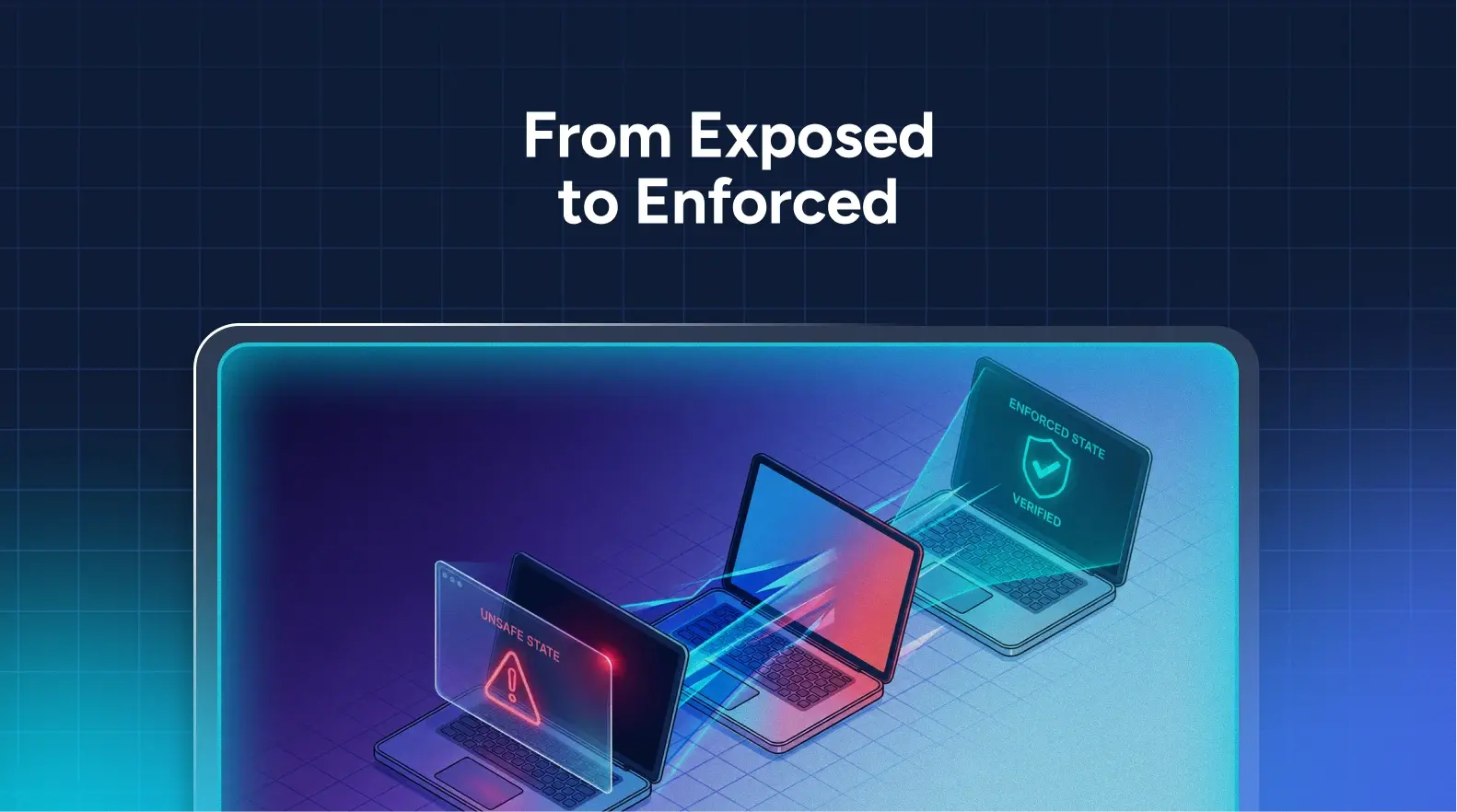
Enterprise endpoint security has quietly shifted from an inventory problem to a control problem. Most organizations can identify their endpoints, measure compliance, and detect suspicious activity. What they cannot consistently do is keep those endpoints inside an intended security state as environments, users, applications, and infrastructure continuously change.
Device posture management exists because maintaining security has become a continuous control challenge rather than a periodic administration task.
Device Posture Management As A Control Loop
Device posture management (DPM) is the continuous practice of defining a desired endpoint state, measuring the actual state, evaluating its exposure and dependencies, applying safe remediation, and validating that the desired state persists. The important word is management.
Posture is a condition. Management implies an operating loop.
A useful DPM control loop contains five parts:
1. Desired state
Define what must be true for a class of endpoints, applications, identities, and network connections.
This might include disk encryption, supported operating-system versions, restricted local administrator rights, hardened browser settings, disabled legacy protocols, or approved security agents.
2. Observed state
Collect current configuration and control data across endpoints, servers, cloud instances, and relevant network devices. A last-known state is useful, but it is not the same as a current state.
3. Decision state
Determine whether the difference between desired and observed state creates meaningful exposure. The decision should account for asset criticality, business dependencies, compensating controls, and the age of the deviation.
4. Correction state
Apply a safe, deterministic change where the risk justifies it. High-impact changes may require approval or a staged rollout. Low-risk, repeatable corrections should not wait for a ticket queue.
5. Proved state
Validate that the change worked, did not create an unacceptable operational impact, and remains in place. A device is not controlled because a command was sent. It is controlled when the intended state has been confirmed and sustained.
This isn't simply another workflow. It is a closed-loop control system. Traditional endpoint security measures state and reports deviations. Device posture management continuously compares actual state against intended state, safely applies corrective action, validates the outcome, and prevents regression. The objective is not visibility. The objective is stable control.
This model changes the unit of progress. The unit is no longer the number of findings discovered. It is the number of exposures safely removed and prevented from recurring.
Why Visibility Falls Short As A Security Objective
Posture management is different from posture monitoring. The latter aims to deliver visibility. That lets you know what's happened or happening. Posture management however aims to deliver control. That lets you know mechanisms are or could be in place. to prevent technology from being used unsafely.
That's no trifling distinction, especially as exposure thrives in the gap between discovery and correction.

Case in point: BitSight’s analysis of more than one million organizations found that the median vulnerability listed in CISA’s Known Exploited Vulnerabilities (KEV) catalog remained unremediated for 174 days after detection.
Only 40% of KEVs were remediated by the deadline assigned by CISA. In other words, even after an exposure was publicly cataloged as actively exploited and a fix was available, organizations often carried that known risk for nearly six months.
So while detection is essential, it's only half the job. And the other half is far too often overlooked and underprioritized. The operating objective must include reducing the time during which an unsafe state remains usable by an adversary.
This is why “coverage” and “compliance” need more precise definitions.
- Inventory coverage means an endpoint is known to a system.
- Telemetry coverage means a system is receiving current signals from the endpoint.
- Policy coverage means the endpoint has been evaluated against a defined rule set.
- Control coverage means an unsafe state can be changed through a governed mechanism.
- Posture integrity means the intended state has been applied, validated, and maintained.
The first three of those definitions describe awareness. The last two describe control. NIST’s guidance on information security continuous monitoring makes the same distinction.
Compliance Is Useful, But Doesn't Tell the Whole Story
Device compliance policies have an important role in Zero Trust access decisions. Microsoft Intune, for example, evaluates managed endpoints against defined requirements, reports a compliance status, and can work with Microsoft Entra Conditional Access to block access from endpoints that do not meet those requirements.
But compliance findings will always be relative to the policy that was assigned, the signals that were collected, the reporting interval, and the actions available when a device fails. An endpoint can satisfy an access policy while still carrying configuration drift that matters elsewhere in the attack path. It can also become noncompliant after the last evaluation and remain usable until the next check-in or enforcement event.
DPM should connect access posture to operational posture. It should account for the settings that make an endpoint exploitable, the privileges available to its operator, the applications that can connect to it, and the changes that can persist after a policy evaluation.
Think of device compliance as one gate. Device posture management is the operating system behind the gates, the state changes, and the evidence that the controls are still holding. Put differently, compliance measures whether an endpoint satisfied a requirement at the time it was evaluated. Posture management measures whether that requirement continues to hold as the environment changes.
One is an assessment. The other is an operational capability.
The Control Problem Inside A Familiar Endpoint
Consider an endpoint that reports into a unified endpoint management platform and has an active endpoint detection agent. The endpoint is visible. The management relationship is healthy. No malicious process has been detected.
but a deeper configuration assessment finds that the endpoint still permits a legacy protocol, grants local administrator rights to a broad group, allows an unapproved browser extension to access sensitive sites, and has a security policy that differs from the intended baseline.
None of these conditions necessarily produces an immediate detection event. Together, they expand the ways the endpoint can be used unsafely.
The correction is not simply “push a policy.” A safe action requires context.
- Is the legacy protocol required by a production dependency?
- Which devices communicate with it?
- Can the change be tested on a small ring first?
- What is the rollback path if a business application fails?
- How will the platform verify that the setting changed on every targeted endpoint?
- What will prevent the setting from drifting back next week?
None of these questions are security questions in isolation. They're control questions. Together they determine whether a security team can safely change the system without introducing unacceptable operational risk.
This is the last mile of endpoint security. It is also where many technology stacks become insight-only systems. They identify the gap, produce a report, and leave operators to coordinate the correction across Security, IT, and Operations.
That operating model creates an exposure gap even when the underlying tools are working as designed.
What Should Posture Control Measure
A posture-control program needs a different scoreboard from a visibility program. Counts still have a place, but they should support measurable outcomes rather than become the outcome themselves.
Most security metrics describe activity. Good posture metrics describe control quality. The objective isn't to prove work occurred. It's to prove the intended security state remained intact.
Useful measures include:
1. Critical-control integrity
What percentage of endpoints currently satisfy the controls that matter most to the organization?
Separate controls that are merely evaluated from controls that are continuously enforced.
2. Median exposure window
How long does a critical deviation remain exploitable after it is discovered?
Measure the time from validated discovery to validated safe state, not the time from alert creation to ticket assignment.
3. First-pass safe-remediation rate
How often does an approved change produce the intended result without manual rework, business disruption, or rollback?
A high-volume automation system that creates follow-up work is not producing control. It is moving work around.
4. Recurrence and drift rate
How often does the same unsafe condition return after it has been corrected?
Recurrence indicates that the organization has treated a symptom without addressing the source of the configuration drift.
5. Exception age and expiry discipline
How many exceptions are active, who owns them, what compensating control exists, and how long until the exception expires?
An exception without an owner or end date is a second baseline.
6. Sustained posture integrity
What percentage of endpoints remain in the intended state after seven, 30, or 90 days?
A snapshot can demonstrate a successful change. A time series demonstrates control.
7. Operational impact
How often do posture changes require rollback, generate service-desk demand, or create an unplanned interruption? Safe remediation should reduce exposure without transferring the cost to availability or productivity.
These measures give Security and IT a common language. They also give leadership a clearer line of sight on more important and business relevant questions:
How much exposure can we remove, how quickly, and how confidently can we keep it removed?
Asking More of the Technology Stack
The move from posture visibility to posture control requires more than another dashboard. It requires capabilities that connect policy, telemetry, action, and proof.
That changes the evaluation criteria change. The question is no longer "Can the platform find unsafe settings?" It becomes "Can the platform consistently return systems to their intended state without creating unacceptable operational risk?"
Ask for a state model, not a collection of settings
The platform should represent desired configurations as policy intent, map them to the right endpoint groups, and distinguish approved exceptions from unmanaged drift. A list of settings is not a control model.
Ask for dependency-aware change analysis
A security setting can be correct in isolation and disruptive in context. Before a change is applied, the system should identify affected applications, services, users, and network paths. Operators need to understand blast radius before they authorize action.
Ask for safe remediation and rollback
The safest automation is governed automation. It applies changes in the right sequence, limits the rollout, validates the result, and provides an immediate path to revert when the observed impact differs from the expected impact.
Ask for continuous enforcement
A one-time hardening exercise creates a baseline. Continuous enforcement protects the baseline as the environment changes. NIST’s configuration-management guidance notes that unauthorized or unanalyzed changes can render systems vulnerable and calls for more frequent assessment and monitoring of security-relevant configuration settings.
Ask for evidence that survives an audit
The platform should show the original state, the decision, the action, the validation result, the exception context, and the current state. “A policy was sent” is weak evidence. “The control was applied, verified, and remains intact” is operational evidence.
Ask for interoperability without surrendering control
Endpoint posture rarely lives in one system. It spans identity, endpoint management, EDR, vulnerability management, directory services, cloud control planes, and network infrastructure. Integrations should move both directions: data into the decision process and validated actions back into the systems that own the state.
Every major security platform can identify unsafe conditions. Far fewer can safely change those conditions at enterprise scale. The differentiator is no longer visibility. It's control fidelity – the ability to produce predictable, validated, low-risk state transitions across diverse environments.
How to Introduce Posture Control Without Breaking Existing Models
You do not need to rebuild the security stack to start measuring control. Begin with a small set of high-consequence controls. Choose settings that are relevant to your attack surface and operational environment: local administrator membership, unsupported operating systems, disk encryption, host firewall configuration, exposed remote-management protocols, legacy services, browser extensions, security-agent health, and privileged access paths.
For each control, define five things:
- The desired state.
- The evidence required to prove the state.
- The business dependencies that could make a change disruptive.
- The safe remediation path, including rollback.
- The metric that shows whether the control remains intact.
Then establish an operating rule: a finding is not complete when it is assigned, acknowledged, or placed in a queue. It is complete when the exposure has been safely reduced and the result has been validated.
That rule sounds simple. But it can yield a very significant impact - changing behavior quickly as it shifts the focus from reporting to outcomes.
Device Posture Management and Autonomous Endpoint Management
Security teams have historically measured findings, vulnerabilities, and compliance percentages. Those metrics describe the environment, but they say little about the organization's ability to govern it.
The more meaningful unit of performance is sustained intended state. How quickly can unsafe conditions be removed? How reliably do they stay removed? How confidently can changes be made without disrupting the business?
Those questions measure security as an operational capability rather than an auditing exercise.
Enterprise security spent the past decade becoming exceptionally good at observing systems. The next decade will be defined by how effectively organizations govern them.
Device posture management is not another way to measure endpoints. It is a discipline for continuously maintaining trusted state despite constant change. That's the shift from posture visibility to posture control, and ultimately from security reporting to security engineering.


FAQ
What is device posture management?
Device posture management is the continuous process of defining, measuring, correcting, enforcing, and proving the security state of endpoints and related devices. It extends beyond visibility by maintaining a desired security state over time through continuous validation, safe remediation, and drift prevention.
How is device posture management different from device compliance?
Device compliance measures whether an endpoint satisfies a defined policy at the time it is evaluated. Device posture management goes further by continuously validating security state, identifying configuration drift, safely correcting deviations, and ensuring controls remain effective as environments change. Compliance is an assessment, while posture management is an operational capability.
How is device posture management different from endpoint detection and response (EDR)?
EDR detects suspicious activity and helps investigate attacks after they occur. Device posture management focuses on reducing the conditions that make attacks possible by continuously managing endpoint configurations, privileges, security controls, and policy drift. The two capabilities complement each other, with one detecting threats and the other reducing preventable exposure.
Why isn't endpoint visibility enough to improve security?
Visibility tells security teams what exists and what is happening. It does not ensure devices remain securely configured or that unsafe conditions are corrected. Device posture management closes this gap by continuously comparing actual state against desired state, safely applying corrective actions, validating outcomes, and preventing regression.
What should organizations measure in a device posture management program?
Meaningful metrics focus on sustained control rather than activity. Examples include critical-control integrity, median exposure window, first-pass safe-remediation success, recurrence and drift rates, exception age, sustained posture integrity, and operational impact. These measures demonstrate whether security controls remain effective over time, not simply whether findings were discovered.
Can device posture management help reduce configuration drift?
Yes. Configuration drift is one of the primary problems device posture management addresses. Rather than relying on periodic audits or manual reviews, it continuously monitors endpoint state, detects unauthorized changes, reapplies approved configurations when appropriate, and validates that the desired security posture persists.
Does device posture management replace endpoint management platforms?
No. Endpoint management platforms remain responsible for provisioning, software deployment, and lifecycle management. Device posture management builds on those capabilities by providing continuous control, governance, validation, safe remediation, rollback, and evidence that endpoints remain in their intended security state.
How can organizations introduce device posture management without disrupting operations?
Start with a small set of high-consequence controls, define the desired state and required evidence, understand business dependencies, establish safe remediation and rollback procedures, and measure whether controls remain intact over time. This phased approach reduces operational risk while building confidence in continuous posture control.
About Author