Gartner’s How to Achieve the Minimum Viable AI Governance


Blog
What Is IT Governance and How Does it Lower Decision Fatigue?

Configuration Drift
Risk Management
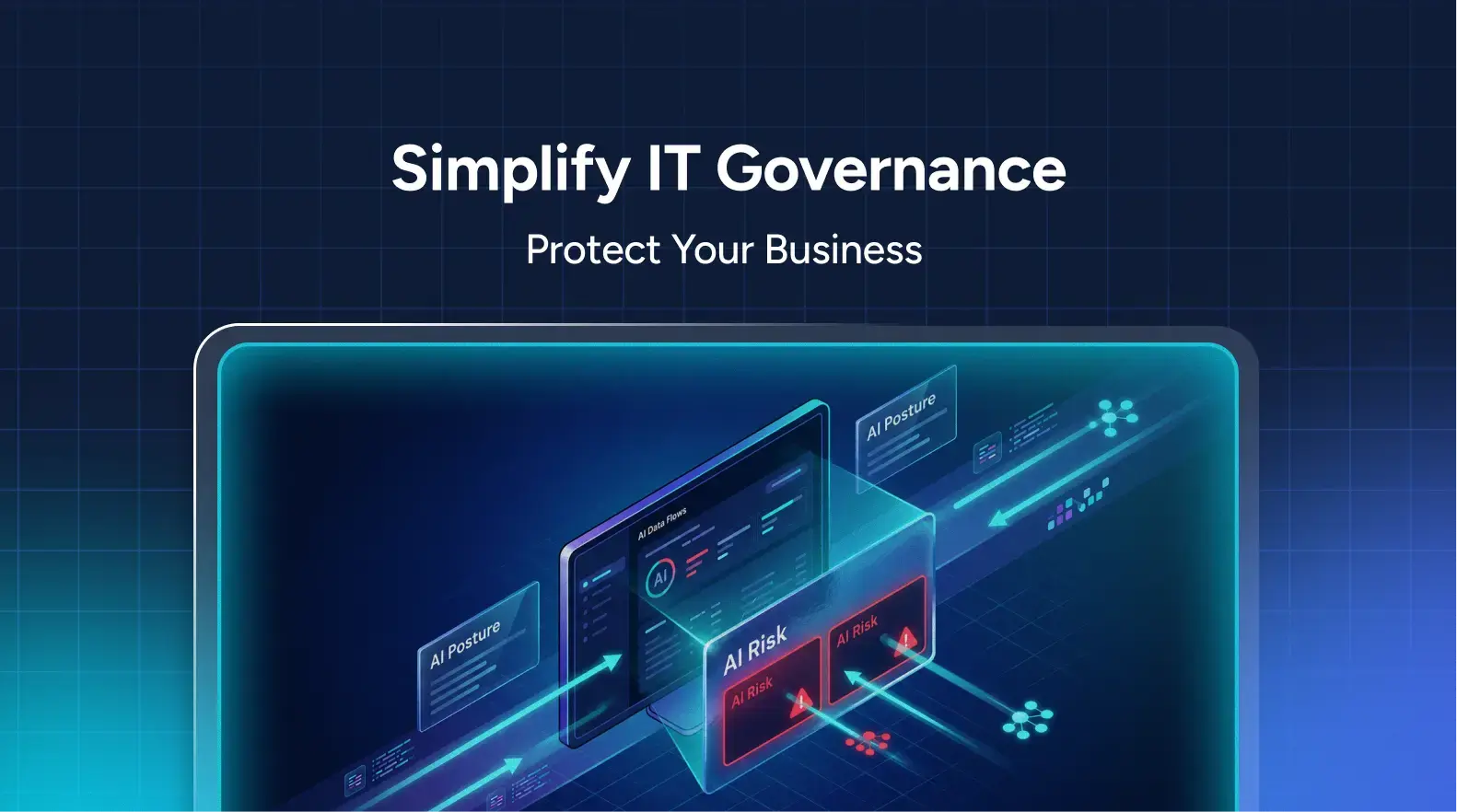
When people ask what is IT governance, it is often framed as a policy problem. In practice, it's an operational design problem. Whenever technology change outpaces controls, Security, IT, and the operators responsible for execution inherit a growing number of small, high-consequence decisions.
AI accelerates that pattern dramatically. Every assistant, agent, browser extension, and model introduces questions about permissions, persistence, integrations, identity, and oversight.
Which tools are allowed? Which systems can connect? Which changes can be automated? Which actions require approval? Which configurations must remain enforced across environments?
If those questions are not answered in advance, change management turns into improvisation. And that's a recipe for disaster; especially when operating at scale and speed.
This dynamic shifts into very clear focus when it comes to AI. The proliferation of open questions and the need to address them at the speed of the business creates operational drag. Some of the decisions taken will be poorly communicated and many will be rushed. That's a tough position to be operating from and one likely to produce inconsistent policies and unnecessary exposure.
It's a problem that's exacerbated by the inevitable glut of temporary policies that need to be walked back carefully and unwound down the road. It's a messy business and a breeding ground for risk.
The better approach is to treat smart governance as the mechanism that reduces the number of risky decisions humans need to make in the first place.
Sound hygiene, strong posture, and effective governance do more than reduce exposure. Together, they simplify change management by shrinking ambiguity at the edge of the enterprise, where most operational mistakes actually happen.
The Real Cost of Decision Fatigue In Enterprise IT Environments
Governance isn't struggling because organizations lack policies. It's struggling because humans have become the execution engine for too many operational decisions.
Decision fatigue is a well-established psychological effect: as the volume of choices rises, the quality and consistency of those choices tends to deteriorate.
In enterprise security, that deterioration rarely looks dramatic in the moment. It shows up as delayed approvals, inconsistent exceptions, permissive defaults, weak rollback discipline, and policies that vary by team, tool, or incident.
The measurable effect is not just mental exhaustion. It is operational inconsistency. That matters because Security and IT teams are already operating under strain. Microsoft found that 68% of people say they struggle with the pace and volume of work, and 46% report feeling burned out.
In cybersecurity specifically, ISC2 reports that 47% of professionals feel overwhelmed by workload and 48% feel exhausted from trying to stay current on threats and emerging technology.
That is the environment in which governance decisions are being made. The talent market adds another layer of pressure. ISC2 also found that 33% of organizations do not have the resources to adequately staff their teams, 29% cannot afford to hire the people with the skills they need, and 59% report critical or significant skills gaps.
When teams are understaffed, under-skilled for emerging domains, or forced to stretch generalists across specialized work, every governance decision carries more friction and more risk. That strain compounds downstream. When skilled personnel are scarce and controls are not settled in advance, remediation work accumulates faster than it can be closed.
Decision fatigue in cyber operations does not show up as indecision alone. It shows up as delayed remediation, permissive defaults, weak rollback discipline, and policy drift between teams that thought they were aligned. Vulnerability queues grow. Exceptions linger. Temporary policies become semi-permanent.

CISOs end up presiding over expanding risk catalogues. Even when they're well understood and thoroughly documented, they're still not being reduced at the pace the business requires. Every day, security teams are often trying to prioritize thousands of daily alerts while critical exposures remain unaddressed. That is what backlog looks like in practice.
AI intensifies this dynamic because it introduces new decision paths into teams that already have too many. Consider a familiar scenario. A business unit starts using a desktop AI assistant to summarize contracts, rewrite customer emails, and generate internal code snippets. Now Security has to answer a stack of downstream questions.
Is the assistant pulling data into a vendor-controlled context window? Is sensitive content retained? Can this agent authenticate as a user? Can it invite external users? Can it execute code? Can outputs be copied into other systems without validation?
Does the assistant have access to email, file shares, browsers, developer tools, or identity tokens? Can a user install a plug-in that extends the assistant’s reach into line-of-business systems? Can it create persistence through MCP? Can it grant itself broader permissions?
What started as “let’s try an AI tool” becomes an ongoing change-management burden because the environment was never hardened for safe adoption. In this sense, decision fatigue is simply accumulated governance debt becoming visible.
Smart governance is about reducing the number of live judgment calls required after the tool has already landed. And the best security control is the one that removes the need for a decision.
AI is a useful example here, but it is only one example. It is the latest in a long line of change drivers that demonstrate the point: whenever governance lags behind operational change, decision fatigue increases, backlogs expand, and risk remains open longer than anyone intended.
It was true for the Cloud, true for SaaS, true for identity, and true for automation. Now it's true of AI too.
Hygiene, Posture, and Governance
Organizations often separate hygiene, posture, and governance into different programs owned by different teams. Infrastructure manages hardening. Security Operations monitors risk. Governance defines policy. On an organizational chart, that division makes sense. Operationally, however, it creates unnecessary friction because each discipline answers a different question about the same environment.
Hygiene is your baseline discipline: hardened configurations, least privilege, controlled software installation, logging, patching, browser policy, script control, and clean identity practices. It tells you whether you've configured and kept your technology in a safe manner.
Posture is your continuously measured reality: whether those controls remain intact, whether drift is widening the exposure gap, and whether operators can see what changed. It tells you the extent to which your technology can be used in an unsafe way. Better posture equals lower potential for unsafe applications.
Governance is the decision model that determines what is permitted, what requires approval, how risk is accepted, and how changes are enforced. It tells you what type of changes can be made without violating established internal policies.
These layers are sequential, not interchangeable.
Governance cannot compensate for poor hygiene because it has nothing reliable to govern. Posture cannot validate controls that were never implemented correctly. Hygiene alone cannot prevent tomorrow's unsafe changes from undoing today's good work.
The real advantage appears when the three reinforce one another. Governance establishes the boundaries. Hygiene implements them as technical controls. Posture continuously verifies that those controls remain intact as the environment evolves.
Viewed this way, governance is no longer a collection of policies or approval workflows. It becomes the mechanism that converts organizational intent into operational reality. Hygiene defines the baseline. Posture measures adherence to that baseline. Governance ensures that future changes continue to respect it.
That is ultimately why strong governance reduces decision fatigue. Instead of asking operators to repeatedly decide whether a change is acceptable, the environment has already encoded those decisions into enforceable patterns.
Human judgment becomes the exception rather than the default, allowing Security and IT teams to spend their time solving genuinely new problems instead of revisiting yesterday's decisions.
Rethinking What IT Governance Means in the Real Enterprise
The core question is not whether a new technology introduces risk. Every new capability does. The real question is whether your operating model forces people to make too many judgment calls once that capability is already in motion.
That is where weak governance breaks down. It leaves operators deciding, in real time, what is allowed, what should be escalated, what can be rolled back, and what exposure is acceptable. At scale, that does not create flexibility. It creates inconsistency.
Most governance failures aren't policy failures. They're architecture failures. Organizations ask operators to repeatedly decide what the environment itself should already prevent. Every recurring approval is evidence that the platform hasn't encoded yesterday's lesson.
Strong governance does the opposite. It settles recurring decisions in advance, embeds them in controls, and gives teams clear boundaries for action. That is how sound hygiene, strong posture, and effective governance reduce change-management complexity: they replace improvisation with enforceable patterns.
Smart governance does not try to inspect every prompt or chase every new tool announcement. It focuses on controlling the conditions under which AI can operate safely.
That means starting with four practical questions.
- What is allowed to run?
- If operators can install unvetted AI desktop tools, browser extensions, local models, or code assistants without guardrails, governance will always be late. Application control, software inventory, endpoint hardening, and browser policy matter here because they determine whether shadow AI becomes normalized behavior.
- Second, what is allowed to connect?
- An internal AI tool with unnecessary access to email, shared drives, identity stores, knowledge bases, ticketing systems, or source code repositories creates an avoidable attack surface. If the tool only needs read access to a narrow knowledge domain, giving it broader reach is not innovation. It is excessive agency by design.
- Third, what is allowed to persist?
- Many AI risks are really retention and propagation risks. Sensitive prompts copied into browser histories, synced clipboards, unmanaged notes, agent memory layers, or third-party logs can outlive the original use case. Strong posture is what tells you whether the enterprise is actually configured to prevent that persistence, not whether a policy document says it should.
- Fourth, what is allowed to change automatically?
- If an AI system can draft, classify, enrich, route, reconfigure, or trigger actions, you need a business-aware approval model. Not every action deserves a human gatekeeper. High-impact actions do. The distinction matters. Good governance removes friction from low-risk automation and adds friction exactly where the blast radius justifies it.
- If an AI system can draft, classify, enrich, route, reconfigure, or trigger actions, you need a business-aware approval model. Not every action deserves a human gatekeeper. High-impact actions do. The distinction matters. Good governance removes friction from low-risk automation and adds friction exactly where the blast radius justifies it.
Notice that none of these questions concern prompts or models. They're all questions about the operating environment. That's where governance scales.
Well-designed governance compresses complexity. Instead of asking operators to make hundreds of context-specific judgment calls, it pre-decides the boundaries.
Instead of debating every AI-related change request from scratch, it defines safe patterns for adoption. Instead of treating change management as a sequence of exception tickets, it turns recurring decisions into enforceable standards.
When you harden endpoints, restrict unneeded privileges, standardize browser and extension behavior, control data movement, and continuously enforce policy, you reduce the number of branches in the operational tree.
Fewer branches mean fewer exceptions. Fewer exceptions mean less operator fatigue. Less fatigue means fewer rushed decisions that introduce new exposure.
This is how hygiene and governance quietly improve change management: not by making humans better at saying yes or no all day, but by making fewer risky choices available in the first place.
Beyond Architecture, There's the Business Factor
The more important implication for most organizations is upstream. Weak governance increases the cost of technology adoption because each rollout has to be debated, constrained, and cleaned up manually. Strong governance reduces that marginal cost.
Once baseline controls are established, you can adopt new AI capabilities with more confidence, less fear of disruption, and less operator drag.
This is one of the least appreciated ROI arguments for proactive posture management. The value is not only in preventing a bad event. It is in making safe change cheaper to execute.
Start with operational control points rather than lofty principles. Harden the endpoint layer where AI tools actually land. Govern software installation, browser extensions, local model runtimes, prompt-handling paths, and clipboard or file-sharing behavior.
Reduce privilege sprawl so internal AI tools and the people using them cannot casually reach sensitive systems they do not need. Define approved AI patterns by use case, not vague policy statements. Separate low-risk assistance from high-risk action-taking. Add human approval where the blast radius is real.
Then continuously validate that the intended state remains the actual state.
This last step is where many programs break down. Controls that are only checked periodically create blind spots between audit moments. AI adoption does not wait for the next audit cycle. Configuration drift, unauthorized installs, changed permissions, and new integrations happen continuously.
If enforcement is periodic, governance becomes stale faster than the environment changes. That is why continuous visibility and continuous enforcement matter. They turn governance from a declared intention into a lived operating condition.
The Takeaway
The hardest part of smart governance is building an environment where useful change can happen without forcing Security, IT, and operations teams into endless case-by-case arbitration.
Smart governance lowers decision fatigue because it replaces improvisation with bounded choices. Sound hygiene keeps the baseline clean. Strong posture tells you when reality departs from policy. Effective governance determines which changes are safe, which need approval, and which should never make it into production at all.
Put differently: if your operating model depends on people making perfect decisions inside a messy environment, it will not scale. If the environment is hardened, measured, and governed, change management gets simpler because the system itself carries more of the discipline.
That is a path to fewer preventable problems, lower operational drag, and more confident adoption of whatever comes next.
Organizations often measure governance by the number of policies they publish. They should instead measure it by the number of operational decisions people no longer have to make.
That's the difference between documenting security and engineering it.


FAQ
What is IT governance in cybersecurity?
IT governance is the framework that determines how technology is used, what changes are permitted, who approves them, and how risk is managed. Effective IT governance turns security policies into enforceable operational controls so teams spend less time making repetitive judgment calls and more time reducing actual risk.
How does IT governance reduce decision fatigue?
Strong governance eliminates unnecessary decisions by defining acceptable behavior before changes occur. Instead of asking administrators to repeatedly decide whether a configuration, application, or AI tool is acceptable, governance establishes clear guardrails that can be consistently enforced across the environment.
What is the difference between IT governance, security posture, and cyber hygiene?
Cyber hygiene establishes secure configurations and foundational controls. Security posture continuously measures whether those controls remain effective as environments change. IT governance defines the rules for how technology should be deployed, modified, and operated. Together, they create a system where secure behavior becomes the default rather than relying on constant human judgment.
Why is decision fatigue becoming a bigger cybersecurity problem?
Modern enterprises are constantly introducing new cloud services, AI tools, browser extensions, integrations, identities, and automation workflows. Every new technology creates additional operational decisions. Without governance to standardize those decisions, organizations accumulate inconsistent policies, approval bottlenecks, and configuration drift that increase both operational overhead and cyber risk.
What role does IT governance play in AI security?
AI governance establishes the boundaries for how AI systems can be used within the enterprise. That includes determining which AI tools are approved, what data they can access, which systems they can connect to, and which actions require human approval. These controls reduce the likelihood of shadow AI, excessive permissions, and unintended data exposure.
Can good IT governance improve change management?
Yes. Mature governance reduces change management complexity by replacing ad hoc approvals with predefined policies and automated controls. Teams spend less time evaluating routine requests and more time focusing on genuinely high-risk changes that require expert review.
How can organizations measure whether their IT governance is effective?
Rather than counting policies or governance meetings, organizations should measure operational outcomes. Indicators such as fewer policy exceptions, reduced configuration drift, faster remediation, fewer manual approvals, and more consistent enforcement demonstrate that governance is improving operational resilience instead of creating additional bureaucracy.
Is IT governance only about compliance?
No. Compliance is one outcome of effective governance, not its primary purpose. Well-designed governance improves operational consistency, reduces security risk, simplifies technology adoption, lowers decision fatigue, and enables organizations to deploy new capabilities with greater confidence while maintaining appropriate control.
About Author