
Gartner’s How to Achieve the Minimum Viable AI Governance


Blog
Can Smarter Vulnerability Prioritization Clear Your VM Backlog?

Autonomous Remediation
Configuration Drift
Endpoint Hardening
Exposure Management & CTEM
Vulnerabilities
Vulnerability prioritization today has come a long way. Severity used to dominate the conversation. That made things simple. But it also made for pretty lousy prioritization. Without considering things like attack chain complexity and known exploits together with asset exposure and criticality, operators risk chasing the wrong end of the Pareto Principle.
Yet even with a much more sophisticated approach to prioritization, operators are struggling to put critical vulnerabilities to bed. According to Axonius research, it takes 43 days on average to fully remediate a known exploited vulnerability, and only 26% of those vulnerabilities are ever fully resolved.
The problem is not necessarily poor prioritization. A queue can be ranked correctly and still grow.
Once actionable vulnerabilities enter the environment faster than they can be safely remediated and verified, the backlog increases regardless of how accurately the queue is ordered.
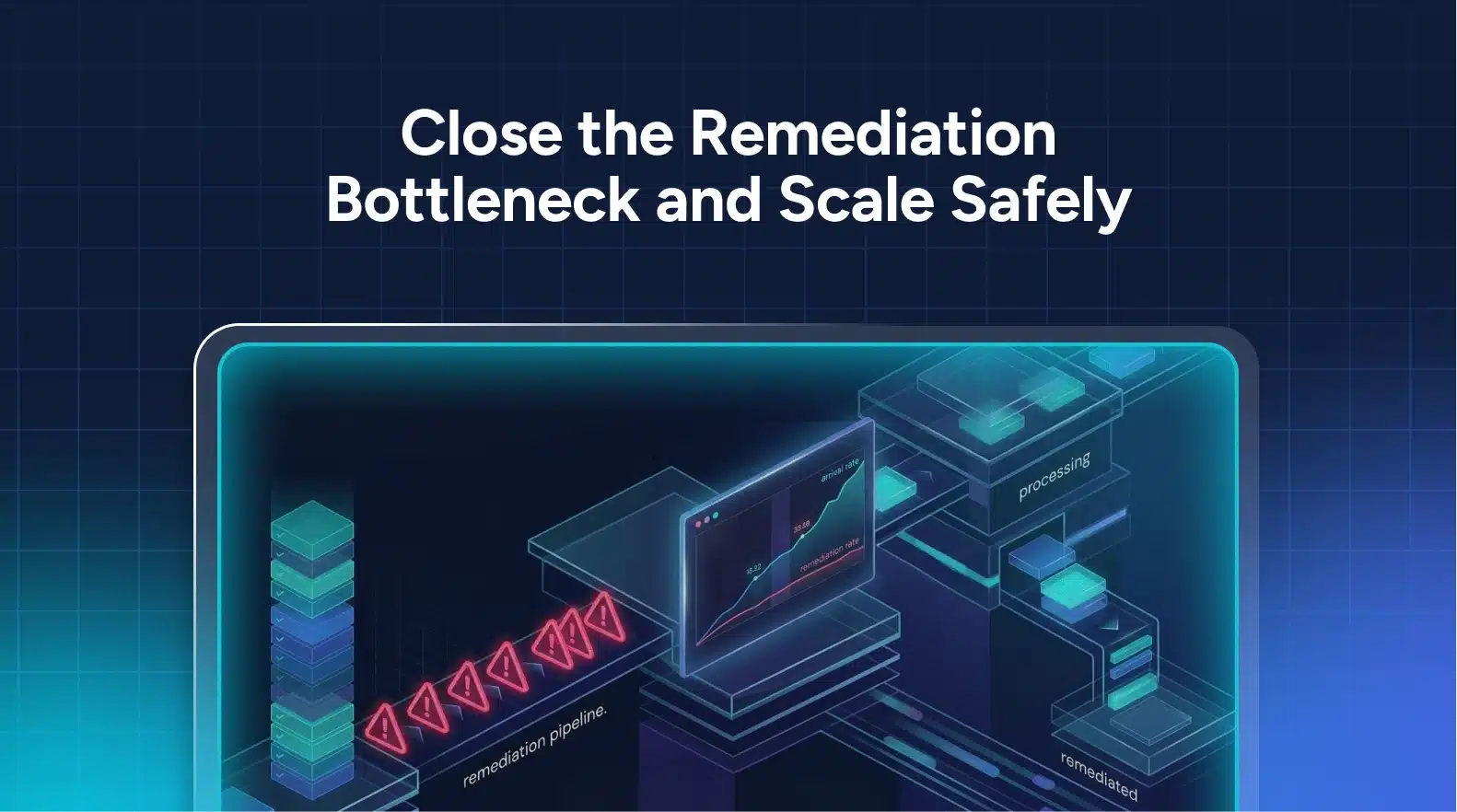
Backlog growth comes down to two rates:
- Exposure arrival rate – how quickly new actionable exposure enters the environment.
- Verified remediation rate – how quickly the organization safely removes it.
The basic arithmetic is simple:
Backlog change = new actionable exposures – verified remediations
If 8,000 actionable exposures enter the environment each month and 6,000 are actually remediated, 2,000 are added to the backlog. Prioritization determines which 2,000 remain. It does not change the arithmetic.
Reducing the backlog means increasing verified remediation throughput without increasing human effort at the same rate.
Why Vulnerability Management Produces Backlogs So Easily
Vulnerability management has a structural tendency to accumulate work.
Today, discovery is inexpensive and repeatable. A scanner can reassess thousands of assets and produce new findings without creating a comparable amount of work for the team operating the scanner. New CVEs arrive continuously, software inventories change, previously unmanaged assets enter scope, and improvements in coverage expose vulnerabilities that were already present but previously unseen.
But after a vulnerability is found, it needs to be addressed. That's where remediation comes into play. And for most organizations it is considerably more expensive and exhausting than discovery.
The affected population has to be established. The appropriate corrective action has to be identified. Application and operational dependencies may need to be understood. Some systems may be ready for immediate remediation while others require testing, a maintenance window, a compensating control, or an exception.
A scanner might report 8,000 instances of the same vulnerability. After examining the affected population, 7,400 endpoints may share the same corrective action and operational conditions and can be handled as one controlled remediation campaign. The remaining 600 may need to be separated because of application dependencies or other constraints.
The reverse can also happen. A single high-priority vulnerability can produce several distinct remediation paths because different parts of the affected population cannot safely receive the same change.
The machinery for identifying vulnerable instances can therefore produce work much faster than the machinery for changing the affected systems.
Traditional vulnerability workflows often preserve the scanner finding as the unit of work. Findings become tickets, tickets are assigned to owners, and remediation proceeds through investigation, approval, scheduling, execution, and verification. That model provides accountability, but not necessarily time savings. CVSS, KEV, EPSS, asset criticality, exposure, and threat intelligence all inform that decision. But they do not increase remediation throughput.
A critical vulnerability might be identified and correctly prioritized on Monday, while ownership takes a day to establish, application validation takes another two, approval adds three more, and deployment waits for the following weekend. The patch itself might take only minutes to install.
This imbalance also helps explain why prioritization has become such a large part of vulnerability management. Once finding volume exceeds remediation capacity, the practical response is to determine which findings deserve attention first.
Reducing the vulnerability backlog depends on converting large populations of findings into executable remediation work, then completing that work faster than new actionable exposure enters the environment.
Remedio approaches this at the asset-state level rather than treating every vulnerability instance as an independent unit of work. Findings can be correlated with the affected systems and the conditions surrounding them, creating the context needed to turn scanner volume into executable remediation work.
More Engineers Do Not Change the Scaling Model
Adding engineers can increase remediation capacity. And if the backlog is primarily the result of temporary understaffing, that may be exactly what's needed. But persistent vulnerability backlogs usually expose a different problem: remediation effort rises with the number of findings, affected systems, and exceptions that need to be processed.
That complexity will always scale much faster than you can realistically grow your headcount.
Discovery today is already largely automated. A vulnerability scanner can assess another 10,000 endpoints without requiring analysts to inspect each endpoint individually. But remediation is still largely a matter of human work.
Teams investigate applicability, identify owners, assess dependencies, coordinate with application teams, prepare changes, obtain approvals, schedule deployments, verify results, handle failures, and document exceptions.
If 5,000 endpoints share the same vulnerability, treating them as either 5,000 individual remediation tasks or one homogeneous deployment group creates the wrong scaling model. The affected population needs to be decomposed into operationally similar sub-populations before remediation begins.
Those populations cannot be defined by CVE, operating system, or business unit alone. Systems that look identical in a vulnerability scanner may have very different asset criticality, application dependencies, component usage, configuration states, management authority, uptime requirements, reboot tolerance, and network context.
At enterprise scale, engineers cannot realistically perform that analysis manually for every remediation campaign. The remediation system needs to correlate vulnerability and asset state with dependency and operational context, then automatically identify lookalike populations that share sufficiently similar remediation conditions.
A low-criticality workstation population with no observed dependency on the affected component may support one execution policy. Production endpoints with an active dependency may require another. Systems with conflicting management policies, unusual application dependencies, or high operational criticality may need to be isolated into smaller cohorts or withheld for human review.
Remedio is designed around that scaling problem. Dependency intelligence, pre-execution validation, cohort-based execution, and automated verification reduce the human analysis required for a remediation campaign, even as the number of affected endpoints grows. Engineers remain involved where the evidence indicates that judgment is required rather than because every endpoint has to pass through the same manual process.
Remedio evaluates affected assets using vulnerability context alongside factors such as asset criticality, dependency information, component usage, configuration state, and operational risk, allowing a large affected population to be separated into remediation cohorts with similar execution conditions.
The segmentation also needs to influence how the change is executed. Cohorts can require different validation criteria, rollout sizes, scheduling constraints, rollback conditions, and levels of human approval.
Those cohorts can then follow different remediation paths. A low-risk population with no observed dependency may be eligible for rapid staged remediation, while systems with critical dependencies or higher operational sensitivity can be isolated for additional validation or human review. The objective is to automate not only the change, but much of the decisioning required to determine where that change can be made safely.
Results from early deployments should provide additional evidence for whether remediation can safely expand to other systems with similar characteristics.
This is where the scaling model changes. The system is continuously turning a large vulnerability population into smaller, contextually similar remediation populations, determining how each can be changed safely, and separating the exceptions that genuinely require human judgment.
Doing that reliably requires endpoint-level context, dependency intelligence, pre-execution validation, controlled rollout, post-change verification, and rollback to operate as parts of the same remediation system.
Without that decision layer, organizations can automate deployment, but much of the analysis required to determine where, when, and under what conditions it is safe to deploy remains manual.
Not Everything in the Backlog Needs a Patch
There is another problem with treating backlog reduction as a patching exercise: much of the work is not patching.
In 2024, 40,009 new CVEs were published, the highest annual total on record. Even within vulnerability management alone, processing that volume through manual testing and deployment is difficult.
The remediation queue also contains different kinds of work.
- Patchable software flaws have a validated update that can be deployed.
- Misconfigurations and insecure defaults may require a registry change, disabled protocol, service modification, browser setting, privilege change, or secure baseline.
- Unsupported or unauthorized software may need to be removed, isolated, restricted, or replaced.
- Exceptions and compensating controls are required where the preferred state cannot be reached without disrupting a business dependency.
- Recurring exposures were fixed once but have returned because of policy changes, software installation, another management authority, or user action.
Trying to push all of these through a generic patch workflow creates work rather than removing it. The remediation path needs to match the condition.
The required state may involve applying an update, changing a configuration, removing software, enforcing a compensating control, or maintaining an approved exception. Bringing those actions into the same remediation layer allows the response to follow the condition rather than forcing every exposure through a patch-centric workflow.
Move From Ticket Processing to State Change
Reducing the backlog requires a remediation process built around the actual state of the asset rather than the lifecycle of the ticket.
Step 1: Normalize Findings Into a Common Asset-State Model
Vulnerability scanners, configuration auditors, EDR platforms, cloud tools, and compliance systems describe exposure differently.
The remediation process needs to connect each finding to the affected asset, establish its current and desired state, and determine the corrective action required to close the gap.
This also helps collapse duplicate findings that describe the same underlying condition. Three tools can create three tickets. But at the end of the day, you still have an endpoint with one state that needs to change.
Step 2: Select the Correct Corrective Action
Some findings need a software update. Others need a configuration change. Some need software removed. Others cannot be directly corrected at all.
Axonius found that 4.98% of CISA KEV catalog entries prescribe disconnection rather than patching because the affected product has reached end of life.
The goal is not to automate every finding into the same action. The corrective action has to reflect the state of the asset, its dependencies, and the operational constraints around it.
Once that decision is understood, it should be translated into reusable remediation logic rather than an investigation repeated for every ticket.
Step 3: Understand the Change Before Executing It
Executing a command remotely is easy. Establishing that the command is safe on a particular system is harder.
Change viability depends on application dependencies, whether the affected component is actually in use, competing configuration authorities, reboot requirements, and the operational sensitivity of the affected population.
When this context is missing, organizations compensate with testing, meetings, approval layers, and long maintenance windows. That caution is reasonable but it's also costly. The goal should be to reduce the uncertainty that makes so much manual coordination necessary.
Step 4: Pilot, Verify, and Expand
Automation does not require pushing a change simultaneously to every affected device.
Start with a representative population and verify both the intended security change and the health of dependent services. If the result is clean, expand the deployment progressively across the remaining eligible population. Unexpected behavior should stop the rollout and trigger investigation (or rollback) before more systems are affected.
This preserves change control while removing much of the repetitive execution that makes manual remediation slow.
With Remedio, for example, the rollout can be governed by the characteristics of the remediation cohort rather than a generic deployment ring. Pre-execution validation establishes whether the change remains appropriate for the target population, staged execution limits the blast radius, post-execution validation confirms that the intended state was reached, and rollback provides a recovery path when the result falls outside the expected conditions.
Step 5: Treat Drift as Part of Remediation
Suppose an organization disables an insecure protocol across 12,000 endpoints. The change succeeds. Several weeks later, a legacy GPO re-enables the protocol on part of the estate.
Under a ticket-centric model, the original remediation campaign is already closed. The problem returns to the backlog when the next assessment finds it.
A state-based model sees the situation differently. The secure state has been invalidated. The process should detect the change, identify the conflicting configuration authority, and either restore the intended state or send the affected population for review.
Endpoint states are not static. Policies change. Software is installed. Devices return after being offline. Users make changes. Multiple management systems compete for authority.
A fix that is correct on Tuesday is not necessarily still present on Friday.
Remediation therefore ends with sustained state, not successful execution. It's why Remedio continues validating the resulting endpoint state after the original remediation event. If a GPO, management tool, software installation, or other change reintroduces the vulnerable condition, that state can be detected and corrected rather than waiting for the next vulnerability scan to recreate the finding and return it to the backlog.
Measure Whether Exposure Is Actually Leaving the Environment
If the objective is to make verified remediation outpace new exposure, measurement needs to show whether that is actually happening and where remediation capacity is being lost.
MTTR by finding type shows where different forms of remediation slow down. Patching, configuration correction, software removal, and exception handling follow different operational paths, so an aggregate MTTR can conceal significant differences between them.
Remediation completion rate versus discovery rate shows whether the organization is gaining or losing ground. A falling MTTR can look encouraging while the backlog continues to grow if new actionable exposure is still arriving faster than verified remediation is being completed.
Time to verified safe state measures how long the affected asset actually remains exposed. Ticket closure, deployment completion, or a successful command does not establish that the intended state exists across the affected population.
Recurrence rate shows whether remediation is durable. A vulnerability or insecure configuration that repeatedly returns consumes remediation capacity each time it re-enters the queue and indicates that the underlying state is not being maintained.
Exception age shows where remediation has stalled rather than completed. Exceptions may be operationally necessary, but aging them exposes cases where temporary compensating controls or risk acceptance have become the long-term treatment for unresolved exposure.
Operator effort per verified remediation shows how efficiently the remediation system converts human effort into risk reduction. If remediation throughput increases only because more engineers are processing more work, capacity has improved without changing the scaling model. When verified remediation increases while operator effort per correction falls, the process is becoming more scalable.
Taken together, these metrics show more than whether the team is closing work. They reveal whether exposure is leaving the environment faster, whether fixes are holding, and whether increasing remediation volume still requires a corresponding increase in human effort.
The Next Constraint Is Remediation Throughput
Vulnerability prioritization has made it possible to distinguish the exposures that demand immediate attention from the much larger volume that can wait. That is necessary, but it does not change the rate at which those exposures can be removed.
The next stage of progress is downstream. A prioritized vulnerability has to be translated into affected populations with similar operational characteristics, matched to the appropriate corrective action, evaluated for dependencies and change risk, and moved through controlled execution and verification. Doing that manually recreates the same capacity constraint that produced the backlog in the first place.
This is where remediation technology has to catch up with vulnerability discovery and prioritization. Remedio applies endpoint and dependency intelligence to determine how affected populations can be segmented and safely remediated, then supports controlled execution, verification, rollback, and continued enforcement of the resulting state.
The objective is not simply to process a larger queue. It is to change the relationship between vulnerability volume and the human effort required to remove it.
When verified remediation can scale without engineering effort increasing at the same rate, the backlog stops being something teams continually reprioritize and becomes something they can systematically reduce.


FAQ
How do you know whether a vulnerability backlog is actually unhealthy?
Backlog size alone is a weak indicator. A large backlog may be manageable if high-risk exposures are leaving the environment faster than comparable new exposures arrive. The stronger signals are backlog age, exposure duration, recurrence, remediation throughput, and the proportion of actionable exposures that remain unresolved beyond their expected remediation window.
A backlog becomes structurally unhealthy when exposure is accumulating faster than the organization can produce verified remediation outcomes.
A backlog becomes structurally unhealthy when exposure is accumulating faster than the organization can produce verified remediation outcomes.
Should vulnerability teams set backlog reduction targets by CVE count?
Usually not. CVE counts preserve the scanner's unit of work rather than the remediation team's unit of execution. One vulnerability may affect thousands of endpoints that can receive the same corrective action, while another may require several remediation paths because the affected systems have different dependencies or operational constraints.
Targets are more meaningful when they measure affected assets moved to a verified safe state, exposure eliminated, and time to remediation.
Targets are more meaningful when they measure affected assets moved to a verified safe state, exposure eliminated, and time to remediation.
How should remediation cohorts be created?
Start with the corrective action, then identify which affected assets can safely receive that action under equivalent operating conditions. Useful cohort dimensions include asset criticality, application and service dependencies, operating system and software state, configuration state, management authority, reboot tolerance, network context, maintenance constraints, and rollback requirements.
The objective is not merely segmentation. It is to establish populations for which the same remediation decision can be executed and validated with comparable confidence.
The objective is not merely segmentation. It is to establish populations for which the same remediation decision can be executed and validated with comparable confidence.
Which vulnerability remediation activities should remain manual?
Human involvement is most valuable where uncertainty changes the remediation decision. Examples include systems with poorly understood dependencies, unusual configurations, conflicting business requirements, fragile production workloads, or remediation paths without reliable recovery mechanisms.
Routine execution should become increasingly automated once the corrective action, eligible population, validation criteria, operating constraints, and recovery path are sufficiently understood. This concentrates engineering attention on exceptions rather than repeatedly processing known-good remediation paths.
Routine execution should become increasingly automated once the corrective action, eligible population, validation criteria, operating constraints, and recovery path are sufficiently understood. This concentrates engineering attention on exceptions rather than repeatedly processing known-good remediation paths.
How can organizations automate remediation without increasing change risk?
Automation should inherit the controls of a mature change process rather than bypass them. That means evaluating dependencies before execution, establishing eligibility conditions, starting with representative pilot populations, monitoring operational health, verifying the resulting security state, and maintaining a recovery path if the change behaves unexpectedly.
The practical goal is controlled execution at machine scale, not simply faster deployment.
The practical goal is controlled execution at machine scale, not simply faster deployment.
What should happen when a remediated vulnerability returns?
A recurring exposure should generally be treated as evidence that the desired state is not being maintained, rather than as an entirely new remediation task. The organization should identify what invalidated the safe state, such as policy processing, software installation, configuration changes, competing management systems, or user action, and correct the underlying source where possible.
Persistent validation can then detect subsequent deviation and reapply the appropriate control before recurrence becomes another long-lived backlog item.
Persistent validation can then detect subsequent deviation and reapply the appropriate control before recurrence becomes another long-lived backlog item.
How should vulnerability management teams measure remediation capacity?
Measure the system by verified outcomes rather than activity. Useful indicators include remediation rate versus discovery rate, time to verified safe state, recurrence rate, remediation success rate, operator effort per verified remediation, and MTTR segmented by remediation type.
Together, these metrics reveal whether the organization is actually increasing remediation throughput or simply processing more tickets around an expanding exposure population.
Together, these metrics reveal whether the organization is actually increasing remediation throughput or simply processing more tickets around an expanding exposure population.
About Author

CVE-2026-81983: Integer Overflow Vulnerability Enables Out-of-Bounds Write in Adobe Acrobat
A single 32-bit multiplication is enough to turn a malicious PDF into memory...