Gartner’s How to Achieve the Minimum Viable AI Governance


Blog
Cybersecurity Statistics Every Security Leader Should Know

Autonomous Remediation

In today’s digital battlefield, knowledge is power. As threats evolve rapidly and the costs of security failures continue to rise, businesses must stay informed. The Big CISO Factbook uses facts and figures to highlight the challenges faced by IT and security teams worldwide.
The Factbook combines Remedio field insights, original market research, and third-party statistics to paint a data-driven picture of an evolving threat landscape. Ultimately this Factbook is meant to be a resource to help inform decision making and guide strategic planning.
Careening Complexity & Creeping Complacency
It’s no secret that threat actors are constantly refining their tactics, making it increasingly difficult for businesses to defend themselves. With every organization now operating in a digital environment, the attack surface has expanded significantly. As the number of connected devices continues to grow and oversight is challenged by remote work, shadow IT, and configuration drift, the risks multiply and businesses are more likely to face disruption.
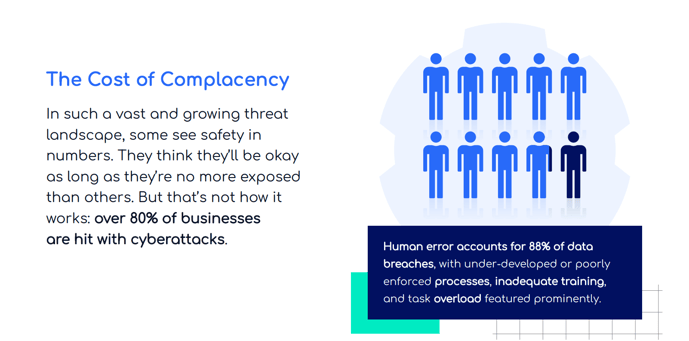
But perhaps the biggest issue is complacency. Despite existing in a state of persistent risk, some decision-makers think it acceptable – comforting themselves in the knowledge that their peers are just as vulnerable. They reason that with so many soft targets, they’re relatively safe; at least statistically speaking. So they allow themselves to be indolent.
Of course, in reality – statistically speaking – such an approach is foolish. And this Factbook stands as a powerful rebuttal of such rationalization. The truth is that that type of keeping down with the Joneses attitude results in a race to the bottom that sees everyone lose. It’s not just irresponsible, it’s downright dangerous.
Hardening is seldom easy, but when dealing with technical or design flaws, at least the fix is usually straightforward. When it comes to how technology is deployed however, it’s much more difficult. Existing at the operations level, it’s inherently a function of context. It’s hard to define, mired in human error, and cannot be solved with a patch.
All of which is why vendors generally steer clear of such issues and leave operators to their own devices (literally) – outfitted with little more than their careful attention-to-detail and manual best efforts. As far as methodologies go, it’s far from bulletproof. Case in point: 88% of data breaches are rooted in human error.
It can come from many places, too many to count in fact – from poorly defined processes, a lack of training, or simple overload (too many tasks and too little time), just to name a few. But no matter the source (and without casting any aspersion), you can always count on humans – especially stressed and overworked humans – to occasionally miss things, make mistakes, and exercise questionable judgment. It’s par for the course really. To wit, IDC found that companies with 500-1,499 employees never even investigate 27% of their security alerts.
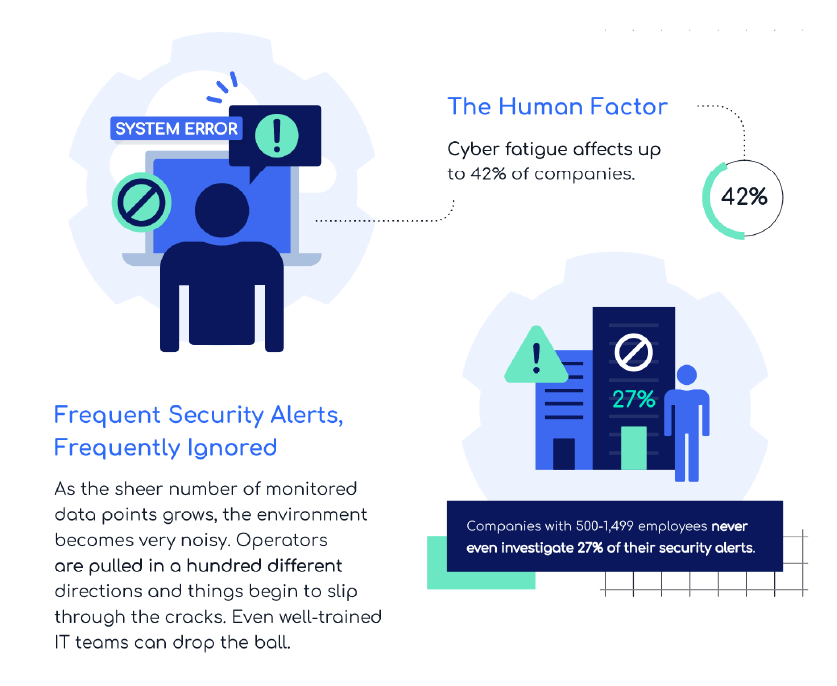
Cyber fatigue, or the reluctance to take proactive measures due to the overwhelming nature of threats, affects up to 42% of companies. And even when there is a clear will to act, struggles with basic security hygiene compound the challenge and prevent operators from getting out from behind the eight ball.
In this sense, most organizations fail to get out of their own way. And the results are catastrophic:
- Attacks impact 80% of businesses
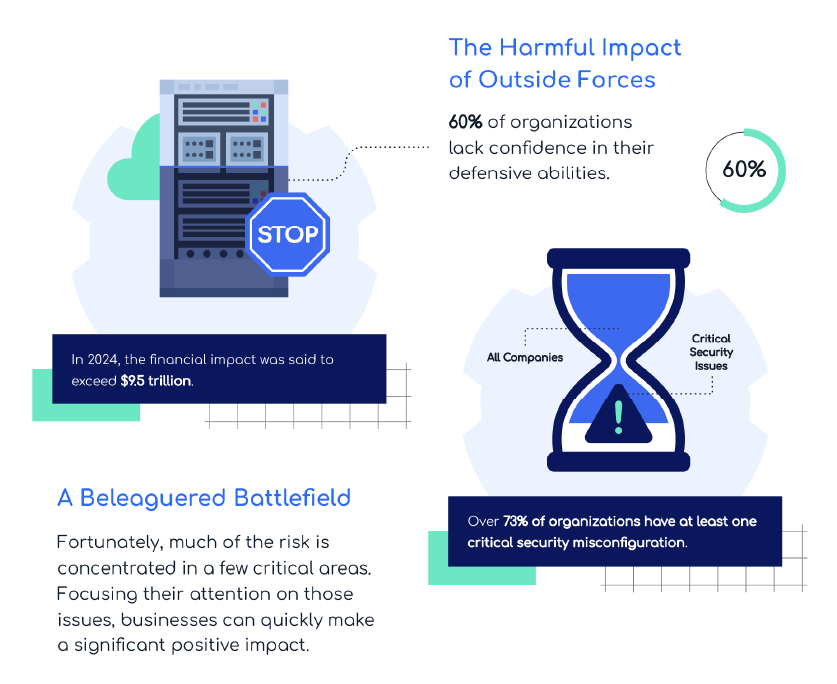
- 60% of organizations lack confidence in their defensive abilities
- The 2024 financial impact is said to have reached $9.5 trillion
The Transformative Takeaway for the Cybersecurity Strategist
The good news, if you can call it that, is that in most organizations the mess is not evenly spread across the enterprise. It’s pretty concentrated in fact – which means there are going to be some low-hanging fruit.
Consider, for example, the facts that:
- 35% of all security incidents stem from misconfigurations
- 73% of organizations have at least one critical security misconfiguration
- Misconfigurations are responsible for 80% of ransomware attacks
- Ransomware breaches now cost an average of $5.13 million (up 330% from 2023!)
- Misconfigurations add up to cost businesses 9% of their revenue, on average.
To make matters worse, there’s a significant talent gap in the cybersecurity industry. With a global shortfall of 3.4 million cybersecurity professionals, businesses must find ways to maximize productivity without compromising their efficacy or security. And allocating 0.52% of their total budgets to cybersecurity, which is the current standard, just isn’t going to cut it.
If nothing else, let The Big CISO Factbook serve as a wakeup call. We need to be more vigilant and we need to rise to the challenge. We can’t afford to bury our heads in the sand.
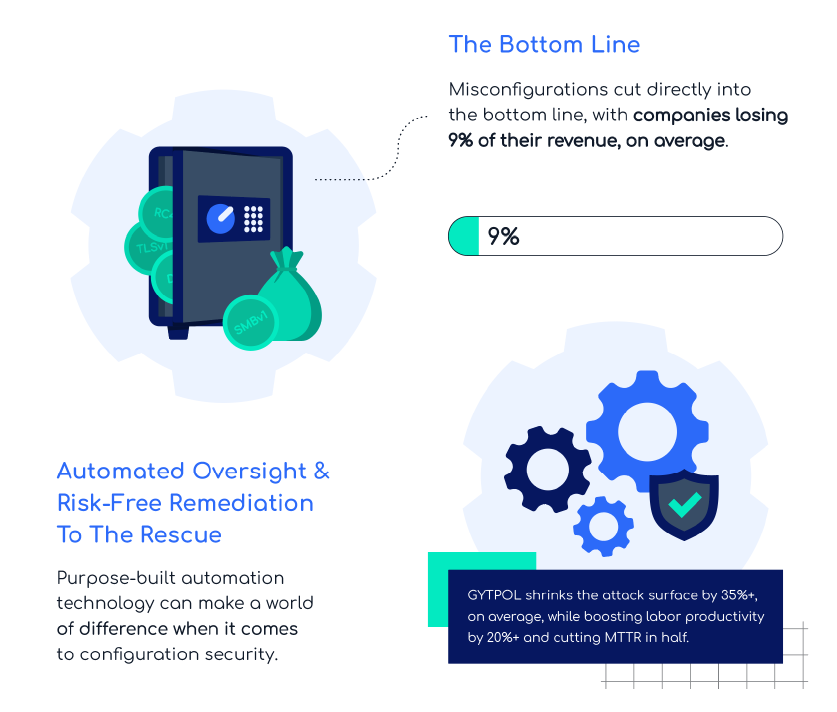
To survive and thrive in the coming years, organizations will need to take a more proactive approach and invest in automation technologies that enhance hygiene and error-proof configuration security. It might not be easy, but I can promise you that it’ll be worthwhile.


FAQ
Why are security misconfigurations responsible for so many cyber incidents?
Misconfigurations create unintended exposure by leaving systems operating outside their intended security baseline. Unlike software vulnerabilities, which require code flaws, misconfigurations often result from operational decisions, incomplete deployments, configuration drift, or temporary workarounds that remain in place. Because they are common across endpoints, servers, cloud resources, and identity platforms, attackers frequently exploit them as an easier path into enterprise environments.
How can organizations reduce cyber risk without continuously adding new security tools?
Many organizations achieve greater risk reduction by improving the effectiveness of existing controls rather than expanding their security stack. Standardizing configurations, continuously validating security settings, automating remediation where appropriate, and monitoring for configuration drift can reduce exposure while simplifying day-to-day security operations.
Why is configuration drift a long-term security problem?
Configuration drift occurs when systems gradually deviate from approved security baselines through software updates, administrative changes, policy exceptions, or operational requirements. Even environments that begin in a secure state can become increasingly exposed over time if those changes are not continuously detected and corrected.
What is cyber fatigue, and why does it matter for security teams?
Cyber fatigue describes the operational strain created by large volumes of alerts, security tasks, and competing priorities. As teams become overloaded, important issues may take longer to investigate or remediate. Reducing unnecessary manual work through prioritization and automation can help security teams focus on the risks that matter most.
How should security leaders use cybersecurity statistics when making strategic decisions?
Industry statistics are most valuable when they provide context rather than dictate priorities. Organizations should compare external trends against their own environment, business objectives, threat exposure, and operational maturity to determine where investment will have the greatest impact.
Why do security incidents often originate from operational challenges rather than technical failures?
Many incidents occur because security controls are difficult to maintain consistently across large, changing environments. Staffing constraints, competing business priorities, legacy systems, and manual processes can all contribute to gaps between security policy and real-world implementation, creating opportunities for attackers.
Can automation improve both security and operational efficiency?
Yes. When implemented with appropriate governance and validation, automation can help organizations maintain secure configurations, reduce repetitive manual work, accelerate remediation, and improve consistency across large endpoint fleets. This allows security teams to spend more time addressing higher-value risks instead of routine maintenance.
What metrics should security leaders track beyond vulnerability counts?
Effective security programs also measure configuration compliance, remediation time, configuration drift, policy coverage, automation success rates, and exposure reduction over time. These operational metrics provide a clearer view of how effectively an organization is reducing real-world cyber risk, rather than simply counting identified issues.
About Author