
Gartner’s Top Strategic Technology Trends for 2027


Blog
Top ESPM Enforcement Checks for Hardened Baseline Configuration

Configuration Drift
Endpoint Hardening
Exposure Management & CTEM
Risk Management
Security Misconfigurations
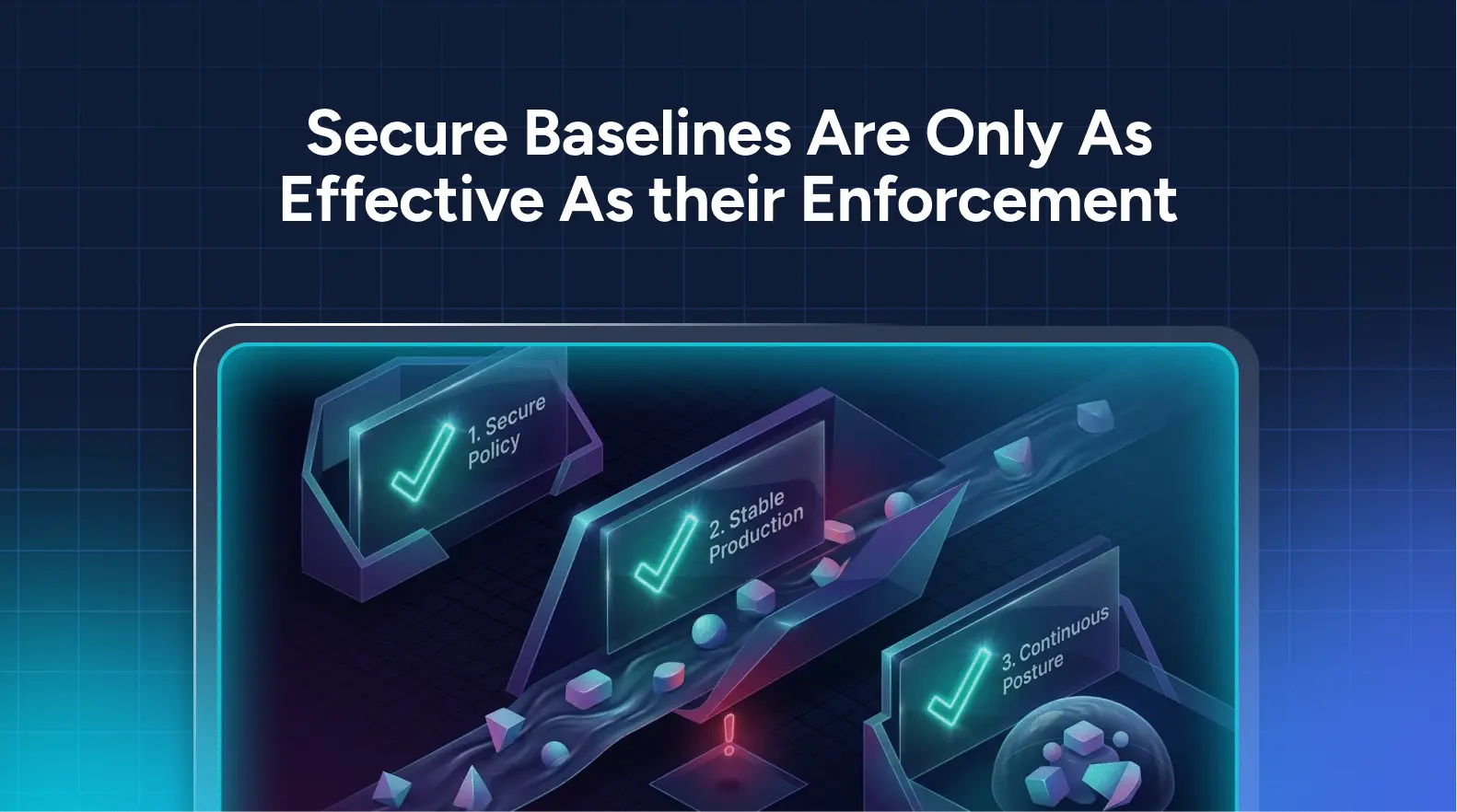
Baseline hardening rarely fails because the controls are unknown. It fails because the controls don't hold.
You can publish a standard, map it to CIS, push it through GPO or Intune, and still end up with an endpoint estate that drifts away from the intended state faster than operators can pull it back. That is the uncomfortable reality in mature environments. The baseline exists. The audit evidence exists. The enforcement does not.
This is where endpoint security posture management matters. ESPM should not be treated as another visibility layer. Its job is to continuously validate whether endpoints still match the hardening state you approved, and to help operators restore that state safely when they do not.
That capability is far from trivial. Ponemon's endpoint security study found that the average time to apply, test, and fully deploy patches was 97 days, with 40% of organizations saying patch rollouts were taking longer because of operational concerns.
That gap between known exposure and safe correction is the real operating problem. It is also why the most valuable hardening checks are not simply the most severe ones. They are the ones you can verify continuously, remediate safely, and keep in place despite updates, exceptions, and policy collisions.
This guide focuses on those checks. Not every possible baseline item. The ones most worth enforcing through ESPM because they reduce attack surface, recur frequently, and lend themselves to continuous control.
Key Takeaways: Baseline Endpoint Hardening Checks for ESPM
- Hardening checks only reduce exposure when they are continuously enforced, not merely documented.
- The strongest ESPM candidates combine exploitability, broad prevalence, low change uncertainty, clear verification, and high likelihood of recurring drift.
- Identity, legacy protocols, endpoint protection integrity, application control, and configuration authority conflicts should form the core of most enforcement programs.
- Security baselines are necessary, but they do not create protection on their own. Continuous validation and safe remediation do.
- The right metrics are time-to-neutralization, verified remediation rate, recurrence rate, rollback rate, and coverage under enforcement.
Why Baseline Hardening Still Breaks Down in Mature Environments
Most large organizations already know what secure configuration looks like. Microsoft publishes security baselines to provide an opinionated starting point for Windows hardening, specifically so teams can apply tested security settings consistently rather than inventing their own from scratch.

CIS Benchmarks exist for the same reason, offering consensus-based secure configuration guidance across operating systems, cloud platforms, network devices, applications, and more.
The problem starts after adoption. Software updates reset settings. Emergency troubleshooting creates exceptions that never get reviewed. A local admin reverses a control to make an application work. GPO says one thing, Intune says another, and the endpoint takes whichever policy wins the conflict that day.
That is why baseline hardening is not a one-time deployment discipline. It is a state management discipline. If you cannot verify that the intended control still holds across the fleet, then the standard is only a policy artifact.
Security teams often discover this too late. They have evidence of control definition, but not evidence of control persistence. And persistence is what determines whether a control meaningfully reduces exposure.
What Makes a Hardening Check Worth Enforcing Continuously
Not every secure configuration belongs in the first wave of continuous enforcement. The best candidates usually meet five tests.
1. The insecure state creates a credible attack path
If a control only improves theoretical neatness, it should not outrank a configuration that adversaries actively exploit. Legacy authentication protocols, excessive local privilege, disabled host firewalls, and unapproved remote access software all create conditions that can be exploited directly or chained into lateral movement.
2. The exposure appears often enough to matter
A rare finding on one isolated asset may deserve attention, but it should not dominate your ESPM design. Widespread controls matter more. A moderate misconfiguration on thousands of endpoints often represents more operational risk than a critical issue on one tightly contained system.
3. The change can be applied safely
This is where many hardening programs stall. Operators do not resist hardening because they doubt the security principle. They resist because they do not want to break authentication, line-of-business software, printing, remote support, or production workflows. Any control selected for continuous enforcement must be evaluated through a change-safety lens, not just a policy lens.
4. The result can be verified
An enforceable control must produce observable proof. You need to know whether the endpoint reached the intended state, not just whether a command was issued. Verification must test outcome, not activity.
5. The exposure is likely to come back
Recurring drift is one of the clearest signals that a control belongs in continuous enforcement. If a setting reverts after updates, local changes, or policy collisions, then a point-in-time audit model will never be enough.
Top Baseline Endpoint Hardening Checks for ESPM Enforcement
Identity and Privilege Checks
Identity controls deserve top billing because excessive privilege expands blast radius faster than almost any other baseline flaw. If an attacker compromises an endpoint with broad local or inherited rights, the problem is no longer local.
The highest-value checks here include:
- Local administrator group sprawl: Identify and remove accounts that should not have local admin privileges.
- Dormant privileged accounts: Detect stale accounts that still retain elevated rights.
- Password and lockout policy drift: Validate password length, complexity, reuse restrictions, and lockout thresholds against the approved baseline.
- Service account over-permissioning: Review service accounts for privilege growth that outlasted the original business need.
- Credential exposure via local settings or scripts: Flag plaintext or recoverable credentials stored where they should not be.
These checks are operationally valuable because they are common, measurable, and directly tied to privilege escalation and lateral movement. They also drift quietly. That makes them strong candidates for continuous validation.
Legacy Protocol and Service Checks
Legacy services remain active for one simple reason: they are easier to leave alone than to retire safely. But they are also among the cleanest examples of exposure that baseline enforcement can reduce quickly.
The most important checks usually include:
- SMBv1 enabled: SMBv1 remains a high-value target because it is obsolete, widely discouraged, and still turns up in production.
- NTLM usage where stronger alternatives exist: NTLM persistence often reflects technical debt rather than real necessity.
- LLMNR and NetBIOS exposure: These protocols can create unnecessary credential interception and spoofing opportunities.
- Print Spooler enabled where not required: This is a classic example of a service that often remains active by default longer than it should.
- Unnecessary remote management services: Telnet, open RDP where not needed, and similar services enlarge the attack surface without adding security value.
CIS Benchmarks explicitly emphasize disabling unnecessary services, closing unnecessary ports, restricting insecure protocols, and enforcing least privilege as part of secure baseline design. These are not cosmetic hardening items. They reduce reachable attack surface.
Endpoint Protection Integrity Checks
A control that is installed but not functioning is a false comfort. That is why ESPM should continuously verify control integrity, not just configuration intent.
Priority checks here include:
- Host firewall disabled or mis-profiled: Firewall protections must be active and aligned with the intended policy per profile.
- EDR or security agent health failure: An agent that is stopped, outdated, or not reporting creates an invisible protection gap.
- Disk encryption disabled: BitLocker, FileVault, or equivalent controls should be active where policy requires them.
- Tamper protection disabled: Security controls should not be easy to disable locally.
- Logging or telemetry gaps: A system that cannot prove security control execution is harder to trust and harder to investigate.
Microsoft's security baseline guidance exists partly to give organizations a tested starting point for these kinds of settings, reducing the guesswork involved in consistent endpoint protection hardening.
Application and Execution Control Checks
Application control is harder than it sounds because the problem is no longer limited to traditional software inventory. Browser extensions, scripting engines, shadow tooling, remote access utilities, and unmanaged AI applications can all create exposure that standard asset lists miss.
That makes the following checks increasingly important:
- Unauthorized software installed: Especially tools that provide persistence, remote control, lateral movement, or unsanctioned data handling.
- Unapproved browser extensions: Extensions can capture data, modify traffic, or bypass expected governance.
- Macro and script execution policies disabled: Office macro abuse and loose scripting controls still provide attackers with useful execution paths.
- Application allowlist drift: Approved software inventories should not remain static while endpoints change underneath them.
- Unmanaged AI or coding assistants: These tools can create new local data flows, new sync points, and new policy exceptions faster than governance processes adapt.
This area requires more operational judgment than firewall or protocol checks. Removing or restricting software can affect productivity. That means stronger reliance on pilot cohorts, exclusions, rollback plans, and business-aware change logic.
Configuration Authority Conflict Checks
Hybrid endpoint management introduced a new baseline problem: multiple legitimate systems now claim authority over the same setting. That creates silent drift even when every team believes it's following policy.
The most useful checks here include:
- GPO and Intune conflicts: Different values for the same control should be surfaced and resolved intentionally.
- Local override of managed settings: Endpoints should not quietly diverge from centrally declared policy.
- Golden image deviation: Approved baseline templates should remain reference points for active validation.
- Policy delivery without policy application: A pushed control that never took effect is still a failed control.
- Exception age and exception ownership: Temporary exceptions should expire. Otherwise they become shadow policy.
This category often delivers the most strategic value because it explains why otherwise sensible hardening programs fail to produce lasting posture improvements. It is not always the controls themselves. It is the conflict between control authorities.
How to Prioritize and Safely Enforce Endpoint Hardening Checks
One of the biggest mistakes in hardening is treating all remediations as equally safe. They are not. The same configuration change can be routine on one endpoint and disruptive on another, depending on application dependencies, business criticality, and the control mechanisms already in place.
Quick wins typically have minimal application dependency, are easy to verify, and can be reversed without significant operational consequences. Disabling unnecessary services, correcting straightforward local policy settings, and restoring missing security controls often belong here.
Higher-risk changes tend to affect authentication, network access, identity, business-critical software, or shared infrastructure dependencies. Restricting NTLM, modifying remote access pathways, tightening certain firewall rules, or removing widely used but unofficial tools may be the right move, but should not be enforced blindly.
An effective ESPM program turns this assessment into a continuous detect, validate, remediate, and enforce process:
- Detect: Continuously compare live endpoint configurations against approved security baselines, identifying deviations and the affected device populations.
- Validate: Evaluate each corrective action against endpoint criticality, application and service dependencies, policy ownership, existing exceptions, and rollback readiness. Segment affected endpoints into operationally similar cohorts rather than applying one remediation strategy across the entire fleet.
- Remediate: Execute low-risk corrections automatically where appropriate. Apply higher-risk changes through staged rollouts, with pre-execution validation, post-change verification, and the ability to reverse changes that produce unintended consequences.
- Enforce: Continuously verify that corrected controls remain in their intended state, detect recurring drift, and reapply approved configurations when safe. Escalate persistent conflicts or changes that require renewed operational validation.
This approach allows organizations to increase remediation throughput without making operational risk proportional to the number of endpoints being hardened. Routine corrections can proceed with minimal intervention, while human attention remains concentrated on changes with meaningful business consequences.
It also changes the role of the baseline. Rather than serving as a static checklist of desired configurations, it becomes a continuously enforced security state, with each corrective action governed by its operational context and verified outcome.
Yes Actions vs. Outcomes, No Security vs. Operations
The hardening conversation is often framed the wrong way. Too much attention goes to which controls belong in the baseline, and not enough goes to which controls can be enforced continuously, verified reliably, and restored safely when they drift.
That is the operational shift ESPM should drive.
Start with checks that matter to real attack paths. Prioritize the ones that recur. Separate quick wins from controls that need pilot validation. Measure whether the exposure window is shrinking. Then keep the loop closed.
Counting how many hardening actions were triggered tells you very little. Instead, mature programs measure:
- Time-to-neutralization: How long the exposure remained exploitable before verified correction.
- Verified remediation rate: How often the change produced the intended safer state.
- Recurrence rate: How often the same issue came back after correction.
- Coverage under enforcement: What percentage of in-scope endpoints are actually being checked continuously.
- Rollback rate: How often the remediation had to be reverted because of operational impact.
- Exception age: How long temporary acceptance remains open beyond its intended review point.
These measures tell you two things at once: whether exposure is disappearing faster, and whether the mechanism making it disappear can be trusted.
The industry already has plenty of guidance on what a secure configuration should look like. Microsoft baselines, CIS Benchmarks, and other frameworks already provide that. The hard is maintaining those controls across hybrid, fast-changing environments without negatively impacting operations.
Baseline hardening defines the target state. Safe remediation determines whether that state can be restored without creating a different problem.
That is the real boundary line in modern endpoint operations.
Detection without correction leaves the exposure gap intact. Hardening without validation creates operator hesitation. Enforcement without context can create downtime. What you need is continuous, context-aware, business-aware control that restores the secure state and proves it holds.
That is also why the highest-value hardening checks are the ones that lend themselves to safe remediation. The goal is not to enforce the longest checklist. It is to enforce the controls that reduce exposure measurably and sustainably.


FAQ
What is the difference between endpoint hardening and ESPM?
Endpoint hardening defines and applies secure configurations. ESPM continuously validates whether those configurations still hold, identifies drift, and supports corrective action when endpoints fall out of policy.
Which hardening checks should most organizations enforce first?
Most organizations should begin with high-value, low-uncertainty controls such as local admin sprawl, disabled host firewalls, legacy protocols like SMBv1, missing disk encryption, and obvious unauthorized software.
Why do secure configurations drift so often?
They drift because endpoints are living systems. Updates, troubleshooting, policy overlap, software installs, local overrides, and exception handling all change state over time. Continuous enforcement exists because drift is normal, not exceptional.
Are CIS Benchmarks enough for an endpoint hardening program?
CIS Benchmarks are an excellent baseline reference because they provide consensus-based secure configuration guidance across many technology families (CIS Benchmarks). They are necessary guidance, but they do not replace continuous validation and remediation.
Why is change safety such a big issue in hardening?
Because the right security control can still create business disruption if it is applied without context. Operators need to know what depends on the current state, how the change will be scoped, how success will be verified, and how rollback will work.
How should teams measure whether hardening is working?
Use outcome-focused metrics: time-to-neutralization, verified remediation rate, recurrence rate, rollback rate, and coverage under enforcement. Those metrics show whether exposure is truly being reduced.
How does this align with Remedio's approach?
Remedio's approach is built around the idea that visibility without safe remediation is incomplete. The goal is not just to identify insecure configurations, but to close the loop through context-aware correction, continuous enforcement, and measurable posture improvement.
About Author