
Gartner’s Top Strategic Technology Trends for 2027


Blog
Is Unified Vulnerability Management A False Promise?

Endpoint Hardening
Exposure Management & CTEM
Patch Management
Vulnerabilities

A vulnerability queue is not a remediation program. Enterprise security has become remarkably good at finding exposure. The harder problem is determining what can be safely corrected, executing the change, and proving the risk is gone.
Unified vulnerability management promises to bring fragmented security capabilities together. Asset discovery, vulnerability intelligence, risk prioritization, configuration assessment, patch management, and remediation workflows become part of a more coherent operation.
That is a worthwhile ambition. But bringing exposure data together is not the same as getting the problems fixed.
An organization can have a consolidated vulnerability dashboard, integrated endpoint management, automated patch deployment, and well-defined change procedures, yet still leave consequential exposures unresolved for weeks or months.
The tools may be integrated. The corrective decisions are not. This is where the promise of unified vulnerability management begins to break down.
Unifying Visibility Doesn't Unify Responsibility
Traditional vulnerability management was built around a relatively straightforward division of labor. Security identified vulnerable assets, assessed severity, prioritized findings, and handed remediation to IT.
That model worked reasonably well as an organizing principle when the primary objective was to identify known vulnerabilities and distribute corrective work. But it left the most consequential part of remediation outside the security workflow.
The difficult work begins when security asks production systems to change.
Exposure now encompasses more than vulnerable software. It includes insecure configurations, conflicting policies, excessive permissions, unsupported applications, configuration drift, and security controls that are defined centrally but ineffective on the devices they are supposed to protect.
Correcting these conditions can involve several distinct administrative systems and operational owners.
An endpoint may be governed by Group Policy, Intune, local configuration, application-specific settings, and security software simultaneously. Each control plane may report its own version of the intended state.
A consolidated platform can correlate those findings, but correlation does not resolve disagreements between the systems responsible for enforcing them.
Consider a workstation that violates an approved security baseline. The endpoint management system reports that the required policy was assigned successfully. A configuration assessment finds that the corresponding setting is still insecure.
Both systems may be reporting accurately. Because a policy configured is not the same as a policy enforced.
The policy could be overridden by another control, incorrectly targeted, superseded by local configuration, or incompatible with the endpoint's current operating conditions.
Opening a remediation ticket merely transfers the unresolved contradiction to another team. The corrective process has to establish why the effective state differs from the intended state before selecting the appropriate intervention.
Depending on the cause, the appropriate response may be a local correction, policy revision, removal of a conflicting instruction, or an approved exception.
The ability to distinguish those outcomes matters more than the convenience of displaying the findings together.
Patch Availability ≠ Patchability
Patch automation addresses an important part of the vulnerability management problem. But a patch being available does not establish that applying it is the appropriate next action for every affected system.
Consider a vulnerable component installed on 4,000 endpoints. The vendor has released an update, the patch-management system identifies the affected devices, and the security team has approved deployment.
On the face of it, you're ready to act. But that's not quite right. Suppose 200 of those endpoints support an application that invokes the component through an infrequently used workflow.
Deploying the update everywhere may interrupt a business-critical process. Deferring the update across the entire population unnecessarily preserves exposure on systems where that dependency does not exist.
The missing information is not another vulnerability score. It is evidence about how the affected systems actually operate.
A useful way to assess patchability is through three distinct questions:
- Applicability: Does the proposed correction address the vulnerable component or insecure state on this particular system?
- Dependency: Which applications, services, identities, processes, and business workflows rely on the component or configuration being changed?
- Impact: What operational consequences could result from the change, and what evidence would establish that the correction succeeded without unacceptable disruption?
Most patch-management systems are designed to handle applicability and execution. Many also provide deployment rings, maintenance windows, approval workflows, and rollback mechanisms.
These controls are valuable, but they address different aspects of change risk.
A canary deployment can pass every health check and still miss the dependency that matters. A monthly financial-close application, for example, may never execute during the pilot window. The absence of failures establishes that the observed workloads tolerated the change, not that every business-critical dependency will.
Similarly, a successful installation confirms that a deployment operation completed. It does not necessarily establish that an infrequently executed service remains functional or that the underlying exposure has disappeared.
This creates a decision-confidence gap between knowing a corrective action exists and having sufficient evidence to execute it responsibly.
Dependency-aware remediation aims to narrow that gap. Remedio uses endpoint and operational context to inform corrective decisions before changes are deployed, including whether application or service dependencies warrant additional safeguards, staged execution, or operator review.
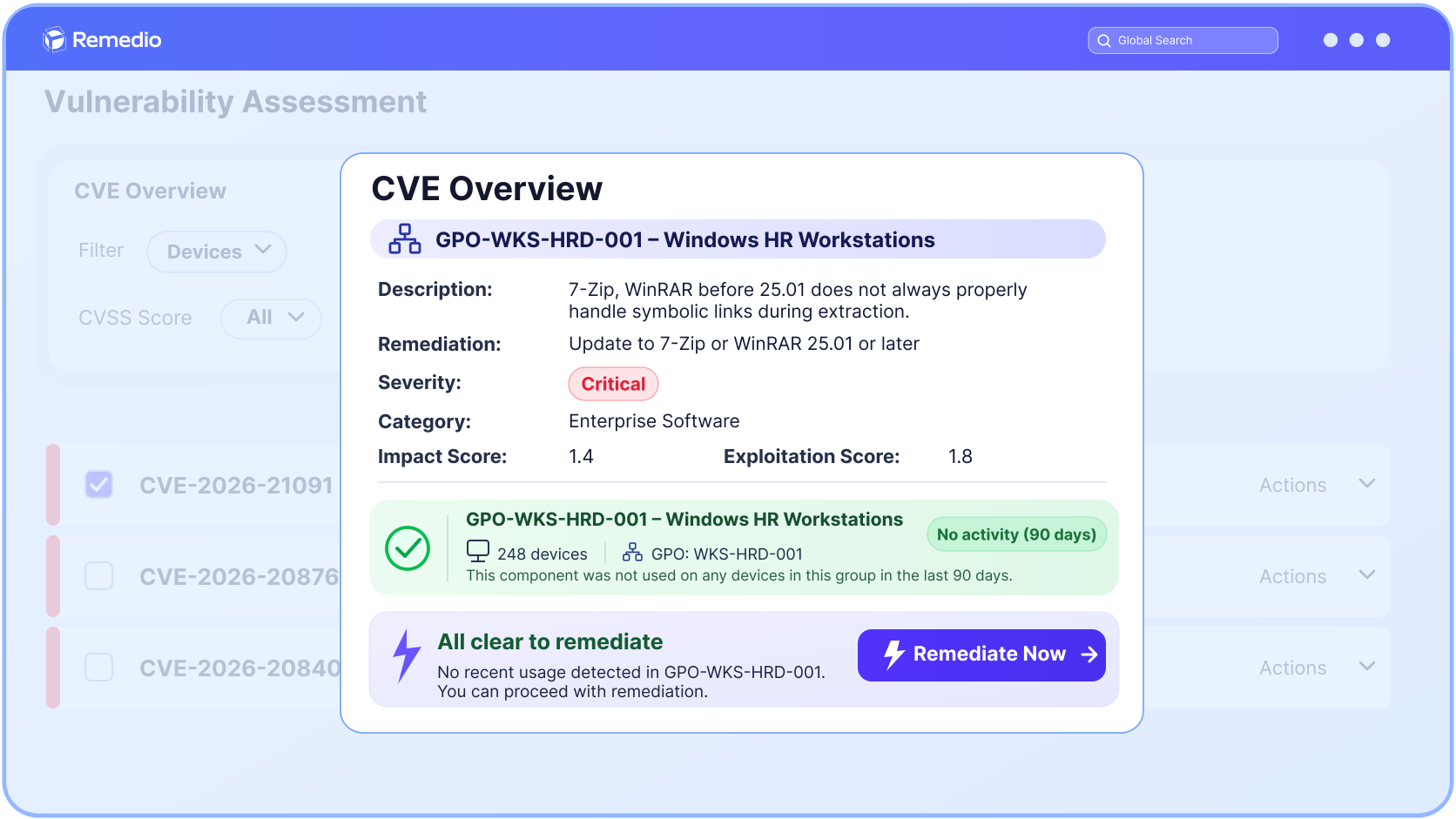
The important distinction is not automation versus manual intervention. It is whether the decision to automate is supported by relevant evidence.
A 90-day usage trace may improve confidence but cannot prove that a rarely scheduled workflow is irrelevant. A mature remediation process must distinguish confirmed dependency, observed non-use, and insufficient evidence.
Microsoft's Security Stack Is the Starting Point, Not the Finish Line
For many enterprises, Microsoft provides the foundation of endpoint security and configuration management.
Defender supplies vulnerability and threat intelligence. Intune, Group Policy, and related services support configuration deployment, policy administration, remediation, and compliance assessment.
These are substantial capabilities, and replacing them is neither necessary nor inherently desirable.
Microsoft's documented vulnerability remediation workflow also illustrates a broader operational reality. Security teams can initiate and track remediation activity, while the appropriate administrative tools and operators implement supported changes. The Intune remediation integration helps coordinate this process within the Microsoft ecosystem.
The question is what happens when the corrective decision requires evidence that spans these systems and the applications running on the endpoint.
A vulnerability recommendation may identify the required software update. An endpoint management system may successfully deploy it. A compliance assessment may subsequently observe the expected configuration.
But the organization may still need to determine whether the change was appropriate for a particular business application, whether another control subsequently reversed it, and whether the corrected state remains effective.
An integrated remediation architecture is not inherently inferior to a native one. What matters is whether the integration preserves corrective authority, evidence, and accountability across the entire exposure lifecycle.
Those responsibilities can be coordinated through existing Microsoft services, specialized tooling, and established operational procedures. The challenge is maintaining continuity across them.
This is where complementary exposure remediation capabilities become relevant. They can connect the intelligence generated by established security platforms with dependency assessment, corrective execution, and endpoint-state verification without displacing the underlying management infrastructure.
Unification should not require replacing capable control planes. It should reduce the operational distance between them and the security outcome they are supposed to produce.
That is a more useful standard than asking whether every capability exists within a single product.
The Difference Between Executing Change and Resolving Exposure
Security programs often treat 3 events as interchangeable:
- A corrective action was initiated.
- The endpoint reached the intended security state.
- That security state remained effective.
In actual fact, those may represent 3 distinct outcomes.
A patch deployment can report success while the vulnerable component remains active through a separate installation. A configuration command can complete while another policy overrides the setting.
A control can be effective immediately after remediation and drift back into an insecure state following an application update or administrative change.
Each belies a different failure mode. The first concerns execution. The second concerns effectiveness. The third concerns durability.
This suggests a different way to think about remediation:
Every corrective action should have an explicit verification contract.
That contract should establish what evidence must exist before and after execution.
Before the change, the system needs to identify the affected population, establish the exposure, determine the appropriate corrective action, and assess material operational dependencies.
During execution, it must respect the required approval boundary, rollout constraints, and recovery conditions.
After execution, it must verify that the intended security state was achieved, identify systems where the correction failed or remained uncertain, and detect subsequent recurrence.
The Remediation Verification Contract
A remediation process should establish what each stage must prove, not simply whether its assigned task was completed. The evidence required changes as the exposure moves from identification to sustained correction.
The distinction is between evidence of activity and evidence of security outcomes. A successful deployment satisfies the execution stage, but the exposure should remain unresolved until fresh endpoint evidence confirms the intended state. Similarly, a passing verification establishes the state at the time of assessment, not permanent protection.
This creates a more defensible measure o
f remediation effectiveness: the proportion of identified exposures that reach verified correction and remain resolved over a defined observation period, with unknown states, exceptions, and recurrence reported separately.
Remedio's remediation model, for example, is designed around this continuity. Dependency-informed intervention planning, controlled execution, rollback, endpoint verification, and continued enforcement are treated as connected parts of the corrective process rather than separate administrative activities.
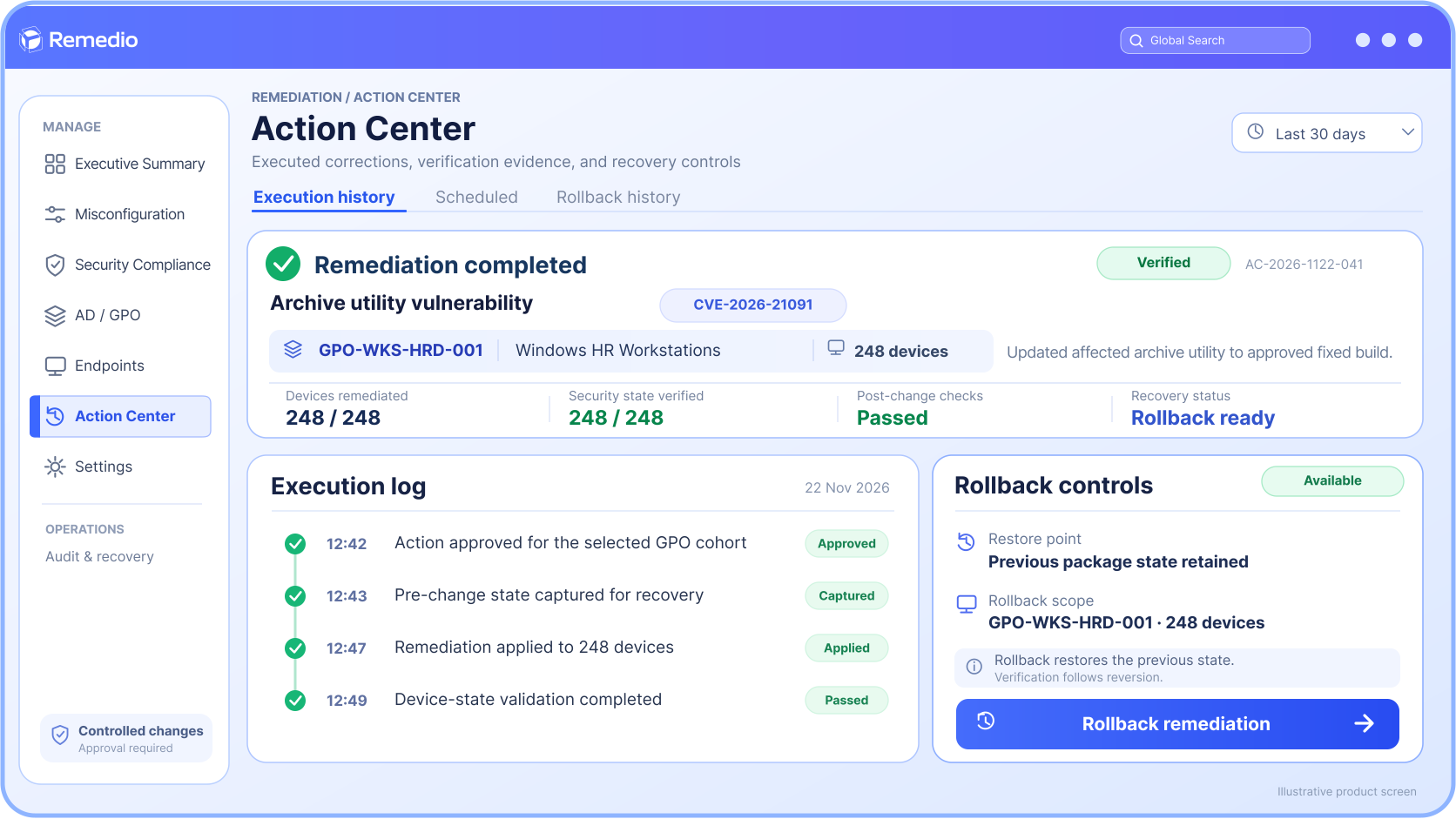
Rollback provides a means of recovering from an undesirable change. Verification establishes whether the intended security outcome actually occurred.
Neither substitutes for the other. The strongest remediation process therefore combines pre-execution evidence with controlled deployment and post-execution validation.
Where evidence is incomplete, the correct response may be additional testing, a narrower rollout, a compensating control, or an explicit risk decision. Autonomous remediation should be capable of recognizing when unconditional execution is not justified.
A Unified Dashboard Can Conceal a Fragmented Operating Model
Connected tools can make work look complete even when no one is clearly responsible for confirming the problem is fixed.
A vulnerability scanner sends a finding to a ticketing system. A change is approved. The endpoint management system reports a successful deployment, and the ticket closes.
Every participating system has completed its assigned task. Yet none of those events necessarily establishes that the security exposure has been removed.
Adding more integrations can improve coordination, but it can also introduce additional state representations, automation rules, retry mechanisms, exception handling, and administrative dependencies.
The result may be a workflow that is highly automated but difficult to reason about.
Remediation ownership should follow the exposure, not the ticket.
A scanner, change-management system, and endpoint deployment platform can each complete their assigned work while the vulnerability remains unresolved. The exposure should retain an accountable owner until the required state is verified, with unresolved exceptions and unknown outcomes explicitly recorded.
This doesn't mean one platform must perform every action natively. It means the remediation process must maintain continuity of evidence and accountability even when multiple tools participate.
An assessment based primarily on discovery coverage, integrations, and patch deployment capabilities can overlook important differences in remediation decision-making, execution safeguards, and verification.
Our comparative analysis of the top unified vulnerability management platforms examines how leading solutions approach these requirements and where their operational models differ.
A workflow that depends on a few manual reconciliations may function adequately for dozens of findings. Across thousands of endpoints, recurring drift, and overlapping configuration authorities, those same handoffs can become a persistent source of unresolved exposure.
Measure the Exposure That Remains
The metrics commonly used to evaluate vulnerability management can reward activity without proving risk reduction. Findings discovered, patches deployed, tickets closed, and mean time to remediation all provide useful operational information.
But they can also obscure whether the required security state actually exists.
A more rigorous program should distinguish completed actions from verified exposure elimination.
- Exposure window should measure the time from confirmed detection to validated correction, not merely ticket closure or deployment completion.
- Verified remediation rate should identify the proportion of targeted systems with current evidence that the required state was achieved.
- Recurrence rate should capture exposures that return after correction, including configuration drift or reverted policy settings.
- Unknown-state population should remain visible separately from confirmed compliance. Missing evidence cannot be counted as successful enforcement.
- Operational impact should capture remediation-induced failures, unplanned rollback, and service disruption alongside security outcomes.
These measures also expose the true cost of fragmented remediation. If a platform generates excellent recommendations but requires extensive manual investigation, repeated approvals, and reconciliation across multiple systems, that operating burden is part of its effectiveness.
The objective is not maximum automation. It is maximum verified exposure reduction within acceptable operational risk.
So, Is Unified Vulnerability Management a False Promise?
Not inherently. But the term becomes misleading when unification stops at visibility, prioritization, or workflow orchestration.
A platform can be technically integrated and operationally fragmented. It can automate thousands of changes while remaining dependent on manual decisions about which changes are safe. It can report successful remediation activity without proving that the intended security state persists.
The next meaningful advance in vulnerability management will come from closing these gaps.
That requires more than connecting scanners to patch deployment. It requires sufficient context to select the right correction, safeguards to execute it responsibly, evidence to verify its effectiveness, and continuous observation to detect when the exposure returns.
The real test of a unified platform is whether it can maintain accountability from the moment an exposure is identified until its correction is verified and sustained.
Risk is reduced when the environment is corrected, the correction is safe enough to operate, and the result is still true after the change window closes.

FAQ
What should enterprises evaluate beyond feature coverage when choosing a unified vulnerability management platform?
Feature coverage establishes what a platform can discover or initiate, but not whether it can reliably eliminate exposure. Enterprises should test how the platform reconciles conflicting evidence, determines corrective-action applicability, evaluates dependencies, and verifies the resulting security state.
A useful proof of concept should follow representative exposures across several control planes. For example, can the platform distinguish a vulnerability scanner's finding from an Intune deployment result, a conflicting Group Policy setting, and the configuration actually observed on the endpoint? Can it identify the appropriate correction without creating a policy conflict or disrupting an application dependency?
The strongest evaluation criterion is whether the platform maintains a defensible chain of evidence from exposure confirmation through sustained remediation, including exceptions, failed changes, and recurrence.
How can security teams reconcile contradictory vulnerability and configuration evidence across different control planes?
Contradictory findings do not necessarily indicate that one tool is malfunctioning. A scanner may correctly identify an insecure endpoint configuration while Intune reports successful policy deployment and Group Policy reports a different intended setting. Each system can be accurate within its own scope without establishing the endpoint's effective security state.
Reconciliation requires correlating asset identity, configuration authority, policy targeting, precedence, endpoint-observed state, and the timestamps associated with each observation. Security teams must determine whether the discrepancy reflects delayed application, conflicting instructions, an unsuccessful deployment, or a subsequent configuration change.
The remediation should target the authority responsible for the discrepancy. Correcting an endpoint locally while leaving a conflicting upstream policy intact may temporarily close the exposure only for the next policy refresh to reopen it.
How can a vulnerability remain exploitable after a patch management system reports successful deployment?
Patch deployment confirms that an installation operation completed, not necessarily that the vulnerable execution path was eliminated. Applications may continue running previously loaded libraries until restarted, retain vulnerable components in separate installation directories, or use statically bundled dependencies unaffected by an operating-system package update.
Verification should establish which component version is actually active, whether the affected process has been restarted when required, and whether the vulnerable functionality remains reachable. Where remediation involves configuration changes, the effective settings must also be checked.
A successful deployment status is supporting evidence, but it cannot independently establish remediation. The relevant outcome is whether the conditions required for exploitation have been removed from the affected system.
How should organizations assess application dependencies before deploying vulnerability remediation at scale?
Dependency assessment should establish whether the proposed change affects applications, services, scheduled processes, authentication flows, or shared components that depend on the vulnerable software or configuration.
Observed component usage can provide valuable evidence, but the observation period matters. Ninety days without recorded activity may support a lower-disruption remediation decision when telemetry coverage is adequate. It cannot establish that a component is unused by quarterly financial processes, disaster recovery workflows, or applications whose relevant execution paths were not observed.
Canary deployments should represent materially different workload and dependency profiles rather than simply a convenient sample of endpoints. Where dependency evidence remains incomplete, teams should determine whether targeted testing, narrower deployment, compensating controls, or service-owner approval is necessary before broader execution.
Can unified vulnerability management work without replacing existing security and IT management tools?
Yes. Effective unification depends more on coordinated decision-making and consistent evidence than on consolidating every capability into one product.
For example, a vulnerability scanner may identify an affected component, an endpoint management system may deploy the update, and a separate configuration authority may govern the settings required to eliminate the exposure. These systems can remain in place, provided the remediation workflow can correlate their evidence, resolve conflicting instructions, and establish whether the intended security state was achieved.
The architectural challenge is maintaining continuity across discovery, decision-making, execution, and verification. Integrations that merely transfer findings or synchronize ticket statuses do not necessarily provide that continuity. The organization must also retain an accountable owner for unresolved exposure, particularly when multiple platforms report their individual tasks as complete.
Why can configuration drift repeatedly reopen vulnerabilities that were previously remediated?
A successful configuration correction can be reversed when another management authority reapplies an insecure setting. Group Policy refreshes, Intune policies, local administrative changes, application updates, and configuration-management scripts can all modify the effective endpoint state after remediation.
This creates a recurring failure mode: the security platform corrects the endpoint, an upstream process restores the vulnerable configuration, and the same finding reappears. Increasing the frequency of endpoint correction may shorten the resulting exposure window without eliminating its cause.
Persistent remediation requires identifying which authority governs the setting, resolving conflicting instructions, and validating the effective configuration after subsequent policy application. Recurrence should therefore be investigated as a potential control-plane problem rather than automatically treated as another isolated endpoint misconfiguration.
How can CISOs measure whether unified vulnerability management is actually reducing exposure?
Patch counts, remediation tickets, and mean time to close measure workflow activity, but they do not establish how much exploitable exposure remains.
A stronger measurement model tracks the time between confirmed detection and verified correction, the proportion of identified exposures that reach a validated secure state, and the frequency with which those exposures recur. It should separately account for exceptions, failed remediation attempts, and assets whose effective security state cannot be established.
The measurement denominator is particularly important. A rising remediation success rate can be misleading if newly discovered assets, unmanaged systems, or endpoints with insufficient telemetry are excluded. Changes in discovery coverage and verification quality must be distinguished from genuine risk reduction.
Operational costs also matter. Remediation that repeatedly requires manual reconciliation, emergency rollback, or service restoration may deliver less sustainable exposure reduction than its deployment statistics suggest.
What technical evidence is sufficient to authorize autonomous vulnerability remediation?
Autonomous remediation should be authorized according to the confidence and operational consequences of the specific corrective action, rather than the availability of an automation workflow.
The decision requires evidence of exposure and technical applicability, an assessment of relevant dependencies, a defined deployment scope, appropriate validation checks, and a recovery mechanism suited to the proposed change. A reversible configuration adjustment affecting a well-understood endpoint cohort may justify a different approval boundary from a database update, authentication change, or shared infrastructure modification.
Rollback capability alone is insufficient. Some changes can produce irreversible data effects or downstream service disruption even after the original configuration is restored.
Where dependency evidence is incomplete, the workflow should support additional testing, constrained deployment, explicit approval, or temporary mitigation rather than treating uncertainty as permission to proceed. Post-execution verification must establish that the exposure was eliminated and that required service behavior remains intact.
About Author