
Gartner’s Top Strategic Technology Trends for 2027


Blog
GPO Monitoring and Policy-Driven Security at Scale

Active Directory & Identity Security
Configuration Drift
Endpoint Hardening
Group Policy & Intune
Security Misconfigurations

A GPO can appear correctly configured while the intended restriction is missing from an endpoint. Before changing anything, your team needs to establish whether the problem lies in the policy, its targeting, its application, or the resulting device configuration.
Traditional GPO monitoring tools only tell you if a setting changed; Remedio connects Active Directory assessment, automated GPO validation, and safe remediation to help you fix the root cause. It compares directory-side policy-planning data with endpoint-reported results, identifies discrepancies, and guides correction. Continuous validation and enforcement then help keep approved settings in place.
The operational promise is straightforward: establish what protection belongs on a system, diagnose why the evidence differs from that requirement, correct the appropriate layer, and verify the result.
When the same apparent failure can require very different actions, being able to draw a straight line to the root cause makes a very big difference. After all, reapplying a setting will not repair a targeting error. Similarly, expanding policy coverage will not improve an insecure requirement. A local correction is not likely to survive the management instruction that caused the problem.
Why Basic GPO Monitoring Alone Doesn't Prove Protection
Configuration and processing information are necessary evidence. But that only really gives you a starting point. Your team still has to connect that evidence to the security requirement and the endpoint’s current state.
A device can receive its assigned policy and remain inadequately protected because the policy is insufficient for its role. Another can have an appropriate policy assigned but fail to receive the required settings. Treating both as generic noncompliance obscures the correction each needs.
For policy-driven security, the useful question is therefore specific: Does this system have the protection it requires, and can we explain the result?
Why AD Assessment, GPO Monitoring, and Validation Belong Together
AD assessment and GPO validation examine different parts of that question.
An Active Directory security assessment examines directory configuration and administration for weaknesses. In the policy-management workflow, it helps establish whether the governing environment and policy design need attention.
Remedio supports continuous AD inspection, identification of obsolete or unused accounts, and detection of duplicated, conflicting, or unlinked GPO settings. It also supports benchmarking and alignment with security standards and internal policies.
While continuous Group Policy monitoring tracks directory-level changes and policy modifications in real time, GPO validation goes a step further to prove those intended settings actually reach the relevant users and computers and are reflected in endpoint evidence.
Connecting the two helps distinguish an inappropriate instruction from a failure to implement an appropriate one. That distinction should be settled before a correction is expanded across a fleet.
This keeps remediation attached to its cause. It prevents a successful local change from being mistaken for resolution of a broader policy problem.
How Remedio Resolves GPO Discrepancies
Remedio’s GPO workflow follows a practical lifecycle: Assess, Validate, Remediate, Verify.
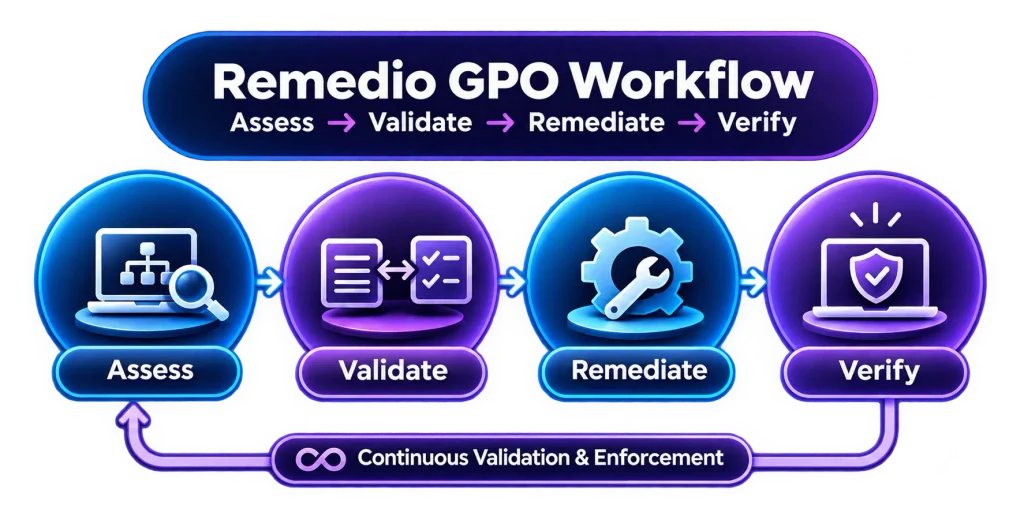
Each stage contributes something needed by the next. Assessment establishes the requirement and governing conditions. Validation identifies discrepancies. Remediation addresses the responsible layer. Verification establishes the result and supports continued enforcement.
Assess: establish the requirement and governing conditions
Start by deciding which protection the affected systems require.
Use Remedio’s AD and policy findings to examine directory hygiene, policy design, and targeting. Review conflicting settings and ineffective policies in the context of the systems they govern. An unlinked GPO may be obsolete; a duplicated setting may warrant consolidation rather than emergency correction.
Combined AD and GPO management integrate controls across environments where Group Policy, MDM, and local configurations coexist. That gives the assessment relevance beyond a policy considered in isolation.
The output should be an approved target state and a defined population. Without those, a tool can establish that something differs without establishing which state is correct.
Validate: compare expected application with endpoint evidence
Remedio compares policy-planning information from the directory with policy-application information from endpoints.
Its Automated Group Policy Validation brief describes two complementary inputs:
- Planning Resultant Set of Policy, or Planning RSoP: a model of expected policy application under specified conditions.
- Logging RSoP: policy-application information collected from the target system.
A domain-side RSoP agent obtains planning data through the Group Policy Management Console interface. Endpoint sensors collect logging data. Both datasets are sent to Remedio’s backend for comparison, supporting SaaS or on-premises deployment.
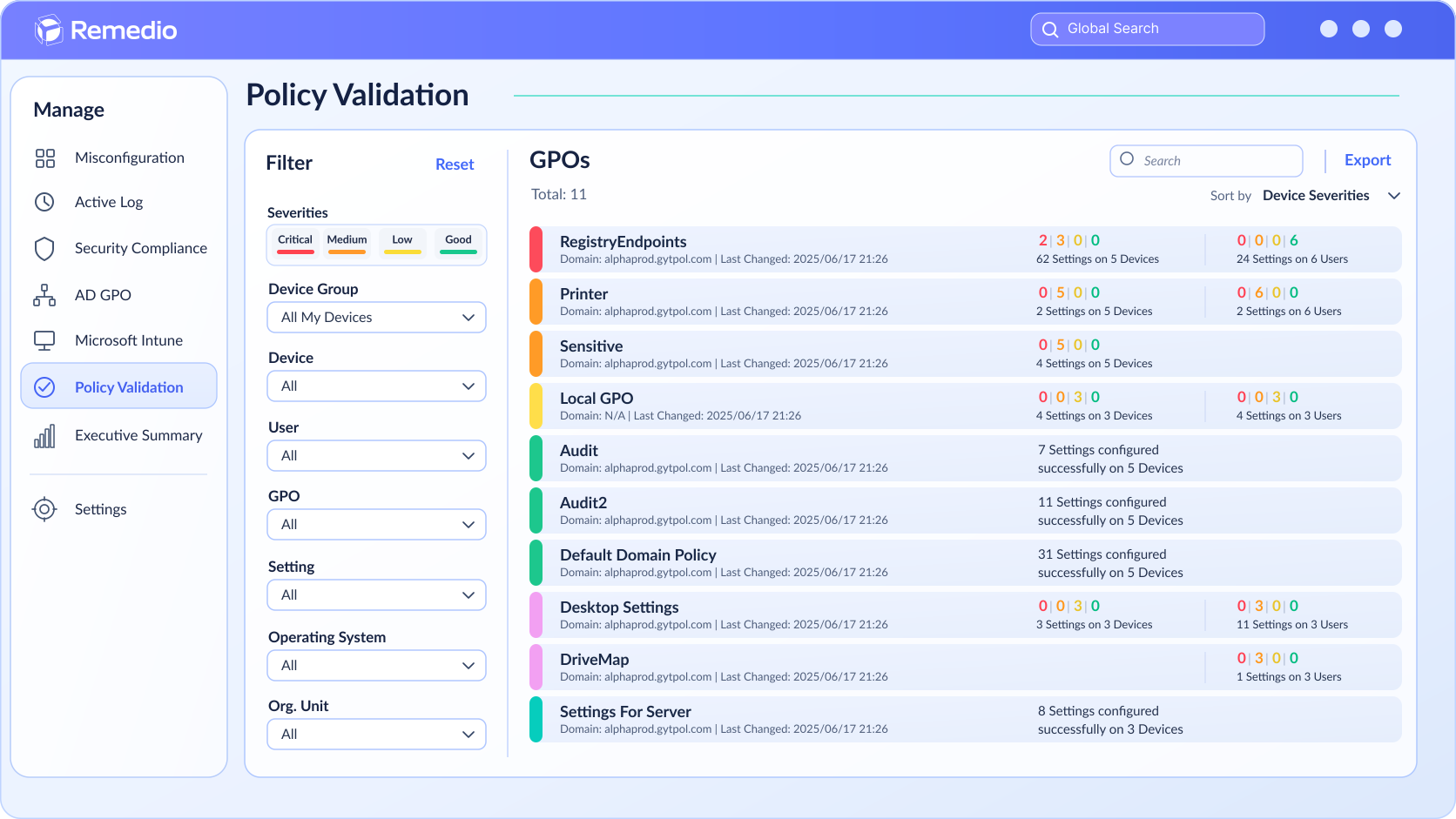
Remedio's rules engine covers more than 30 logical patterns, including missing settings, drift, targeting and precedence issues, and template-related discrepancies. Findings are presented with severity information and guided remediation.
For operators, the value is at this stage is diagnostic. The comparison helps narrow the investigation from “this endpoint failed a check” to the conditions behind a difference in expected and reported application.
Policy-processing evidence should then be considered alongside relevant device-configuration checks. A reported policy result is not a comprehensive test of every downstream business function.
Remediate: correct the layer responsible for the failure
The diagnosis determines the action.
A targeting problem needs a targeting correction. An unsuitable requirement needs policy-owner revision. An endpoint misconfiguration may be suitable for an approved automated fix. A dependency that prevents immediate enforcement requires a bounded treatment plan.
Remedio combines policy validation with automated configuration correction, dependency-aware execution, and rollback. Those capabilities let teams act on findings while retaining control over scope and operational impact.
The distinction between guided remediation and automated execution remains important. Identifying a source-policy issue does not mean every associated policy edit happens automatically. Keep ownership explicit for changes that affect broader device populations.
Verify: confirm the setting and keep checking it
Verification should establish whether the required endpoint state was reached, rather than stop at a completed action.
Check the setting on the affected systems. Test relevant business functions. Then continue validating the approved configuration so later drift or renewed conflicts become visible.
Remedio's GPO security capabilities combine continuous GPO monitoring and validation with the automated restoration of secure settings and correction of configuration drift. This connects the initial correction to ongoing enforcement.
A recurring failure deserves renewed diagnosis. Repeating the same fix may restore the setting temporarily while leaving its cause untouched.
After Finding Policy Breakages, You Still Need to Fix Them
Remedio connects AD and GPO findings with endpoint evidence so teams can investigate why a control failed before deciding what to change. Its validation workflow helps identify conflicting or ineffective policies, while the broader platform provides context for prioritizing and executing the correction.
Consider a restriction intended for users on shared workstations. It applies in one user context but not another. Repeatedly changing the local setting would leave the difference unexplained. Remedio’s GPO validation investigates conditions including loopback configuration and item-level targeting, helping the operator identify where policy application diverges and validate the correction.
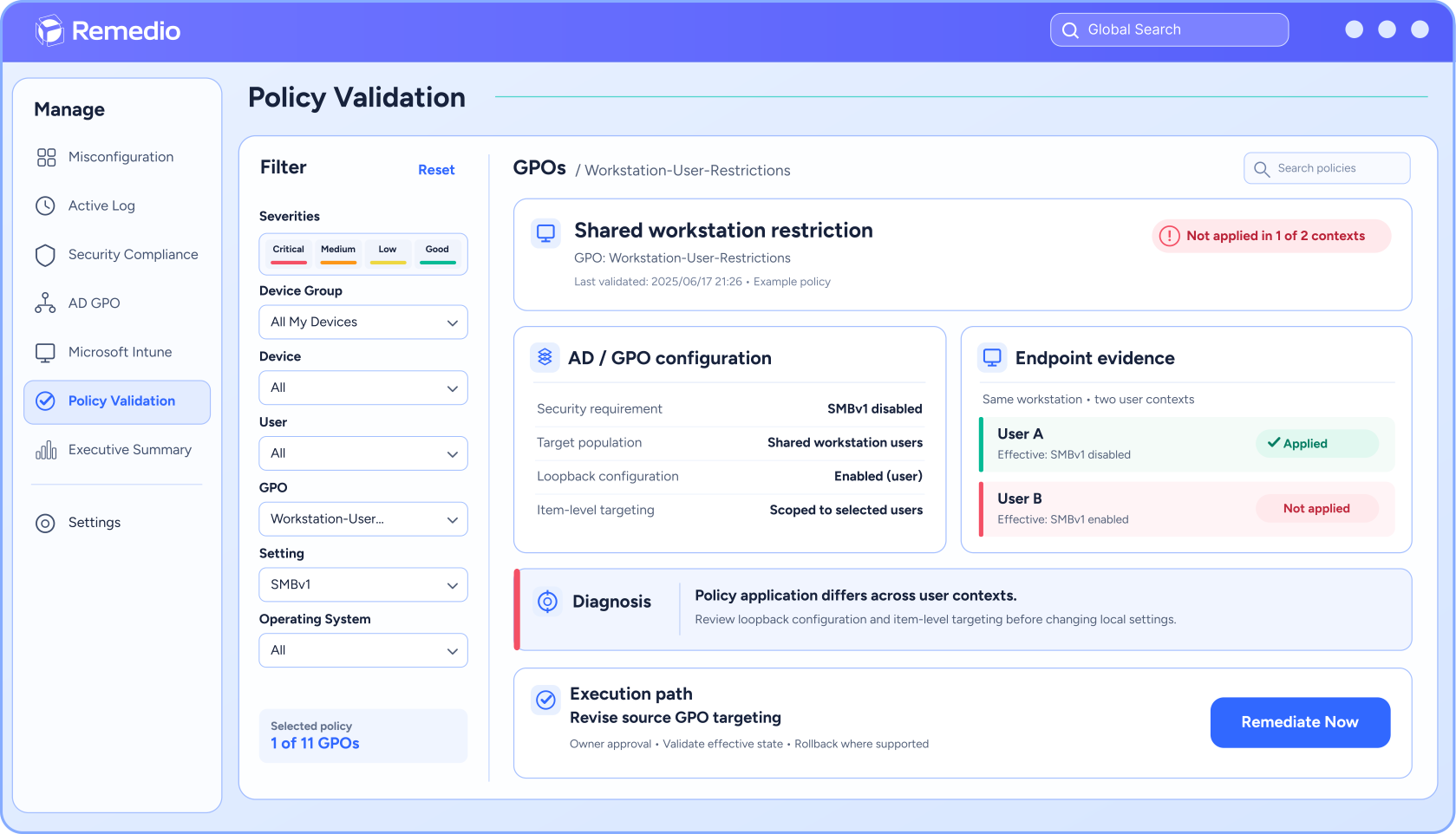
That diagnosis determines the execution path. A source-policy problem may require an administrator-led revision. An endpoint misconfiguration may support approved automated remediation. An obsolete instruction may need retirement, while a legitimate operational dependency may require a scoped exception.
Governance makes the correction repeatable and gives operators clear limits within which to act. For a policy-related change, establish:
- The approved security requirement and affected population.
- The policy owner and execution owner.
- Dependencies and business functions that require testing.
- The authorized execution path and, where supported, rollout schedule.
- Verification and rollback conditions.
The appropriate response depends on the cause, not simply on whether the endpoint differs from an expected configuration.
If an operational dependency prevents immediate enforcement, assign a specific exception with an owner, compensating measures, and an expiry. Avoid allowing one unresolved dependency to become a permanent exemption for an entire device class.
Remedio’s broader remediation approach supports dependency-aware changes, validation, verification, and recovery. Use the controls available for the specific action to address the diagnosed condition, then confirm both the required configuration and the affected business functions.
Remedio gives us the ability to fix problems in our environments without impacting our operations; it’s a real game-changer.

Correcting a setting without resolving the instruction that caused it can leave the same failure waiting for the next policy cycle.
How to Measure and Maintain the Effectiveness of Corrections
Remedio’s ongoing validation and correction across AD, GPO, Intune, and local configurations help teams identify when approved settings stop holding. Policy revisions, migrations, and organizational changes warrant renewed validation because earlier evidence may no longer represent the systems or conditions in scope.
Measure that continuity against the full population requiring each control. Separate verified settings, confirmed failures, approved exceptions, and devices without sufficiently current evidence. Otherwise, a shrinking observed population can make protection appear to improve while leaving more systems unaccounted for.
Alongside remediation workload, use these program measures to assess whether protection is established and maintained:
These are recommended program measures, not assumed built-in Remedio dashboards. Use them to direct the next action: repeat failures call for investigation of the governing configuration, unknown devices need coverage work, and overdue exceptions require decisions from their owners.
A correction is durable when the required setting remains in place, affected business functions continue to work, and current evidence supports that conclusion. Tracking those outcomes gives security and IT a shared basis for deciding where enforcement is dependable and where further work is needed.
From GPO monitoring to continuous policy assurance, Remedio helps security and IT teams connect policy intent to endpoint evidence and continuous enforcement.
That is the practical value of bringing AD assessment, GPO validation, and safe remediation together. Teams can investigate where the policy-management relationship failed and act at the responsible layer, with the controls needed to protect operations.


FAQ
What does Remedio add to GPO monitoring?
Remedio connects directory-side planning data with endpoint-reported policy results to identify discrepancies and guide investigation. Its broader configuration capabilities support validating device state, correcting misconfigurations, and continuously enforcing approved settings.
How does Remedio compare intended and applied policies?
Remedio collects Planning RSoP through a domain-side agent and Logging RSoP through endpoint sensors. Its rules engine compares the datasets to identify discrepancies, including missing settings and targeting or precedence issues, and provides findings with guided remediation.
Why combine AD assessment with GPO validation?
AD assessment examines governing directory and policy conditions. GPO validation examines application and endpoint evidence. Connecting them helps determine whether the required correction belongs in the policy, its targeting, its application, or the endpoint configuration.
Can Remedio work alongside Intune and existing Group Policy?
Yes. Remedio’s published AD and GPO positioning includes validation and enforcement across GPO, MDM, and local configurations, with Intune configuration validation and guidance. It complements the systems used to administer policies rather than requiring every policy-management function to move into Remedio.
Does every discrepancy trigger automatic remediation?
No. The response depends on the finding, approved scope, and supported execution path. Some findings require guided administrator action or policy-owner revision. Others may support approved automated correction. Remedio Fortify’s published guidance states that the human controls its execution trigger today.
How should teams verify a correction?
Confirm the required configuration on the affected systems, test relevant business functions, and continue validating the approved state. Remedio’s verification and enforcement capabilities support checking the endpoint outcome; application owners contribute the functional testing needed for their services.
About Author