
Gartner’s Top Strategic Technology Trends for 2027


Blog
Manual Security Is Dead, Only Automated Security Workflows Scale

Risk Management
Security Misconfigurations
Vulnerabilities
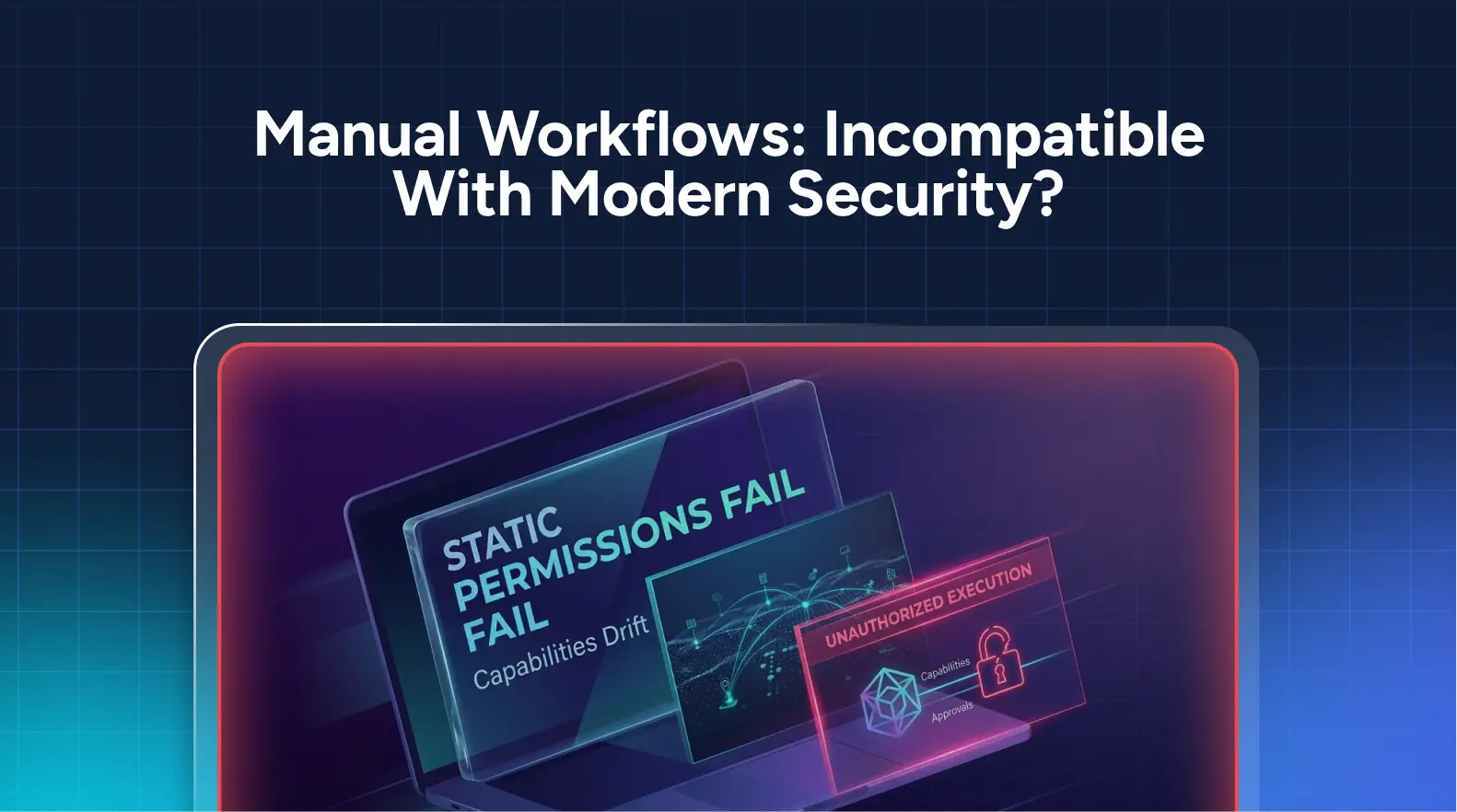
A security control that waits for someone to find time is an exposure window with an owner. While human judgment remains essential, routinely rediscovering and reapplying known corrections makes your defense contingent on attention the business cannot supply. Building a truly resilient automated security workflow requires moving past basic task execution and toward governed, condition-based enforcement.
AI increases the pressure from both directions: attackers gain assistance, while enterprise agents create new paths from data to action. Remedio approaches security automation through governed correction and sustained posture integrity.
The scaling problem in security remediation is not simply the number of findings. It is the number of distinct operating conditions under which those findings must be corrected.
Effective automation must reduce the number of decisions requiring human intervention without assuming that every affected asset can safely receive the same change.
Why AI Makes Best-Effort Security Structurally Inadequate
AI puts pressure on security capacity without requiring fully autonomous attackers. IBM and Ponemon's 2025 Cost of a Data Breach Report found that 16% of studied breaches reportedly involved attackers using AI. The research covered 600 breached organizations, not a representative sample of every enterprise.
The UK's NCSC assessed that AI would almost certainly make elements of intrusion operations more effective and efficient and further reduce disclosure-to-exploitation time. That is a forecast, not a measured universal attack timeline.
The operational implication is uncomfortable: a process that needs proportionally more people whenever corrective demand grows has no credible scaling advantage. Faster discovery can increase the queue faster than it reduces exposure.
AI adoption also changes what security teams must control. Enterprise agents introduce new execution paths through connected applications, delegated permissions, and access to sensitive data. Many of these exposures cannot be resolved through patching because they arise from authorized functionality operating beyond its intended boundaries.
The challenge is no longer limited to whether software contains exploitable vulnerabilities. It increasingly includes whether an agent's effective capabilities remain consistent with its approved purpose.
AI Agents Turn Permissions Into an Expanding Attack Surface
Traditional application security assumes a relatively predictable relationship between software functionality and the privileges required to execute it. AI agents complicate that relationship. Their behavior is influenced by changing instructions, retrieved content, connected tools, persistent context, and the permissions available at execution time.

The security implications extend well beyond vulnerabilities in the underlying software. An agent can operate exactly as designed while performing an action that its owner never intended to authorize.
This creates a distinction security teams must account for:
An agent's intended function is not the same as its effective authority.
Untrusted Content Can Influence Privileged Execution
Prompt injection offers a good case in point for why this matters. An attacker does not necessarily need to compromise an application or steal credentials to influence an agent's behavior. Instructions embedded in retrieved documents, repository files, webpages, or tool responses can attempt to redirect the agent toward actions outside the legitimate user's intent.
The consequences of prompt injection depend on the authority available to the agent. An instruction embedded in a retrieved document may be inconsequential when the agent has read-only access, but dangerous when it can modify records, invoke administrative APIs, or access sensitive data.
This is why prompt filtering and model-level safeguards cannot serve as the sole enforcement mechanism. The execution layer must independently determine whether a requested operation is permitted, using the requesting identity, effective permissions, target resource, and applicable policy.
Persistent agent memory introduces another complication. Research into SpAIware has demonstrated how malicious instructions embedded in persistent memory can influence subsequent agent behavior, including attempts to redirect sensitive information.
The significance is not simply that a prompt-injection payload can survive beyond one interaction. It's that attacker-controlled content may remain available to influence future operations under different execution conditions.
A previously ineffective instruction can become consequential if the agent subsequently receives broader permissions or access to more sensitive resources.
Authorization Must Remain Valid as Capabilities Change
An agent may be approved for a specific business function under a defined set of permissions, integrations, and execution constraints. That approval becomes insufficient when those conditions materially change.
New OAuth scopes, expanded service-account privileges, additional tool integrations, altered resource access, or changes to the agent's execution environment can all expand its effective authority.
Importantly, the agent does not need to behave maliciously for this to create exposure. A legitimate workflow may begin using newly available capabilities that were never considered during the original security assessment.
Authorization drift describes the resulting mismatch between the capabilities currently available to an agent and the conditions under which its behavior was approved. It is an analytical description of an operational problem, not a separate vulnerability category.
This is different from configuration drift insofar as configuration drift concerns changes to a system's intended state. Authorization drift concerns whether previously approved operations remain acceptable after the authority available to execute them changes.
Both require continuous reassessment, but authorization drift also demands enforcement at the point where an operation is attempted.
The Security Boundary Must Outlive the Original Approval
Deployment approval establishes that an agent's capabilities are acceptable under a particular set of conditions. It does not establish that those conditions will remain valid.
Security controls must therefore evaluate changes to effective authority and enforce restrictions at the boundaries where operations occur.
Endpoint controls can constrain local execution and access. Identity systems govern credentials and delegated permissions. API gateways and application-level authorization control operations against protected resources.
These mechanisms are complementary, but none automatically governs every execution path.
The objective is not to prevent an AI model from proposing an unsafe action. It is to ensure that an unsafe proposal cannot become an authorized operation simply because the agent possesses a credential or encounters a persuasive instruction.
Of course, simply introducing manual reviews whenever something changes is not a suitable solution to this problem.
A Worked Example: When an AI Agent's Permissions Change
Consider an enterprise AI assistant that retrieves internal documentation and summarizes operational tickets. It authenticates to the company's ticketing platform through OAuth, using a service identity with read-only permissions. Its deployment has been reviewed and approved for this limited purpose.
Several months later, an administrator enables a new integration that allows the assistant to update ticket records. The integration introduces write-scoped permissions, but the agent's original security assessment, operating instructions, and approved business purpose remain unchanged.
The agent can now modify records that it was previously permitted only to read.
Where Conventional Controls Fall Short
An identity governance system may record the new OAuth grant. A SaaS security platform may identify the expanded permissions. A workflow engine may generate a review ticket.
These are good detection mechanisms, but they do not necessarily prevent the agent from exercising its new authority while the review is pending.
Suppose the assistant subsequently retrieves a ticket containing attacker-controlled text instructing it to modify related records. If the agent interprets those instructions as part of its task, you've got a problem.
The prompt injection influences the agent's behavior, but the expanded authorization determines what consequences that behavior can produce.
Blocking suspicious instructions at the model layer may reduce the likelihood of an unauthorized operation, but it cannot reliably substitute for enforcement at the API or identity boundary.
How Condition-Based Enforcement Changes the Outcome
A more resilient architecture treats the agent's approved capabilities as an enforceable operating boundary rather than a one-time deployment decision.
The approved execution profile specifies the agent's identity, permitted API operations, accessible resources, and conditions under which those permissions remain valid.
When the integration introduces write access, a capability assessment compares the agent's effective permissions against that profile. The new OAuth scope represents a material change requiring reassessment.
The enforcement mechanism must then operate at a boundary it actually controls. Depending on the integration architecture, that could mean restricting or revoking the expanded credential, applying API-level authorization, or preventing the agent from invoking unapproved operations through a controlled tool gateway.
Simply detecting the permission change on an endpoint would not prevent a remote SaaS API from accepting an otherwise valid write request.
If the agent subsequently attempts to modify a ticket, the authorization layer evaluates the requested operation independently of the model's instructions. The operation is denied because write access has not been approved, even though the underlying credential may technically permit it.
Read-only operations can continue where the enforcement architecture supports sufficiently granular restrictions.
The engineering requirement therefor is to connect changes in effective authority to enforceable decisions and verified outcomes. Detecting a permission change is not equivalent to preventing its use, and applying a restriction is not equivalent to proving that the restriction holds.
Verification Must Establish That the Boundary Holds
Enforcement is not complete when a policy update succeeds. The system must establish that the agent can no longer exercise the unauthorized capability.
That requires verifying the effective permissions and testing the relevant execution path. An attempted write operation should be denied, while approved read operations should continue functioning.
The assessment must also account for alternative credentials, cached tokens, or direct API paths that could bypass the intended enforcement point. Revoking one token or blocking one tool invocation does not establish that every route to the protected resource has been closed.
The resulting evidence should identify the capability change, the authorization decision, the enforcement mechanism, and the observed outcome.
If enforcement cannot be verified, the system should not treat the exposure as resolved.
The broader lesson extends beyond AI agents.
Security automation must continuously establish whether the conditions that made an operation acceptable still hold, and whether the controls intended to enforce those conditions remain effective.
Security Automation Can Preserve the Manual Bottleneck
Many security automation initiatives improve the speed of investigation and coordination without materially increasing remediation capacity. A traditional automated security workflow might enrich tickets or orchestrate approvals, but it still leaves engineers to analyze whether a proposed fix is safe to deploy.
A patch management system can distribute an update to thousands of endpoints. A configuration management tool can enforce a prescribed setting. A SOAR workflow can initiate either operation.
But these capabilities generally depend on predefined policies, execution conditions, or operator decisions. They do not necessarily establish whether the proposed correction is compatible with every affected system.
Consider a weak configuration affecting 10,000 endpoints. The affected population may span different operating system builds, application dependencies, business-critical workloads, and management authorities. Some devices can tolerate immediate correction. Others require different corrective actions, additional validation, or maintenance windows.
Executing one command against all 10,000 devices is straightforward automation. Determining where that command can be safely applied is the more difficult engineering problem.
The Real Scaling Challenge Is Decision Complexity
Traditional automation scales the execution of predefined tasks. More advanced remediation must also scale the evaluation of the conditions under which those tasks are permitted.
The system must determine what depends on the affected component, whether another management system controls the relevant setting, what operational consequences the change could introduce, and whether a viable recovery mechanism exists.
These conditions define the remediation safety envelope.
The envelope is not necessarily uniform across an affected population. Two endpoints with the same finding may require different remediation strategies because their operational conditions differ.
This is where dependency intelligence becomes operationally significant. Its value is not simply identifying relationships between components, but distinguishing subpopulations by their suitability for specific interventions.
Human judgment remains essential for uncertain dependencies, consequential changes, and conflicting policies. But human intervention should be driven by genuine uncertainty, not by the number of endpoints requiring correction.
Without that capability, automation may accelerate deployment while leaving engineers responsible for the analysis that determines whether deployment is safe.
What a Modern Automated Security Workflow Should Look Like
Effective security workflows must be able to continuously evaluate changing conditions, execute corrections within defined operational boundaries, and verify that protections remain in place.
Human involvement is reserved for decisions that cannot be safely resolved through established policies and available evidence.
The system and structure of operations must make security decisions reusable across changing environments. And they must do so without allowing execution authority or operational risk to expand unchecked.
Evaluate Changes Against Trusted Context
Changes should trigger programmatic reassessment before newly available capabilities are exercised. An automated security workflow must independently evaluate effective permissions and system dependencies rather than relying strictly on deployment approvals or application identity.
Evaluation must consider effective permissions and observed system state rather than relying on application identity or deployment approval. The execution layer must independently establish what an agent or system is authorized to do, which resources it can affect, and whether the conditions required for a proposed action remain valid.
For endpoint remediation, this also requires understanding application dependencies, asset criticality, policy ownership, and recovery constraints. AI can help assemble context and propose alternatives, but untrusted content cannot grant execution authority.
Where evidence is incomplete, stale, or contradictory, consequential actions must be restricted or referred for review.
Event-driven reassessment should be complemented by periodic reconciliation. Missing telemetry or an undetected change must not be interpreted as evidence that previously approved conditions still hold.
Execute, Verify, and Sustain Remediation
Even an appropriately selected corrective action can produce unexpected consequences at scale. Execution should therefore proceed through controlled rollout stages, with limits on scope, concurrency, and operational impact. Progression depends on verifying that each stage achieves the intended security outcome without disrupting critical functions.
A completed deployment is not proof of successful remediation. Automation must validate the resulting system state and operational health, halt propagation when acceptance criteria are violated, and initiate recovery or escalation where necessary. Rollback itself may be incomplete, particularly when changes produce downstream effects that cannot simply be reversed.
Verification must also extend beyond the initial correction. Software updates, administrative changes, and competing management policies can reintroduce previously resolved exposures. Continuous enforcement should detect and correct this drift while respecting control-plane ownership. When another authoritative system restores an unsafe setting, the appropriate response is to resolve the policy conflict, not repeatedly overwrite its decisions.
The objective is sustained remediation that corrects exposure, contains unintended consequences, and maintains the intended security state as operating conditions change without causing disruption.
Escalate Exceptions, Not Routine Corrections
Human judgment should concentrate on situations where automation cannot establish a sufficiently reliable execution decision.
These include uncertain dependencies, conflicting management policies, consequential changes without adequate recovery options, and incomplete or contradictory evidence.
Escalations should arrive with the context required for a decision: the affected population, observed condition, proposed intervention, dependency evidence, expected operational impact, recovery limitations, and decision deadline.
Once engineers establish an approved correction and its execution constraints, those decisions should be reusable wherever the same conditions hold.
The measure of progress is not simply a smaller queue. It is how much protection remains effective without requiring another routine human intervention.
Measure Whether Protection Still Depends on Human Availability
The operational test is how much approved protection persists without another routine human intervention. Run a tabletop exercise: if routine intervention paused, which controls would hold, which exposures would return, and which known corrections would remain pending?
The effectiveness of security automation should be measured by the exposure it removes, the durability of those corrections, and the operational effort required to achieve them. Ticket closures and completed automation jobs reveal little about these outcomes. A more meaningful measurement framework focuses on five metrics:
These measures expose whether automation is genuinely reducing risk or merely increasing the speed at which changes are attempted.
For cybersecurity ROI, the business question is capacity recovered while protection persists. A process that reduces execution labor but increases outages or manual verification has moved the cost rather than removed it.
Retire Manual Execution as the Default
Manual security has reached its limit as the default mechanism for maintaining routine protection. Your strongest engineers should define boundaries, investigate uncertainty, and redesign weak systems. Repeatedly restoring familiar conditions consumes that judgment without making it reusable.
Start with one recurring exposure whose safe correction can be bounded and verified. Define the prerequisites, exclusion conditions, owner, stop criteria, and recovery path. Maintain the corrected state, and measure both reduced intervention and sustained protection.
Manual security buys another correction. Governed automation establishes a constraint that continues to hold. In an AI-powered environment, that is the difference between doing more security work and building security capacity that can scale.


FAQ
Which security remediation tasks should organizations automate first?
Start with recurring exposures that have predictable corrections, identifiable dependencies, and measurable outcomes. Examples include restoring disabled endpoint protections, correcting well-understood configuration drift, and applying approved changes to compatible device populations.
Prioritize candidates by the repeatability of the decision, not simply the frequency of the finding. A high-volume issue that requires substantial contextual investigation may be less suitable for automation than a lower-volume issue with clearly established execution conditions. The objective is to automate decisions that can be made reliably, not merely actions that can be scripted.
What happens when automated remediation conflicts with Group Policy, Intune, or another management system?
Conflicting management authorities can create remediation loops. One system corrects an insecure setting while another restores the previous configuration during its next policy refresh.
Repeatedly applying the same correction does not resolve the underlying conflict. Security teams must identify which system owns the setting, reconcile the competing policies, and establish an authoritative desired state.
Where ownership cannot be established automatically, the conflict should be escalated rather than allowing competing tools to overwrite one another indefinitely.
How should organizations test automated remediation before deploying it at enterprise scale?
Testing should establish both security effectiveness and operational compatibility. A successful correction must remove the intended exposure without disrupting dependent services or introducing unacceptable regressions.
Begin with representative systems that reflect the diversity of the production environment. Validate the correction, test recovery procedures, and expand deployment through controlled cohorts with explicit progression criteria.
Importantly, testing must include negative cases: systems where the correction should be withheld because dependencies, permissions, or operating conditions fall outside the approved boundaries. These tests establish whether automation can recognize when not to act.
How can CISOs demonstrate that security automation is actually reducing operational risk?
Measure verified exposure reduction alongside the human effort and operational consequences required to achieve it.
Useful indicators include the percentage of eligible exposures successfully corrected, time to verified remediation, recurrence rates, manual intervention requirements, and remediation-induced failures.
These measures should be evaluated together. A reduction in manual workload is not a security improvement if exposures persist, corrections repeatedly fail, or operational disruptions increase. The strongest evidence of effective automation is sustained risk reduction with progressively less human intervention.
What Is Authorization Drift?
Authorization drift is this article's analytical term for a mismatch between an agent's original approval and its current effective capabilities. New credentials, broader permissions, or changed tools can invalidate approval assumptions. The term describes an operating problem, not a formal vulnerability category.
Does Configuration Hardening Prevent Every Prompt-Injection Attack?
No. Hardening can constrain execution, access, and data paths, but prompt-injection defense also requires application-level safeguards and independent authorization. Remedio's AI-related configuration controls complement those layers; they should not be treated as a guarantee that every malicious instruction will be rejected.
About Author